Writing
All posts
408 posts on AI agents, the laws and asymmetries that shape how we build, and lunch-break physics. Search, filter by tag, or start with a series.
All topics (40 most used of 238)
Advertising (37 posts)AgentCore (14 posts)AgenticAI (51 posts)AgenticWeb (6 posts)AgentMemory (6 posts)AI (217 posts)AIAgents (83 posts)AmazonBedrock (40 posts)Architecture (51 posts)AWS (151 posts)Career (15 posts)Cloud (15 posts)CodingAgents (6 posts)Communication (10 posts)Community (30 posts)Content (8 posts)Curiosity (6 posts)DeveloperExperience (6 posts)DeveloperTools (15 posts)Events (98 posts)GenAI (9 posts)HandsOn (6 posts)Innovation (41 posts)Kiro (12 posts)LawsAndDisorder (6 posts)Leadership (43 posts)LLMs (7 posts)LunchBreakPhysics (6 posts)MCP (19 posts)Media (26 posts)OpenSource (9 posts)Physics (6 posts)Productivity (15 posts)Psychology (10 posts)Publishing (7 posts)Science (6 posts)Security (17 posts)SoftwareEngineering (30 posts)Verification (6 posts)Writing (7 posts)
2026
- My Agent's Rulebook Was an Accidental Threat Model
TL;DR: Almost every safety rule in my personal agent setup got written the day after something went wrong. I ran the whole setup through Shostack’s Four Question Framework (what are we working on, wha…

- Your Agent's Notes Are the Closest Thing It Has to Training Data
TL;DR: A new paper from Meta Superintelligence Labs, UC Berkeley and others measures how well frontier-model agents improve when their weights stay frozen and everything they learn goes into files: to…

- Your Agent Needs to Remember What Passed
TL;DR: Ten pieces, 1% odds each. Guess all ten at once and you need about 10^20 tries. Keep each piece a check confirms and you need about 1,000. In agent loops, the model raises the odds that a chang…
- Who Referees the AI?
TL;DR: In July 2026 a purported disproof of the Collatz conjecture got through Lean’s official proof checker, and through an independent second checker as well. It was wrong. The submission exploited …

- Why Does the Shower Curtain Attack You?
TL;DR: You step into the shower and the curtain leans in to greet you. Something is pushing it inward, and the leading explanations agree on that much. The pressure inside the running shower is slight…

- When the Agent Pays per Inference Call
TL;DR: In June I built a research agent that paid fixed prices for articles from a $1 session on a test network. AWS has now published a production case study for Amazon Bedrock AgentCore payments in …

- My Blog Has a Site Map Again
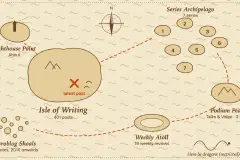
TL;DR: This blog has a site map again, drawn as a pirate’s treasure map, at /map/. Many websites used to have one: a page that linked everything, for lost visitors and for crawlers that found pages la…
- The Matryoshka of Humans in the Loop
TL;DR: Amazon Mechanical Turk closed on 30 September 2026. Its own tagline, “artificial artificial intelligence,” is a useful lens for what came after it, because the human-in-the-loop never left the …

- Same Ads, Different Room
TL;DR: Ads in AI answers work much like search ads in their publicly documented buying mechanics, with three changes. The system reads the whole conversation to pick an ad, where search starts from a …

- What Doesn't Close
What Doesn’t Close “Mmmhh, da haste dir aber nen Thema ausgesucht & ich hoffe sehr, dass du dabei im Kopf behältst, wie wenig sich Asymmetrien letzten Endes vermeiden lassen. Ganz ähnlich, wie Ambival…