What Doesn't Close
 written by Stefan Christoph
What Doesn’t Close
“Mmmhh, da haste dir aber nen Thema ausgesucht & ich hoffe sehr, dass du dabei im Kopf behältst, wie wenig sich Asymmetrien letzten Endes vermeiden lassen. Ganz ähnlich, wie Ambivalenzen zum Menschsein gehören & nicht aufzulösen sind.”
“You’ve picked quite a topic — and I very much hope you keep in mind how little asymmetries can ultimately be avoided. Much like ambivalences are part of being human and cannot be resolved.”
a friend, on reading the series
A note on where this comes from: I’m not a psychologist or a philosopher. I read this research because I kept writing posts about tables where two people live in different worlds, and I wanted to know whether the gaps were problems to fix or facts to live with. The answer turned out to be “both, and telling them apart is the skill.” Every source is cited at the bottom, and the friend whose line opens this post handed me its conclusion in their own words. This isn’t clinical advice.
The line a friend sent me
Somewhere around the sixth post, a friend sent me a note. They said, in effect: you’ve picked quite a topic, and I hope you’re keeping in mind how little asymmetries can finally be avoided, the same way ambivalence is part of being human and doesn’t resolve.
It named the thing the whole series had been walking around. In each of the nine posts I described a table where two people experience the same moment differently, diagnosed why, and handed over a playbook. Each time the moves helped, and each time the gap was still there at the end: they made it better, and most never made it go away. I didn’t hide that, and it’s the argument this last post makes, the conclusion I drew from writing the nine.
Four tables, one shape
Before the argument, four quick scenes, because the shape is easier to see than to state. A performance review: for the manager it’s one of eight conversations this week, for the person across the desk it’s the sentence that decides whether they move, stay, or start looking. A doctor’s office, where the knowledge gap is enormous and is the entire reason you came. A Tuesday-night breakup: one person has been walking through the door for months, the other is told at dinner and the floor gives way. And a kitchen table, where a parent holds an authority a four-year-old does not have and, for now, should not.
None of the four sorts by its topic. Two questions run under all of them: can this gap be narrowed, and should it exist? Those are the two axes this post is built on.
What the nine were circling
Across nine posts I never said one thing out loud: every asymmetry I described was structural. Neither side had a character defect. The gap was a feature of the situation itself, of how roles, incentives, and the human nervous system are built. In the stakes post I wrote the line I’d put on the cover of the series: “you cannot tell someone to open the valve wider when the valve is how the injury gets in.” The numbing is structural, so exhortation can’t fix it.
But I stopped a step too early. I let structural imply permanent, as if a built-in gap couldn’t move. That inference is wrong, and it’s the thing in the series I most want to take back. A structure is exactly what you can sometimes redesign. Change the information flow and the curse of knowledge shrinks. Shorten the loop and feedback latency drops. Some structural gaps narrow a lot when you change the structure. Others barely move, because the interventions available are costly, slow, or only partial: no redesign transfers your stakes into someone else’s body, and some knowledge stays stubborn even after translation.
So the nine posts were all measuring one thing, reducibility: how much of a gap you can narrow, and how. What they never asked is whether the gap that remains should be there. That second question, legitimacy, is the series’ blind spot, and it’s what this final post is for: not a third class I forgot, but a second axis I never thought to draw.
Asymmetry as the condition
The axes hang on one reframe. A gap between people is often what gives certain virtues their occasion. Trust gets extended across an information gap, a doctor’s judgment is what the patient came for because they don’t have it, and generosity is a transfer across unequal stakes. None of them vanishes under symmetry, so asymmetry isn’t required for them. But a legitimate gap is an invitation to trust, where an illegitimate one is an imposition dressed as one. So closing every gap is the wrong default. The skill is two questions deep: can it be narrowed, and should it exist?
Two axes
The mistake I want to avoid is the one the nine posts made: treating a whole topic as if it had one answer. The curse of knowledge in a botched onboarding closes the moment someone translates. The surgeon-patient knowledge gap does not close and should not, so the same topic gets opposite answers. That’s why the unit here is a specific gap under stated conditions, never “knowledge” or “parenting” whole. Expect mixed cases. They are what the model is supposed to produce.
With the unit fixed, every gap gets located on two conceptually distinct axes.
The first axis asks how reducible the gap is. That’s a matter of degree, and it’s always relative to a specified intervention: what could you do, at what cost, over what horizon, and how much of the gap would that close? A gap is highly reducible when a cheap, fast move narrows most of it (translate the jargon, publish the date) and barely reducible when the only moves are expensive, slow, or partial. Resist sorting by “information versus position”. Contracts, appeals, and notice periods change position as well as information, while private or tacit information can resist reduction for years. So think of a line from highly to barely reducible, with no bins on it.
The second axis asks how well the gap is justified. Should the residual gap exist, and is it being run as if it should? It’s a set of defeasible considerations, weighed over a stated horizon, where failing one doesn’t automatically disqualify the gap. Three of them need keeping apart, because they answer different questions.
- Role warrant. Is a differential of this kind warranted at all? Is it grounded in competence, responsibility, or a function the relationship genuinely needs?
- Exercise constraints. Is the gap used well? That means scoped to the warrant, proportionate, accountable, and contestable.
- Temporal adaptation. Should the gap shrink, and over what horizon? Some should (a parent’s authority ought to narrow as the child grows) and some legitimately shouldn’t (durable, well-founded expertise). “Must shrink” is a question you ask, and no condition every legitimate gap has to meet.
A word about who carries the burden. For this assessment, existing authority has to justify itself. A manager’s decision right, an editor’s veto, a platform’s rating power all owe an account, and none of them gets the benefit of the doubt. The burden sits with the powerful party, as a starting position for whoever evaluates it, without presuming the authority illegitimate. Whether it meets the burden is what the three considerations, over the stated horizon, decide.
Cross the two axes and you get four regions. Both axes are continuous, so the boundaries are soft and contested: a gap sits somewhere on a plane, and two careful readers will place the same case a little differently. Each region names a defeasible starting strategy, where to begin and nothing more. Before acting on it, run four checks the region can’t settle for you. What does the intervention cost? What side effects does it carry? Whose rights does it touch? Does it actually improve the outcome?
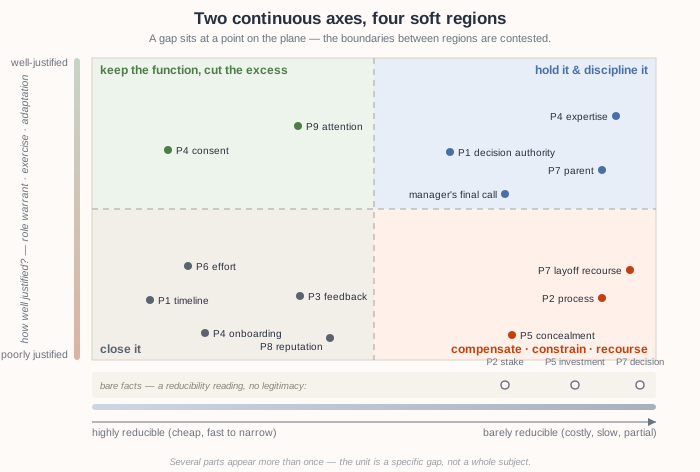
Two continuous axes, four soft regions. Reducibility runs left-to-right; justification (how well the residual gap is warranted and run) runs top-to-bottom. Boundaries are dashed on purpose — contested, and a gap sits at a point, not a cell. Several parts appear more than once because the unit is a specific gap; three bare facts ride the reducibility axis alone (hollow), since an unequal stake, an unequal investment, or an irreversible decision isn’t a legitimacy question.
Here is every gap, with the conditions assumed, the intervention that would move it, and the reading on each axis. One object per row. A bare fact and the arrangement around it sit on separate rows, so a Part can appear more than once, because the unit is a specific gap.
| Gap (part) | Conditions assumed | Intervention + horizon | Reducibility (axis 1) | Justification (axis 2) |
|---|---|---|---|---|
| Undisclosed timeline (1) | one side holds the clock | state the date (minutes) | highly reducible | no warrant to withhold, so weak |
| Decision authority (1) | who holds the offer, timing | distribute some rights (months) | partly reducible | warranted if scoped, accountable |
| Curse of knowledge, onboarding (4) | expert forgot not-knowing | translate, check (a session) | highly reducible | no warrant to stay opaque, so weak |
| A doctor’s expertise (4) | training vs. a web search | can’t transfer (years of study) | barely reducible | strong role warrant |
| The consent arrangement (4) | expert must explain to a layperson | explain, check understanding (per visit) | highly reducible | warranted only if it explains, so it owes consent |
| The stake differential (2) | interview forty vs. your five years | can’t transfer the stake into their body | barely reducible | no reading (a bare fact) |
| The process around it (2) | casual, no notice, no recourse | build in notice, a hearing (a redesign) | barely reducible by you, add recourse | recourse-free arrangement, so weak |
| Feedback latency (3) | mum effect, slow loop | shorten the loop, ask (weeks) | mostly reducible, residue (not plotted): the hardest truths stay costly even then | owed feedback withheld, so weak |
| Effort visibility (6) | hidden work, labor illusion | make it legible (ongoing) | mostly reducible, residue (not plotted): judgment leaving no artifact | concealment used as a lever, so weak |
| The investment differential (5) | all-in vs. exploring | can’t compel reciprocal investment | barely reducible | no reading (nobody’s owed it, a bare fact) |
| Concealed commitment (5) | hiding the imbalance to draw more | name it, stop auditioning (ongoing) | barely reducible by you | concealment or exploitation, so weak |
| Reputation (8) | one rates, the other can’t answer | add reply or appeal (a design choice) | reducible where recourse exists | one-sidedness without recourse, so weak |
| Attention (9) | limited attention, 200 messages | prioritise, record, re-workflow (costs time) | reducible at a cost | broadly warranted, used as an excuse it turns weak |
| A parent’s authority (7) | a four-year-old, safety | can’t and shouldn’t transfer, shrinks over years | barely now, shrinks over years | strong warrant, owes scope and explanation |
| The irreversible decision (7) | someone else opened the door | can’t reverse it | barely reducible | no reading (a bare fact) |
| The recourse arrangement (7) | decided casually, no hearing | add notice, a hearing (a redesign) | barely reducible by you, add recourse | no notice, no recourse, so weak |
“Weak” means the justification is thin as the gap is run. “No reading” marks a bare fact (an unequal stake, an unequal investment, an irreversible decision) that isn’t a legitimacy question at all.
A quick glossary, since each verb names a starting strategy for a region and promises nothing. Close means remove an avoidable gap (it doesn’t mean force equality). Cut the excess means keep the function and drop the power or opacity it doesn’t need. Hold means live at a gap that barely moves without denying it. Discipline means run a well-justified, barely-reducible gap under its conditions. Symmetrise is the error of erasing a gap whose difference was the point.
Reducible and poorly justified: start by closing it
The most tractable region. A cheap, fast intervention narrows most of the gap, and there was no warrant for leaving it open.
Undisclosed timelines (Part 1) [1], feedback latency (Part 3) [3], and effort visibility (Part 6) [6] are plumbing and legibility problems. Name the date, shorten the loop, make the work legible. Two slivers survive even then, and I name them in the hard region below: the hardest truths stay costly to deliver, and some judgment leaves no artifact.
The curse of knowledge in onboarding (Part 4) [4] belongs here. The tappers study is the emblem: tappers of a famous tune predicted ~50% recognition, and listeners managed two and a half percent [19]. The gap shrinks the moment the expert translates and checks for understanding.
Reputation with no recourse (Part 8) [8] too. One side rates, the other can’t answer. A right of reply or an appeal removes precisely that one-sidedness, so the gap is reducible, and its persistence is a platform design choice.
The honest economic counter-argument belongs here too. Signaling and screening (Spence [17], Rothschild and Stiglitz [21], and the response to Akerlof’s “lemons” [16]) mitigate adverse-selection losses without necessarily eliminating the underlying private information, and they do it at a cost. A diploma sorts candidates; it does not prove the quality it is being used to infer. Institutions can also change the structure itself through contracts, appeals and notice periods, which is exactly why reducibility needs its own axis: redesign moves a gap left, and still can’t say whether what remains should exist.
Reducible and well-justified: keep the function, cut the excess
Some gaps can be narrowed but shouldn’t be closed all the way, because part of the gap does a real job. Cut the excess, meaning opacity and unearned power, and keep the function.
The doctor is the clean case. The explanatory gap is reducible and should be reduced: enough explanation for genuine informed consent, questions taken seriously, the patient’s own knowledge of their symptoms and values treated as real input. The goal isn’t symmetry of expertise, though. You came for judgment you don’t have, offered in a way you can act on. Informed consent is the legitimacy condition made concrete, expertise kept accountable and contestable without pretending the gap away. An editor who explains the call instead of just overruling it makes the same move.
Attention (Part 9) [9] sits here too. The gap between what you remember and what a 200-message counterparty registered narrows with prioritisation, records, and workflow changes. That costs real time and tooling, so the gap is reducible at a cost, which is different from irreducible. The residual is broadly warranted. Leaned on as a blanket excuse, it becomes an exercise-constraint failure, and that says nothing about whether the gap could move.
Barely reducible and well-justified: hold it and discipline it
Some gaps barely move and shouldn’t be forced, because the asymmetry is the value the relationship produces. But “well-justified” is a standard you have to keep meeting.
A manager’s final call on a contested decision is one. With no locus of authority nothing gets decided, with unaccountable authority it goes wrong. The warranted version is scoped, accountable, and contestable, and since plenty of decision rights can be distributed, the burden is on the authority to show which shouldn’t be. The decision half of Part 1 [1] has the same shape.
Then the one I got wrong: a parent’s authority (Part 7) [7]. I called parenting “the moral-hazard case” and framed the power as mainly a problem to reduce. That was incomplete. A four-year-old should not have symmetric say over bedtime or safety. One party carrying a world the other can’t yet is the job. What it needs is not reduction but discipline: scope, an explanation pitched at a level the child can hold, whatever reversibility you can preserve, and a gap that shrinks as the child’s capacity grows. Here temporal adaptation is a live condition. A parent’s authority that refuses to narrow over the years has stopped being warranted. “Because I said so” is this region abdicating the discipline its power requires.
Barely reducible and poorly justified: compensate, constrain, create recourse
This is the hardest region, and the one the playbook genre serves worst. The gap barely moves, it’s being run worse than it should be, and you’re often the party with the least power to fix either. As the table’s “no reading” rows mark, I’m judging the procedural arrangement here and never the raw fact that two people differ. An unequal stake, an unequal investment, an irreversible decision are facts. What lands a case here is a thin arrangement around the difference: no scope, no accountability, no recourse.
Stakes, specifically the process (Part 2) [2]. To the recruiter it’s interview forty. To you it’s the next five years. That magnitude gap is a fact, and no good faith transfers your stake into their body. The wrong, when there is one, is in the procedural arrangement: a process that treats your five years as casually as their forty, with no notice and no recourse. You compensate for the stake gap (name it, read their routine as competence and not as a verdict on you, keep more than one table in play) and you hold the process to account for the power it uses.
Concealed commitment (Part 5) [5]: all-in on one side, exploring on the other, Waller’s principle of least interest [20]. The unequal investment is a fact, and nobody is owed reciprocal investment. What lands it here is concealment or exploitation, letting the other side believe the investment is mutual to draw more of theirs. Name it, keep your options warm, stop auditioning, and treat the hiding as the fault.
A one-way door someone else opened, Part 7’s other half [7]. The decision itself barely reverses (a fact), and losses tend to loom larger for whoever absorbs them (loss aversion [18] is a within-person pattern, and how much larger is context-dependent, with no fixed cross-person ratio). What decides the region is how the door was run. A parent’s door is well-justified with discipline, one region up. A layoff decided casually, without notice or a hearing, is the poorly-run version that owes recourse. That’s where the Part 7 correction lands.
Two residues are deliberately left off the plane: the feedback that stays unsaid because the hardest truths cost something to deliver even once the loop is short, and the effort that is unobservable because it left no artifact. They are limits on how far Parts 3 and 6 close. They aren’t arrangements with their own warrant, so they caveat those cases instead of sitting on the plane.
To compensate, name the gap, absorb what you can, and don’t read a structural fact as a personal verdict. Constraining is about holding the power to its scope, so the routine doesn’t leak across the table. Recourse is the appeal, the notice, the right of reply whose absence is what makes the arrangement thin. Closure was never on offer; a poorly-run gap can still be dragged toward accountable even when it can’t be closed.
Performed equality
If a gap barely moves, you can acknowledge it or pretend it isn’t there. The pretending has a name in ordinary life (“we’re all equals here, just speak freely,” from the person who controls your promotion). It’s a denial of authority by someone who still holds the sanctions, and in that form it can be worse than honest hierarchy. Performed symmetry leaves the power gap where it was and removes the acknowledgment, so the risk moves to the weaker party, who now has no standing to name it. It hid the power instead of sharing it, and a hidden power differential is more dangerous than a declared one. If speaking freely goes badly, they can’t say “well, you did have power over me”. The room agreed to pretend you didn’t.

The fake close. ‘We’re all equals here, speak freely,’ from the person who signs the reviews. The gesture doesn’t move the power; it removes the acknowledgment of it, which is the one thing the weaker party could have used.
The research is consistent with this. Amy Edmondson’s work on psychological safety is often misread as “make everyone feel equal”. Her studies find closer to the opposite: safety comes from leader inclusiveness, a leader explicitly inviting and appreciating input in a way that helps a team “overcome the inhibiting effects of status differences” [14]. The leader doesn’t pretend the surgeon and the nurse are interchangeable. They acknowledge the hierarchy and visibly open a channel across it. Acknowledged asymmetry plus explicit invitation reads as more credible than performed flatness.
Arnstein’s ladder of participation names the same pathology. Its bottom rungs, “manipulation” and “therapy,” are non-participation, the appearance of shared power over a gap that hasn’t moved an inch [15].
There’s no clean study that says “performed equality backfires” with a tidy effect size. I’m reasoning from Edmondson’s mechanism and Arnstein’s ladder. But the everyday version is easy to feel. The recruiter who performs equal investment (“we’re so excited about you!”) makes the eventual silence land harder than an honest “you’re one of six, I’ll know by Thursday” would, because the warmth handed the candidate a debt they didn’t know about.
The capacity the gaps call for
My friend’s line put ambivalence next to asymmetry on purpose, and the parallel runs deep. Eugen Bleuler, who introduced “ambivalence” around 1910–1911, used it for the genuine simultaneous presence of contradictory feelings, its affective form, the one I mean here [10]. The mature response, across a century of thought, is to leave it unresolved. Melanie Klein’s “depressive position” is an integrating one, relating to a whole object with concern instead of splitting good and bad into separate people [11]. What I take from it is narrow: holding the good and the bad in the same person at the same time. Keats called a cousin of this “negative capability,” staying “in uncertainties, Mysteries, doubts, without any irritable reaching after fact and reason” [12] (reading it as psychological maturity is my extension, which Keats never made). And Isaiah Berlin’s value pluralism says some conflicts between genuine goods have no solution, only trade-offs, because the values are incommensurable [13].
Every one of those describes a capacity. Klein’s integration, Keats’s tolerance of the unresolved, and (my synthesis, which Berlin never phrased) a willingness to choose without pretending the loss away. None is a technique you execute. They’re things you become able to do slowly. Maturity is sitting in the tension without either collapsing it or being wrecked by it.

Holding the gap. Neither performing that the table is level nor aggrieved that it isn’t — simply in it, attending to each other. That posture, acknowledged and unresented, is a capacity, not a move.
Transpose that to asymmetry and you get the mature stance: holding the gap without denying it (the fake close) and without being needlessly aggrieved by it (the receiver’s failure mode I named in almost every post, a structural fact read as a personal wound).
One guard-rail. Reading a wound as structural is an explanation, and it can dissolve unwarranted self-blame. It doesn’t make the decision fair, and it never removes anyone’s standing to object, appeal, or escalate. Some grievances are warranted, and resentment can be information. “Unresented” means not carrying a private wound for a gap nobody chose. It doesn’t mean swallowing a real wrong.
A playbook produces moves (do this, say that), and I stand behind them. But the gaps in the two barely-reducible regions don’t want moves. They want a capacity: the manager who names the power gap instead of performing its absence, the person who reads silence as noise and not as verdict, the parent who carries a world without abdicating it or being tyrannical about it. A playbook can’t hand you a capacity, only moves that, practised long enough, might grow into one. So the series gave moves to the barely-reducible regions, which needed a capacity more.
Most of the earlier nine stands, and one framing is withdrawn:
- The “close it” moves (knowledge, feedback, effort) and most of the “compensate” moves still stand as written.
- The barely-reducible-region moves now carry a scope they lacked. They serve a capacity, and they answer to legitimacy, which the originals never asked about.
- The Part 7 framing of a parent’s authority as mainly a moral-hazard problem to reduce is withdrawn. The “hold it and discipline it” region above replaces it.
The playbook: locate it, then act on the region
For every other post the playbook was a list of moves. The closer needs two tools instead: a way to locate a gap on both axes, and a way to hold the ones that barely move.
Locating the gap
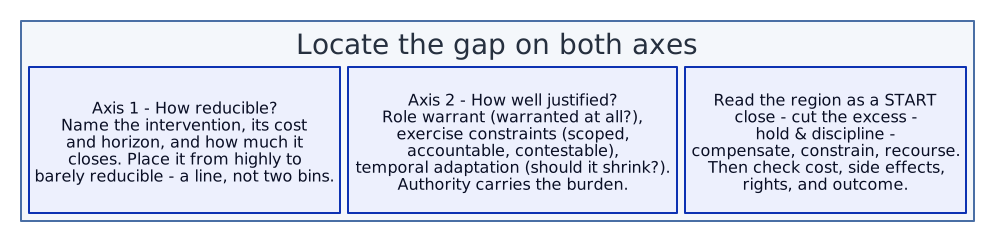
Locating a gap. Ask how far each axis moves — reducibility by degree, justification as role warrant plus exercise constraints plus temporal adaptation — then read the region as a place to start, not a verdict. Authority carries the burden on axis two.
- How far can this gap be narrowed? Name the intervention, its cost, and its horizon, and place the gap on the line from highly reducible to barely reducible.
- How well is the residual gap justified? Weigh role warrant, exercise constraints, and temporal adaptation. Existing authority carries the burden here and doesn’t get the benefit of the doubt.
Read both answers, find the region, and treat its label as where to start. Then run the four checks before you act. The common mistake is misfiling: trying to close a barely-reducible gap (demanding the recruiter feel your stakes), symmetrising a functional one (“do your own research”), or leaving a reducible gap open out of misplaced deference (the doctor who won’t explain).
Holding what won’t close
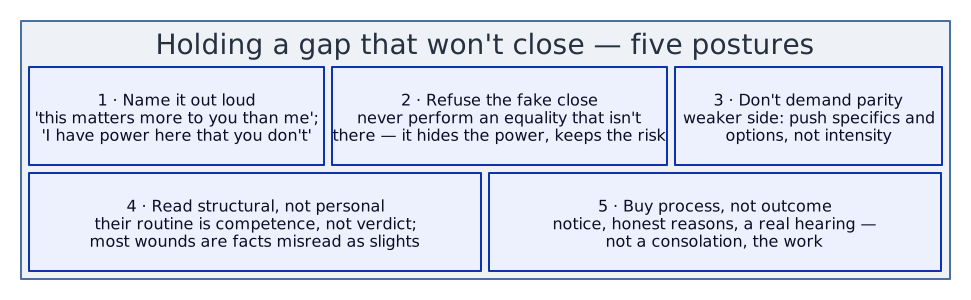
How to hold a gap that barely moves — postures that let you live at it without denying it or being wrecked by it, practised into capacities rather than executed once.
For the two barely-reducible regions, these are the postures. They’re the same handful I kept rediscovering one post at a time, without seeing they were a single list.
- Name it out loud. “This matters far more to you than to me.” “I have power here you don’t.” Acknowledgment is the cheapest high-value thing the stronger party can do, and it’s exactly what the fake close removes.
- Refuse the fake close. Never perform an equality that isn’t there. Flattening a gap you still hold transfers the risk to the weaker party and denies them the standing to name it.
- Don’t demand parity. Insisting the other side feel what you feel triggers the exact defences you’re trying to get through. Push specificity and options instead of intensity.
- Read structural, not personal. Their routine isn’t a verdict. The one-way door wasn’t aimed at you. That explains the decision without excusing it.
- Buy process where you can’t buy outcome. When the result is fixed, fair process (advance notice, honest reasons, a genuine hearing) is the one lever that still reduces the harm. It’s the recourse a poorly-run gap lacks, and it’s real work.
These don’t close anything. They let you stand at a gap that won’t close and be, in my friend’s phrase, someone who keeps in mind how little asymmetries can finally be avoided, and live there well anyway.
Summary
Ask two questions of any gap between people: how far can it be narrowed, and how well is it justified? The answers point to a region (close it; keep the function, cut the excess; hold it and discipline it; or, hardest, compensate, constrain, create recourse), and that’s where to start, not what’s settled. Above all, never perform an equality that isn’t there: an acknowledged gap is survivable; a hidden one is where the risk lands on whoever has the least of it.
Ending the series
This is the tenth and last part. The lens hasn’t run out. A series should end where it has said its thing, though, and this one has said it: two people at one table in different worlds, and the discipline of asking, of each difference, whether it can be narrowed and whether it should exist.
I’ll say what would reopen it. These aren’t “falsifiers” in the lab sense, just three honest boundary tests: cases that would show the plane is drawn wrong, under-defined, or incomplete.
- Is the plane well-defined? Take one gap under one set of stated conditions and see whether two reasonable readers place it in different regions. A little drift near a boundary is fine, since the boundaries are contested. But if the same gap, same conditions, lands squarely in opposite regions under two fair readings, the axes aren’t carrying real information.
- Do the regions override their own checks? Take the gaps the model files in “hold it and discipline it,” run all four checks on each, and look for cases where narrowing further dominates (strictly better on outcome, no worse on the other three) and the “hold” label still steers you to preserve the gap. If the model systematically protects gaps that a dominant narrowing would improve, the regions are overriding the checks instead of organising them, and “hold and discipline” is doing quiet harm in the model’s name.
- Does the plane cover the ground? Find a gap that resists description on either axis, where “how reducible?” and “how well justified?” both come back as category errors. That’s the one I’m most curious about. It would show me an aspect I never learned to see, and it’s the case I most want someone to bring.
I don’t think I’ve hit any of the three, but I’ve been wrong across this series before (the parenting correction is the proof), and I’d rather be shown the straining case than defend a tidy diagram. So put it in the comments: the gap two readers can’t agree on, the well-justified gap the regions kept preserving even where narrowing dominated, or the one that fits neither axis. That’s what would earn a Part 11.
Sources
[2] Asymmetry of Stakes: Staying Humane at Volume · Part 2 · the “valve” line.
[3] The Feedback Exchange Rate · Part 3 · the mum effect.
[4] The Expert Can’t Remember Not-Knowing · Part 4 · the curse of knowledge.
[5] Being Someone’s Option · Part 5 · the principle of least interest.
[6] The Iceberg Problem · Part 6 · the labor illusion.
[7] The Door Only Locks Behind One of You · Part 7 · the parenting/moral-hazard framing I correct here.
[8] One Side Rates, the Other Can’t Answer · Part 8 · ratings as unaudited management.
[9] You Remember Every Word. They Got 200 Messages. · Part 9 · silence as weak evidence.
[10] Eugen Bleuler and “ambivalence” (1911) · the term’s affective form; Freud’s “happily chosen.”
[11] Paranoid-schizoid and depressive positions (Melanie Klein) · the depressive position as an integrating psychic position.
[12] John Keats · “negative capability” (Poetry Foundation).
[13] Value pluralism / Isaiah Berlin (overview) · incommensurable values; trade-offs, not solutions.
[14] Nembhard & Edmondson (2006), “Making It Safe,” Journal of Organizational Behavior 27(7):941–966 · DOI 10.1002/job.413 · consistent with the performed-equality argument here; it does not directly test it.
[15] Sherry R. Arnstein (1969), “A Ladder of Citizen Participation,” Journal of the American Institute of Planners 35(4):216–224 · DOI 10.1080/01944366908977225.
[16] George Akerlof · “The Market for Lemons” (1970, PDF) · adverse selection.
[17] Michael Spence (1973), “Job Market Signaling,” Quarterly Journal of Economics 87(3):355–374 · JSTOR 1882010 · signaling mitigates adverse selection without eliminating the underlying private information.
[18] Kahneman & Tversky (1979), “Prospect Theory: An Analysis of Decision under Risk,” Econometrica 47(2):263–292 · PDF · loss aversion, a within-person pattern, context-dependent, with no fixed cross-person ratio.
[19] Elizabeth Newton (1990), Stanford “tappers and listeners” experiment (PhD dissertation, Stanford University) · overview · ~50% predicted recognition; ~2.5% identified.
[20] Willard Waller (1938), The Family: A Dynamic Interpretation · principle of least interest.
[21] Rothschild & Stiglitz (1976), “Equilibrium in Competitive Insurance Markets: An Essay on the Economics of Imperfect Information,” Quarterly Journal of Economics 90(4):629–649 · JSTOR 1885326 · screening; Spence and Stiglitz shared the 2001 Nobel with Akerlof.
Written with AI assistance; the argument, the sources, and the errors are mine.
#Psychology #Leadership #Communication #Philosophy #Empathy
About the Author
Stefan Christoph is a Principal Solutions Architect at AWS, focused on agentic AI, media & entertainment, and helping builders move from demo to production. He writes about AI architecture, developer productivity, and the future of software.
This is a personal blog. Opinions expressed here are my own and do not represent the views or positions of my employer.
🎬 Also available as a blog walkthrough video on YouTube
❤️ Created with the support of AI (Kiro)