You Remember Every Word. They Got 200 Messages.
 written by Stefan Christoph
A note on where this comes from: I’m not a psychologist. I read the research because I keep living both sides of this — some days I’m the one re-reading a message I sent and reading meaning into the silence, and some days I’m the one with 200 unread and a genuine intention to reply that never survives the day. Every study I lean on is cited at the bottom. Where a number is a vendor survey rather than a peer-reviewed finding, I say so. And this is not burnout advice; if the inbox dread never switches off for you, that’s a different conversation than a blog post can have.
23:00, and again at 07:15
Here is a scene you have probably lived.
It’s 23:00. You wrote the message hours ago — the important one, to the person whose answer matters. You chose the words. You softened the ask, then un-softened it, then softened it again. You read it back before sending, and you have read it four times since, because it is still sitting there with no reply. By now you are not really reading the words anymore; you are reading the silence. And the silence has started to say things. They saw it. They’re deciding how to let me down. I pushed too hard. I didn’t push hard enough. You draft a follow-up in your head — just a little bump, just to float it back to the top — and you fall asleep composing it.
Now cross the table. It’s 07:15 the next morning, and this is the other person’s phone. Overnight and through yesterday it collected — let’s say it’s a busy week, so call it two hundred things: the work threads, the group chats, the three apps that all decided something was urgent, and yours, in there somewhere. They are not deciding how to let you down. They have not, in any meaningful sense, decided anything about your message at all. They glimpsed it for four seconds between message 87 and message 88, thought I need to give this a proper answer, and then a meeting started. Your message is not figural to them. It is one tile in a wall of two hundred tiles, and they are scrolling past the wall.
That’s the whole post, and I want to be careful about it, because it’s easy to hear “get over yourself.” That is not what the research says. It says something kinder and more useful: nobody here is wrong. You spent an hour, so the message is deeply encoded, and you’ll remember it verbatim for weeks. They spent four seconds, so it’s barely encoded at all. Both memories are honest and completely different. The gap between “I remember every word” and “they got two hundred messages” is not a character flaw on either side. It is the structure of the situation. What can be fixed is what each of you does inside it.
And to be clear that this is not only the 23:00 message: the same asymmetry runs through the group chat where you shared something you were proud of and got two thumbs-up, the email you sent your busiest colleague, the text to the family member who takes three days, and the message marked seen ✓✓ with no reply, which is the spotlight effect’s home game and the example I’ll keep coming back to. Pick whichever table is yours. The shape is the same.
That shape has a name, and it’s the last one in this series.
The asymmetry, one more time
I’ve spent this series collecting moments where two people sit at the same table and live in different worlds. Part 1 was the very first one: “we’ll call you,” and the specific misery of waiting for an answer someone else controls. This post closes the loop on that opening, because the person waiting by the phone in Part 1 is the sender here — and this time we’re decoding the silence from the other side, from inside the inbox that never called back. The most recent stop, Part 8, was about reputation: one side rates, the other can’t answer. This one is about attention: one side remembers every word, the other got two hundred messages.
Here is the shape. On one side of the table, a person sends a message that matters to them and then waits. The message is self-generated, chosen, awaited — it stays live in memory, an open loop that keeps re-surfacing. On the other side, a person receives that message into a stream: one of dozens or hundreds that day, each one a small tax on a resource that does not refill just because more arrives. The sender’s message is the event. The receiver’s message is the ground it lands on.
The asymmetry is invisible until it turns toxic, and it turns toxic at exactly one place: the moment the sender starts reading the delay as a message. The unanswered thread becomes evidence. The seen ✓✓ becomes a verdict. The slower-than-last-time reply becomes a diagnosis of the relationship. At that moment the silence itself becomes the injury — and it is a separate injury from whatever the actual answer turns out to be. You can get a yes, late, and remember only that they made you wait. You can get a no, promptly and kindly, and feel respected.
Which is the first reframe, and it’s the one that has run under this whole series: most of the time, nobody is being cruel. The receiver is not savoring your suspense. They are saturated, and saturation is not the same as indifference, and the entire difficulty is that from the sending side you cannot tell them apart. So let me take the two sides one at a time, because — like every pair before them in this series — they have completely different problems.
Two universes
The sender
Your driver is that this matters, and you need to know how it lands. That’s not neediness; it’s the normal weight of caring about an outcome you can’t control.
Your problem is that the silence is ambiguous, and the human mind cannot leave ambiguity alone. It fills the gap, and it fills it with a story about you. The delay has one overwhelmingly likely cause — the other person’s load — and a hundred unlikely ones about your worth, your message, the relationship. Your mind reaches past the likely cause and grabs a personal one, because the personal ones are the ones you can rehearse.
Your failure mode is reading queue position as verdict, and then acting on the misreading. Two things go wrong, and they compound. You interpret the delay as information about how you’re seen (it almost never is), and — separately — you respond to that interpretation by adding pressure: the follow-up, the bump, the “just floating this back up.” Both feel like reasonable responses to the silence. Only they land on a person who is already underwater, and pressure is exactly the thing that makes a saturated person mute you further.
The receiver
Your driver is survival of the volume. You cannot give two hundred messages the attention any one of them deserves and still have a life, so you triage — fast, shallow, mostly on autopilot. That triage is not laziness. It is the only way the throughput is possible at all.
Your problem is that your triage is invisible to the sender, and your silence gets read as a decision you never actually made. From your side, “I’ll get to it properly later” is a benign intention. From theirs, the same silence is indistinguishable from “I read it and I’m ignoring you.” You know you’re not ignoring them. They have no way to know that.
Your failure modes are two, pulling opposite ways. One is silent triage: dropping messages with no signal at all, which quietly converts your load problem into the sender’s waiting problem — the whole machinery of Part 1’s dread fires on your behalf, invisibly. The other is telepressure: trying to answer everything instantly, which feels like conscientiousness and is actually a health tax you pay in burnout and lost sleep, while also training every sender around you to expect instant replies forever. Both feel like the responsible choice. Both make things worse — one for the sender, one for you.
The thing connecting the two sides is a single question of translation: can the sender read the pile instead of the silence, and can the receiver make their triage visible instead of leaving it to be misread? To see why that’s hard, we have to go to the research. This is the long middle of the post, and it’s the why behind every move in the playbook; if you only want the what, jump ahead — the playbook will be waiting.
What the research actually says
The usual caveat first, because it governs how much weight any of this carries. Almost all of this work is correlational and self-reported — people surveyed about their own inbox habits, professionals rating their own exhaustion, lab studies of a specific bias. It is real signal, but it is a map, not a machine. And one honesty flag specific to this post: the “two hundred messages” and “four seconds” are illustrations, not measured constants. Nobody has shown that attention craters at precisely message 88. What has been shown is the direction, and the direction is not in doubt.
Attention is the scarce thing — and abundance makes it scarcer
The founding idea is Herbert Simon’s, from 1971, and it is almost too tidy: “a wealth of information creates a poverty of attention” [1]. His fuller line is worth carrying, because it explains the whole mechanism in one breath — information “consumes the attention of its recipients,” so “a wealth of information creates a poverty of attention, and a need to allocate that attention efficiently among the overabundance of information sources that might consume it” [1].

Your message, from both sides at once. To you it’s the one glowing thing; on their side it hangs somewhere in the wall — one tile among two hundred, lit for the four seconds it takes to scroll past.
Sit with what that means for your unanswered message. It never competed against silence. It competed against everything else in the pile: every other message, notification, and demand arriving at the same finite pool of attention. The more that arrives, the less each item can get. So the receiver giving your hour-long message four seconds is not a verdict on the message. It is the arithmetic of a conserved resource divided across an overabundance of claims on it. What you spent an hour making gets its proportional slice of their day, and their day has two hundred slices in it.
You are peripheral, not centered
The bias that turns that arithmetic into misery is the spotlight effect. Gilovich, Medvec and Savitsky showed that people systematically overestimate how much others notice them [2] — we anchor hard on our own vivid experience of ourselves and fail to adjust for how small we are in anyone else’s field of view [3]. Their experiments were about embarrassing t-shirts and imagined blunders, but the mechanism transfers exactly. When you send a message, you are at the dead center of your own attention. You then assume you’re somewhere near the center of theirs. You are not. You are peripheral — one item, briefly glimpsed, in a world that is as crowded for them as yours is for you.
This is the correction that does the most work. “They saw it and are choosing not to reply” is a spotlight-effect projection: it assumes a spotlight on your message that, from their side, does not exist. There is no spotlight. There is a queue. The delay is your position in the queue, not a decision anyone made about you.
The people who try to keep up pay for it
If Simon explains the scarcity and Gilovich explains the misreading, Larissa Barber and Alecia Santuzzi explain what happens to the receiver who refuses to triage. Their work names workplace telepressure — the preoccupation with, and urge to respond quickly to, messages — and finds it predicts burnout, poor sleep, and impaired recovery [4]. The mechanism is a failure to detach: the person who never mentally leaves the inbox never recovers from it, and the follow-up research points at that lost detachment as the thing that does the damage [5].
Read that against the sender’s instinct. When a message goes unanswered, the sender’s reflex is to want the receiver to feel more urgency. But the receiver who already feels maximum urgency about everything is the one heading for burnout. “Just reply faster” is not a free instruction you can hand the other side — for the person drowning, faster-to-everything is the losing strategy that costs them their health and, eventually, their reliability. The humane and the effective move in the same direction here: less pressure, not more.
There’s a prevalence figure that gets quoted alongside this work — that something like 30% of people keep email open continuously and around 58% typically respond within an hour. I want to flag it honestly: that is an industry survey cited in Barber’s teaching slides, not a peer-reviewed finding, so treat it as a texture-of-the-world number rather than a hard result [6]. But even as texture it makes the point — the norm on the receiving side is not ignoring. It’s drowning while trying not to.
The two memories are both honest
The last piece is the one that makes the gap feel personal, and it’s the simplest. The sender rehearsed, wrote, chose the moment, and re-reads — all of which is self-relevant, self-generated content, which the mind encodes deeply and keeps live as an open loop. The receiver processed the same message once, shallowly, among hundreds. So weeks later the sender remembers every word and the receiver may not remember the message at all — and both are telling the truth about their own experience. This is the same mismatch this series hit in Part 2, where stakes drove memory; here it’s attention volume driving it, at the micro scale of every single message. Memory follows attention, attention followed the pile, and the pile was never about you.
The loop that makes it worse
Put the pieces together and they don’t just sit side by side — they feed each other. The sender overestimates their salience (spotlight), so they read the delay as a verdict (Part 1’s ambiguity-filling), so they follow up with more messages, which adds to the receiver’s overload (Simon), which raises the receiver’s telepressure and slows them down further — which lengthens the very delay that started the spiral. Every turn of the loop makes the next turn worse, and both sides are, at each step, doing something that feels locally reasonable. You do not break a loop like that by trying harder at your end. You break it by changing one of the moves.
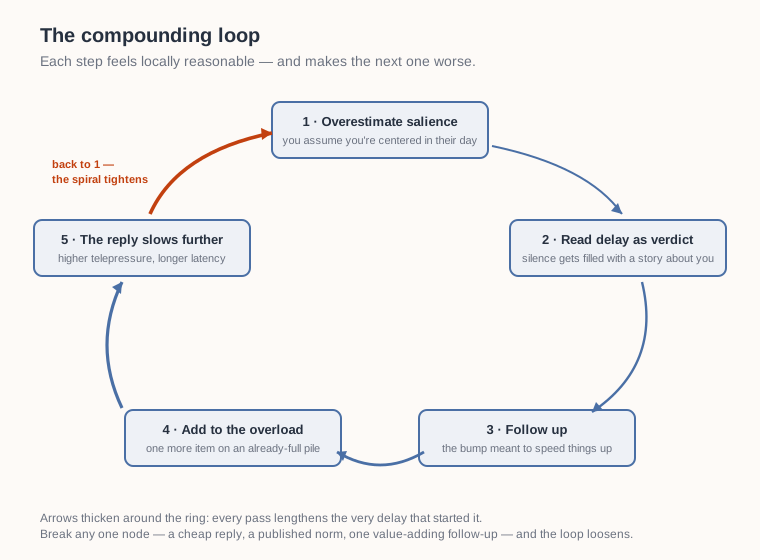
The compounding loop. Each step feels locally reasonable and makes the next step worse. The follow-up meant to speed things up is the move that slows them down. Break the loop at any one node and the whole thing loosens.
The playbook
Enough mechanism. Here’s what to actually do on each side. As throughout this series, notice how the two sides carry different loads — and how cleanly the moves transfer from the work inbox to the family group chat.
If you’re the sender
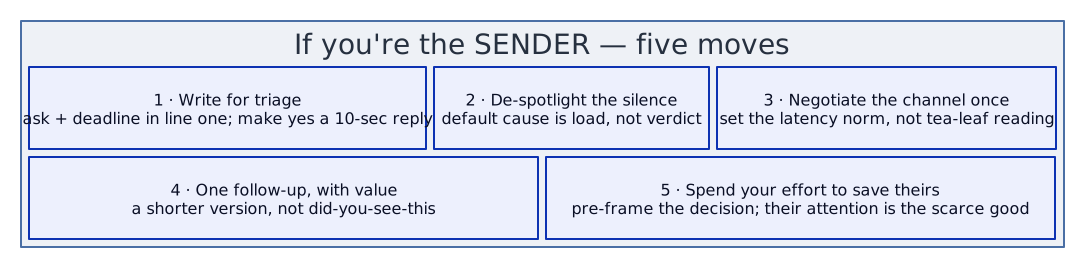
The sender’s five moves. None of them is ‘send it again.’ They’re ways to make your message cheap to answer and to stop reading the silence as a verdict.
1 · Write for triage, not for reading
The receiver is scanning, not studying. So put the ask and the deadline in the first line — or the subject — and make “yes” a ten-second reply. One message, one ask. The lovingly-structured eight-hundred-word note gets processed by a four-second scan for “what do they want, by when,” and everything past that scan is invisible. This is not dumbing it down; it’s respecting the medium. The most caring thing you can do for a saturated reader is be easy to answer.
2 · De-spotlight the silence
Before you interpret a delay, run the base rate: most unanswered messages were never deeply read, let alone judged. The default explanation for silence is load, not verdict — because that is what the research says is almost always true. When you catch your mind building the personal story (“they’re upset, I overstepped”), name it for what it is: a spotlight-effect projection onto a person who is peripheral to none of their own problems and very much in the middle of them. You are not the main character in their inbox. That is a relief, not an insult.
3 · Negotiate the channel once, not every message
The move with the most payoff, and it’s the same one that anchored Part 1. Instead of guessing at latency message by message, set the expectation once: “Is email with a couple of days’ turnaround fine for this, or do we need something faster for the urgent bits?” That one question converts every future silence from ambiguous to explained. You stop reading tea leaves because you already know the norm. It works at work, and it works in families. Most cross-generational messaging friction is an uncalibrated SLA — an agreed answer-by expectation, to borrow the tech term — not a care deficit.
4 · One follow-up, and make it carry value
The double-text is fine. The fifth is pressure, and pressure triggers the exact muting you’re trying to break through. So allow yourself one bump, after a genuinely reasonable interval, and make it add something rather than just repeat: “shorter version — just need a yes/no on X,” or “deadline moved to Friday, so no rush before then.” A follow-up that reduces the receiver’s work gets answered. A follow-up that only says “did you see this” gets buried deeper, because it’s one more thing to process and it reads as reproach.
5 · Spend your effort to save theirs
The receiver’s attention is the scarce good, so the way to buy a reply is to spend your own effort protecting theirs. Pre-analyze the options. Frame the decision so it’s a pick, not a project. Summarize the thread so they don’t have to re-read it. The asymmetry of attention means your hour and their four seconds are priced very differently — so move the work onto your side of the ledger, where it’s cheap, and off theirs, where it’s the whole bottleneck.
If you’re the receiver
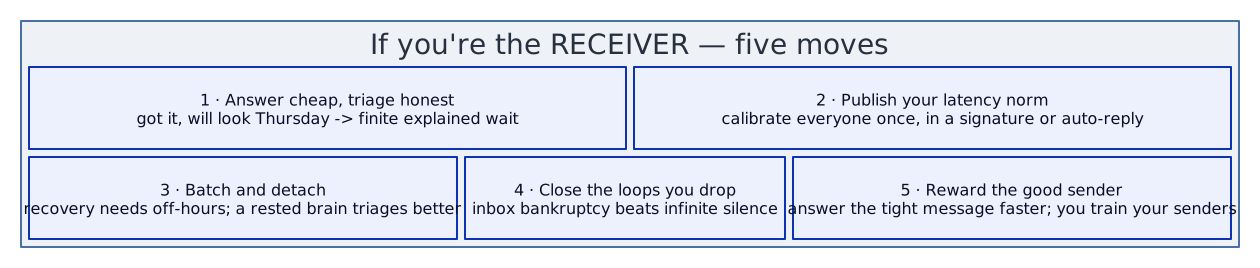
The receiver’s five moves. Most of them are about making your triage visible — turning invisible silence into a signal the other side can actually read.
1 · Answer cheap, triage honest
A five-second “got it — will look properly Thursday” is not a lesser reply; it’s the whole game. It converts the sender’s open-ended, anxious wait into a finite, explained one, and it costs you almost nothing next to the trust that silence quietly burns. This is “no update is an update” from Part 1, at the micro scale of a single message. You don’t owe everyone a full answer now. You owe the people who matter a cheap signal that the message landed and isn’t lost.
2 · Publish your latency norm
The batch version of move 1. Put your actual response rhythm somewhere it calibrates everyone at once — a signature line, a team norm, an honest auto-reply: “I check email twice a day and reply within two working days; for anything urgent, call.” That single published norm does what a hundred individual “sorry for the delay” notes can’t: it sets the expectation before the wait starts, so the silence is pre-explained. Expectation management is the cheapest trust you can buy, and you only have to buy it once.
3 · Batch and detach, deliberately
The telepressure research is blunt: recovery needs detachment, and the always-on inbox is where detachment goes to die. Scheduled blocks for messages, and genuinely off hours where you are not reachable, protect your health — and, counterintuitively, your responsiveness, because a rested brain triages better than a frayed one. This is the move that feels least responsible and is most so. Being reachable every waking second is not a virtue; it’s a slow-motion injury that also trains your senders to expect the impossible.
4 · Close the loops you drop
You will drop some. Everyone drops some. The respectful move is to signal the drop rather than let it rot into infinite silence: a periodic “declaring inbox bankruptcy on anything older than two weeks — please resend if it still matters” is far kinder than leaving a hundred people to each privately wonder whether they were ignored. A dropped loop you close is a small honesty. A dropped loop you leave open is Part 1’s dread, multiplied by everyone you’ve gone quiet on.
5 · Reward the well-calibrated sender
You are training your senders whether you mean to or not. If the person who sends a tight, triage-friendly, one-ask message gets the same slow silence as the person who sends a rambling wall, you’ve taught everyone that effort doesn’t pay — so they’ll all default to volume and pressure. Answer the good messages faster. Let the people around you learn that being easy to answer gets answered. It’s the cheapest way to slowly de-escalate your own inbox.
The same asymmetry, off the clock
Everything above works for the inbox, but the sharpest version of this one lives in private life, because that’s where the silence hurts most and where we have the least structure to lean on.

The family thread, mid-evening. Seen means the message crossed their eyes between the kettle and the kids — contact, not allocation. The checkmark can’t tell the difference, and neither can the sender.
The unanswered personal message with read receipts is the spotlight effect’s purest habitat. Seen, two hours ago, no reply. The sender builds an entire narrative — they’re annoyed, they’re pulling away, I said the wrong thing — and the receiver was making dinner and fully intended to write back properly once the kids were down. Read receipts are the cruelest little feature here, because they show attention contact and get misread as attention allocation. “Seen” means the message crossed their eyes for a moment between two other things. It does not mean they sat with it, weighed it, and chose you last. Contact is not allocation, and the checkmark cannot tell the difference.
Latency norms are deeply personal and vary by person and generation, which is why so much family friction is really just mismatched SLAs. The person who texts back in ninety seconds and the person who surfaces after three days are not expressing different levels of love; they’re running different clocks. The “negotiate the channel once” move works at the kitchen table as well as the conference room — “I’m slow on text, call me if it’s time-sensitive” ends years of low-grade misreading in one sentence. And the one-follow-up rule quietly saves friendships: the double-text is warmth, the fifth is pressure, and pressure makes people withdraw. The receiver-side kindness is just as cheap — a ten-second “saw this, answering properly at the weekend” is the most cost-effective relationship maintenance there is, and almost nobody does it.
And notice, before you decide which side you’re on, that you are the receiver of something. Everyone is drowning in some channel — the work chat, the family thread, the app you’ve muted out of self-defense. The next time a silence starts telling you a story about your worth, remember that you are, right now, someone’s unanswered message, and you know perfectly well that your own silence toward them means nothing of the kind.
The one line to keep
If you remember nothing else, remember the shape underneath all of it, because it holds at every table:
Silence is almost always noise, not signal. Your message competes with two hundred others for a conserved resource, and the spotlight that makes you read delay as a verdict does not exist on the other side — there’s only a queue. So the sender writes for triage, de-spotlights the silence, and sends one follow-up that adds value instead of pressure. The receiver makes their triage visible — a cheap “got it, Thursday,” a published latency norm — instead of leaving the silence to be misread. Nobody is wrong. The gap is the structure. The fix is mechanics on both sides.
That’s the whole thing. Everything else is the evidence for why it works, and the naming that lets you reach for the right move at 23:00 when the silence starts talking.
This is the ninth and closing entry in the asymmetry series — moments where two people share a table and live in different worlds. We started, in Part 1, with a candidate waiting for a call that wouldn’t come, unable to read the silence. We end here, on the other side of that silence, inside the inbox where the call never got made — not out of cruelty, but out of arithmetic. Timeline, stakes, feedback, knowledge, commitment, effort, reversibility, reputation, attention: nine tables, one lens. Two people, the same moment, different worlds — and, at every one of them, a set of small mechanical moves that close the gap a little. I’m not sure the lens is done earning its keep, but the series is, for now.
So, from whichever side you’re usually on: senders, what’s the message you’ve re-read too many times waiting for a reply — and does the queue reframe help? Receivers, what’s your published latency norm, the actual sentence that calibrates the people around you? Put it in the comments. Someone reading this is watching a seen ✓✓ right now and writing a story about themselves that isn’t true, and your reframe might be the one that reaches them.
Sources
About the Author
Stefan Christoph is a Principal Solutions Architect at AWS, focused on agentic AI, media & entertainment, and helping builders move from demo to production. He writes about AI architecture, developer productivity, and the future of software.
This is a personal blog. Opinions expressed here are my own and do not represent the views or positions of my employer.
🎬 Also available as a blog walkthrough video on YouTube
❤️ Created with the support of AI (Kiro)