Being Someone's Option
 written by Stefan Christoph
A note on where this comes from: I am not a psychologist. I read the research because I keep landing on both sides of this, one week the person with options, the next week someone’s option. Every study I lean on is cited at the bottom. Where the evidence is thin or self-reported, I say so. And this is not dating advice dressed up as strategy; dating shows up here only as one table among several, because the same equation runs under all of them.
Four one-sided bets, one equation
Picture four scenes.
It’s the candidate’s final round. This is the only process you have going. You turned down a half-hearted recruiter three weeks ago because this one felt right, and you have told the people close to you that this is the one. Across the table is a company running a shortlist of five. To them you are a strong finalist in a slate of strong finalists; the decision is a Thursday agenda item bracketed by two other meetings. You are both being reasonable. And you can feel, in the pace of their follow-ups and the calendar that keeps slipping, that they have four other conversations and you have one.
It’s the vendor’s make-the-quarter deal. Close this and the number lands; miss it and the year gets hard. You have built the custom demo, flown out twice, given away two days of solution architecture to prove you are serious. On the other side is a buyer running a bake-off. Your bid is, to them, one of four credible options in a spreadsheet with a deadline. They will pick well and move on by Friday. You will remember this deal by name.
It’s the friendship where you always text first. You are the one who suggests the dinner, picks the date, sends the “still on for Thursday?” nudge. They come, they are warm, they mean it. But if you stopped initiating, you have a quiet suspicion the plans would stop. You are the one who invests, and you have started to feel the cost of being the reliable one across a table where the other person is comfortable being found rather than doing the finding.
And it’s the dating app that turned all of this into an interface. Your careful message is, on the other end, one open tab among several. Not out of cruelty. Just structure: their inbox has options, yours has a person you actually want to hear back from. The asymmetry that used to take weeks to reveal itself now ships as a default setting.
Same shape, four times, and only two of them involve a business. On one side, a party who is all-in: one real option, everything riding on it. On the other, a party who is exploring: several options, none decisive. Neither side chose the imbalance out of character. The alternatives created it. And that is the whole point of this post, because once you see the asymmetry as structure rather than as a verdict on your worth, both the feeling and the fix change completely.
That structure has a name. Actually it has two, almost a century apart, and they agree.
The asymmetry, again
I have been collecting moments where two people stand at the same table and live in different worlds. Part 1 was about the wait, “we’ll call you,” and the specific misery of an asymmetric timeline. Part 2 was about magnitude, the routine transaction that is somebody else’s life event. The most recent one, Part 4, was about who knows what, the gap between the side that can see the whole board and the side working from fragments.
This one is about commitment. Who is in, who is keeping options open, and why that single difference redistributes the power at the table before anyone opens their mouth. It shows up in more rooms than hiring ever will, and it has a cleaner mechanical explanation than most of the asymmetries in this series, which is why it earns its own entry.
Here is the shape. On one side, a party is committed: they have invested, they have narrowed to this, and their walk-away is bad. On the other side, a party is exploring: they have alternatives, they have invested less, and their walk-away is fine. The exploring side does not need to be smarter or calmer or more attractive. They just need more options, and the options do the work.
Two sides of the same table
The all-in side
Your driver is that this matters and you have already put yourself into it. The investment is real, the alternatives are thin, and both of those facts pull you deeper.
Your problem is that you can feel the imbalance and you read it as a statement about you. Being someone’s option while they are your plan lands as an indignity even when the other side behaves perfectly well. The mind supplies a story, and the story is personal: I am not compelling enough, I did not land, they are just not that interested. It feels like reading the room. It is usually a misattribution, reading a structural fact (they have alternatives) as a personal one (I am not enough).
Your failure modes are two, pulling opposite ways. One is performing detachment: playing it cool, hiding how much you want it, hoping feigned indifference rebalances the table. It does not, and worse, it starts games that make the real signal impossible to read. The other is escalating: investing more to prove your seriousness, which feels like commitment and is actually the trap we will get to. Both feel like responses to reality. Both usually make it worse.
The exploring side
Your driver is legitimate. Keeping options open before a big decision is not a character flaw; it is how good decisions get made. Optionality is a real and defensible thing to want.
Your problem is that optionality is not free, and some of its costs are invisible to you. Maintaining alternatives leaks, people can feel being one-of-several, and it burns trust with the very option you might end up choosing. And the least-interest position quietly hands you power that is easy to use without noticing, up to and including extracting things from an all-in counterpart that you would never pay for outright.
Your failure modes are two as well. One is exploitation: using someone’s all-in state to get free work, exclusivity, or concessions while you stay uncommitted. The other is false hope: letting someone stay all-in on a signal you have no intention of honoring, which is the commitment version of “keeping warm dishonestly” from Part 1. Neither requires malice. Both do damage.
The thing that connects the two sides is a single equation, and to see it working we have to go to the research. This is the long middle of the post, and it’s the why behind every move in the playbook; if you only want the what, jump ahead — the playbook will be waiting.
What the research actually says
The usual caveat, because it governs how much weight any of this bears. Most of this work is correlational and self-reported, people rating their own commitment, surveys of couples, a few longitudinal studies. It is real signal, but it is a map, not a machine. The mechanisms are solid enough to plan around; the exact magnitudes are softer than tidy prose makes them sound. One honesty flag specific to this post: the “five options versus one” framing is an illustration, not a measured constant. Nobody has shown power flips at precisely five-to-one. What has been shown is the direction, and the direction is not in doubt.
The one who cares less holds the power
Start with the oldest and bluntest finding. In 1938 the sociologist Willard Waller described what he called the principle of least interest: in any relationship with unequal investment, the person who is less interested has more power, because they can more easily walk away [1]. He coined it studying courtship, but it transfers without modification to hiring, sales, and negotiation [2]. The less-invested party controls the terms, sets the pace, and absorbs less risk, not because of anything they did well, but because their exit is cheaper.

One folder against a fan of them. Nobody at this table is being cruel — but everyone can price a walk-away, and the side with the pile knows theirs is cheaper.
Sit with what that means for the all-in side. The power you feel draining away is not leaking because you did something wrong. It is leaking because your walk-away is worse than theirs, and everyone at the table can price a walk-away. This is the first reframe, and it is the same one that ran under Parts 1 and 2: most of the time nobody is being cruel. The recruiter is not savoring your dependence, the buyer is not gloating over your quarter. They simply have somewhere else to go, and you can feel that they do.
Commitment is an equation
Waller named the effect. Caryl Rusbult, four decades later, gave it the mechanism. Her investment model holds that commitment is not a mood or a virtue but a function of three things: satisfaction with the relationship, the size of what you have invested in it, and, crucially, the quality of your alternatives [3]. More satisfaction and more investment raise commitment; better alternatives lower it. The longitudinal work tracked the three inputs over time and found they predicted who stayed and who left [4], and a later paper turned the model into a validated scale with those same four constructs [5].
The decisive insight for asymmetry is the third term. Your commitment is partly a function of your alternatives, which means two people can be equally satisfied with each other and still be asymmetrically committed purely because one of them has better options elsewhere. The company generating a pipeline of five candidates is not less impressed by you than you are by them. They are mechanically less committed because their alternatives term is large and yours is near zero. The equation, not the affection, sets the power.
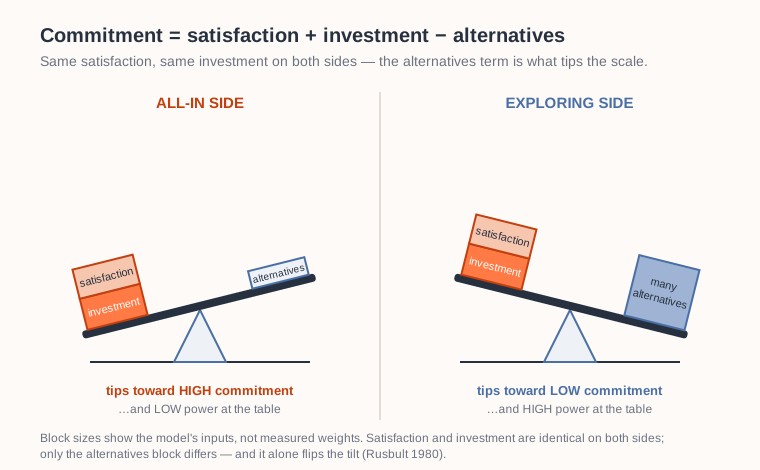
The same equation, two results. Satisfaction can be identical on both sides; the alternatives term is what splits them. High investment and thin alternatives pin the all-in side; many alternatives de-commit the exploring side and hand them the power. Schematic of the mechanism, not measured values.
Investment does not only bind you, it traps you
There is a second-order effect hiding in the investment term, and it is the one that hurts. Investment raises commitment by raising exit costs. The more you have put in, the more it costs to leave, so the more committed you are, so the more you are willing to invest. It is the same machinery as sunk-cost escalation, running in a relationship instead of a budget [3].
That loop is why the all-in side keeps getting more all-in over time, often without deciding to. Each custom demo, each turned-down alternative, each exclusive week makes the next investment feel more justified, because look how much is already riding on it. The asymmetry deepens on its own. The exploring side, meanwhile, has invested little, so their exit stays cheap and their commitment stays low. Left alone, the gap widens rather than closing.
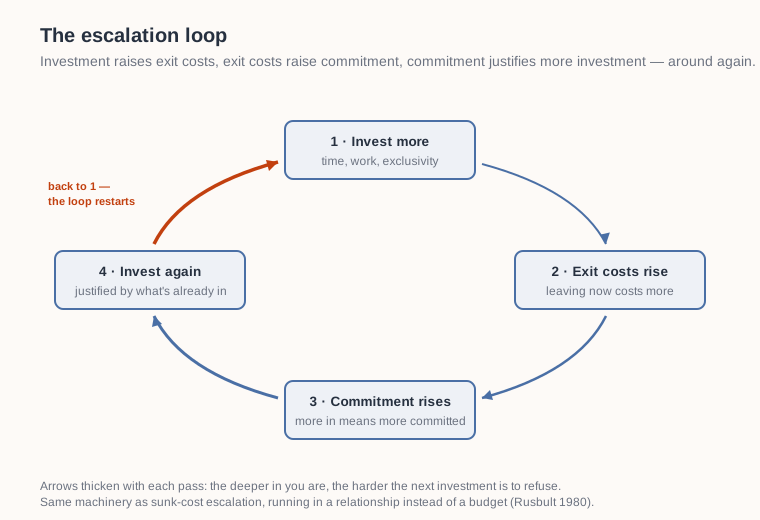
The escalation loop, running clockwise and back to the start. Investment raises exit costs, which raise commitment, which justifies more investment. The all-in side deepens on autopilot unless a cap is set in advance.
Asymmetric commitment is common, and the more-committed side pays for it
If Waller and Rusbult explain the mechanism, Scott Stanley and colleagues document how ordinary it is. Studying unmarried couples, they find substantial shares where one partner is a “strong link” and the other a “weak link,” committed at visibly different levels [6]. Their consistent finding is that the strong link carries more risk, tolerates more, and negotiates worse [7]. The person who is more in is the person who accepts the worse terms, avoids raising hard issues, and stays longer than the situation warrants.
Two honesty flags on this one. It is correlational and self-reported, couples describing their own commitment, so read it as a strong pattern rather than a proven law. And I am borrowing findings about romantic couples to talk about hiring and vendors, which is an analogy, not a demonstration; the equation transfers cleanly, the specific percentages do not. What the research earns is the shape: asymmetric commitment is normal, it is not a rare pathology, and the cost of it lands disproportionately on the committed side.
The fix has a name too
Negotiation theory names the practical translation of Rusbult’s third term. In their work on principled negotiation, Roger Fisher and William Ury argued that your power in any negotiation tracks the quality of your best alternative to a negotiated agreement, which they called your BATNA [8]. That is Rusbult’s “quality of alternatives,” pointed at a bargaining table — the same third term, rediscovered by a different field, and the term the first half of the playbook below hangs on.
I want to be careful here, because this is where the post could slide into negotiation-tactics content and it should not. The BATNA idea earns exactly one job in this piece: it confirms, from an entirely separate field, that the lever is real alternatives, not projected ones. What you do with that at a bargaining table is a different post by different authors. Here it is a grounding, not a how-to.
The playbook
Enough mechanism. Here is what to actually do on each side. As in the earlier parts, notice how the two sides carry different loads, and how cleanly the moves transfer from the conference room to the kitchen table.
If you’re the all-in side
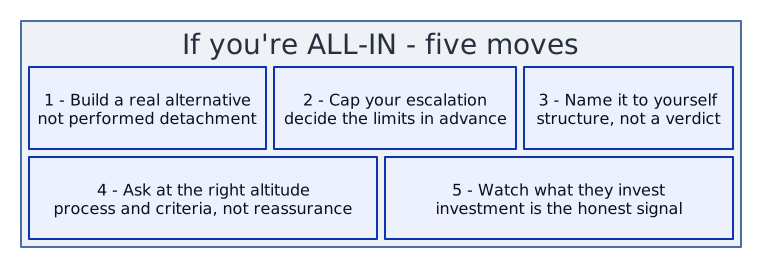
The all-in side’s five moves. Not one of them is ‘play it cool.’ They are ways to change the equation and read the table honestly, rather than perform a detachment you do not feel.
1 · Build a real alternative, do not perform detachment
This is the whole game, and it follows straight from the equation. Feigned coolness leaves your alternatives term at zero; it only hides the number, and people can usually tell it is hidden. One genuine additional option changes your actual psychology, your actual bargaining position, and, as a side effect, how you come across, because the calm of someone with alternatives is real and legible in a way that performed calm is not. Start the second conversation. Keep the pipeline warm. The move is not to want it less. It is to arrange your life so that this is not the only door.
2 · Cap your escalation in advance
The investment loop will keep ratcheting you up in-flight, so make the decision before you are in-flight. Decide the limits ahead of time: two custom demos and then a decision point, one more round of interviews and then I ask directly, this much exclusive effort and no more without reciprocation. A cap set in advance is immune to the sunk-cost pull that a cap set in the moment is not, because in the moment the whole point of the loop is that continuing feels justified by what you have already put in.
3 · Name the asymmetry to yourself, not always to them
“They have five options and I have one” is a structural fact to plan around, not a verdict to feel and certainly not usually a thing to announce. Said to yourself, it is clarifying: it explains the power gap without making it about your worth. Said to them, it often just advertises your weak alternatives term and invites exactly the exploitation you are worried about. Keep the diagnosis private and let it guide the moves; do not turn it into a confession.
4 · Ask the commitment question at the right altitude
You can surface where you stand without begging. “Where are we in your process, and what would make this your first choice?” asks for information you are entitled to and signals seriousness without signaling desperation. Compare that to the escalating “do you understand how much this means to me,” which pushes intensity and, as the least-interest research predicts, tends to make the less-committed side pull back rather than lean in. Ask about the process and the criteria, not for reassurance.
5 · Watch what they invest, not what they say
Words are cheap on the exploring side, and warm words cost them nothing. Investment is the honest signal, on both sides of any table. Their time, their specificity, whether they are advocating for you internally, whether they are turning down their alternatives, all of that is real commitment data in a way that “we’re really excited about you” is not. Read the investment. If the words are warm and the investment is thin, believe the investment.
If you’re the exploring side
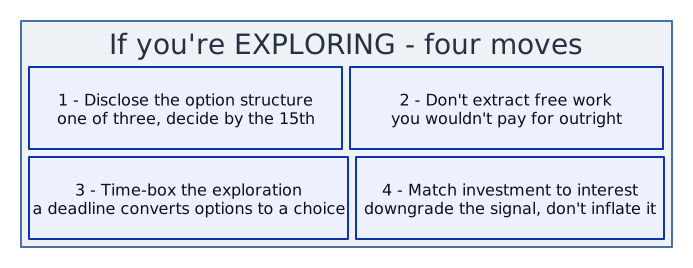
The exploring side’s four moves. Optionality is legitimate; these are the ethics of holding it. Most of them cost almost nothing and protect the relationship with whichever option you eventually choose.
1 · Be honest about the option structure
“You are one of three we are seriously considering, and we will decide by the fifteenth” costs you almost nothing and gives the all-in side something real to plan around. It lets them calibrate their own investment, and it preserves the relationship with whichever options you do not pick, which matters more than it seems, because the person you turn down this year is the person you call next year. Disclosure is the cheapest trust-preserving move available to the side with power, and it is the one most often skipped.
2 · Do not extract what you would not pay for
This is the ethical center of the exploring side, and it is where least-interest power quietly gets abused. Using an all-in party’s free work, their spec work, their trial commitment, their exclusivity, while you stay uncommitted, is taking something you would not buy outright simply because your position lets you. It is also reputationally expensive in any world where people talk to each other. If you would not pay for the two-day solution architecture, do not let the vendor give it to you on the theory that they might win the deal.
3 · Time-box the exploration
Open-ended optionality is unfair to committed counterparts, and it quietly decays your own ability to choose. The buyer who never buys and the person who always keeps one more tab open are running the same failure: a habit of optionality that has hardened into an inability to commit, because a better alternative is always conceivable. A deadline converts options into a decision. Set one, tell people what it is, and honor it. It is a gift to the other side and a discipline for you.
4 · Match your investment to your real interest
If you are not willing to invest reciprocally, downgrade the signal you are sending, do not inflate it. Letting someone stay all-in on warmth you do not mean is the false-hope failure, and it is the same dishonesty as keeping a candidate warm you have already ruled out. The honest move is to make your signal track your actual interest: invest where you mean it, cool the signal where you do not, and let the other side make an informed decision with their own alternatives while there is still time to use them.
The same asymmetry, off the clock
Everything above was framed for work, because that is where commitment asymmetry wears a lanyard. But swap the nouns and the two lists describe private life just as well, and one version of it is common enough to name directly.

The one who always sends the first message. No contract, no negotiation — just the quiet arithmetic of who invests, running under a friendship.
Dating apps industrialized the asymmetry, and the strong-and-weak-link research is the backbone of the felt experience: the side that is more in tolerates more, risks more, and reads the routine silence as a verdict. The move is the same as everywhere else, and it is not to care less. It is to keep more than one real conversation alive, not as a game but because a single option carries a desperate intensity that a genuine set of options simply does not, and that intensity is itself the thing that reads badly.
Friendships run it too. The one who always initiates is the strong link, and the fix is not to sulk or to stop cold. It is to widen the circle so no single friendship carries all your social investment, and to match your initiating to what comes back over time, rather than escalating into the silence. The relative who is always the one to call, the friend cast as the reliable planner, these are commitment asymmetries with no contract attached, and the equation still explains them.
The healthy end state, at every table, is worth being precise about, because it is not symmetric indifference and it is not two people performing detachment at each other. It is chosen commitment: both sides having real alternatives and picking each other anyway. Commitment without alternatives is dependence. Commitment with alternatives is a decision. The goal was never to stop wanting the thing. It was to want it from a position where wanting it is a choice you made, not a corner you got backed into.
The one line to keep
If you remember nothing else, remember the shape, because it holds at every table:
Commitment is satisfaction plus investment minus alternatives, so whoever has more options holds the power, and the fix is not performed coolness but real alternatives. The all-in side builds a genuine second option, caps its escalation in advance, and reads what the other side invests rather than what it says. The exploring side owes honesty for the power it holds: disclose the options, time-box the choice, and never extract what you would not pay for.
That is the whole thing. Everything else is the evidence for why it works, and the naming that lets you reach for the right move when you are the one standing at the table with a single option and a lot riding on it.
This is the fifth entry in the asymmetry series, moments where two people share a table and live in different worlds. Part 1 was the wait, Part 2 was magnitude, Part 4 was information, and this was commitment. There are more I keep bumping into, but I am not committing to a syllabus. The lens keeps earning its keep, which is about as much as I promise any framework.
For now I would rather hear from you, from whichever side you are usually on. If you are often the all-in one: what actually rebalanced a table for you, and was it a real alternative or something else? And if you are often the one holding the options: what is your rule for holding them honestly, the line you will not cross even though your position would let you? Put it in the comments. Someone reading this is all-in on a single option right now, misreading the structure as a verdict, and would take the help.
Sources
[1] Principle of least interest — Willard Waller (1938), overview
[2] The principle of least interest applied to business relationships (Husson University)
[4] Rusbult — A longitudinal test of the investment model (1983, PDF)
[5] Rusbult, Martz & Agnew — The Investment Model Scale (1998, PDF)
[7] Stanley — What happens when partners aren’t equally committed (Psychology Today)
About the Author
Stefan Christoph is a Principal Solutions Architect at AWS, focused on agentic AI, media & entertainment, and helping builders move from demo to production. He writes about AI architecture, developer productivity, and the future of software.
This is a personal blog. Opinions expressed here are my own and do not represent the views or positions of my employer.
🎬 Also available as a blog walkthrough video on YouTube
❤️ Created with the support of AI (Kiro)