The Iceberg Problem
 written by Stefan Christoph
A note on where this comes from: I’m not a psychologist or an organizational researcher. I read the papers because I keep watching good work go uncredited — mine, other people’s, work at the office and work at home — and I wanted to understand the mechanism instead of just being annoyed by it. Every study I lean on is cited at the bottom. Where the evidence is thin or self-reported, I say so. And the “90% is invisible” figure I use is a picture, not a measurement — nobody has weighed an iceberg of labor. The direction is what’s real.
Four icebergs
Picture four people, each being judged by the small part of their work that happens to show.
The first keeps a system running. For three years nothing has broken on her watch — no outages, no data loss, no 3 a.m. escalations — because she spends her weeks on the unglamorous maintenance that prevents all of that: patching the thing before it fails, rewriting the fragile job before it falls over, noticing the disk filling up a month early. Her review says “impact unclear.” There is no incident to point at, because she is the reason there was no incident. The best possible version of her job produces no evidence that she did it.
The second is the reason her team ships. She’s the one who notices two people are about to build the same thing twice and quietly connects them, who writes the doc nobody asked for that saves everyone a week, who unblocks the new hire before the new hire even knows they’re blocked, who takes the notes and tracks the follow-ups. At promotion time her manager struggles to name a single thing that was hers — because all of it turned into somebody else’s shipped feature. The team’s output is her output, wearing other people’s names.
The third does excellent work from two hundred miles away. His code is clean, his written updates are sharp, his decisions hold up. But he is never in the corridor, never visibly at his desk when the skip-level walks past, never the face that comes to mind in the hallway conversation where names get floated. A colleague of merely average output, but reliably present, reads as “dependable” and “committed” — and nobody in that conversation is being malicious. They’re just going on what they can see, and they can’t see him.
And the fourth isn’t at work at all. In a shared home, one person carries what sociologists call the mental load: remembering that the prescription needs refilling before it runs out, that the school form is due Thursday, that the relative’s birthday is next week, that the thing in the fridge is about to turn. None of it is visible. The visible chore — the dishes, the bins — gets the nod of acknowledgment. The invisible orchestration that decided which chores needed doing, and when, and made sure the household never hit a wall, gets none, because there is no wall to point at. Prevention, again, with no counterfactual.
Four icebergs. In each one, someone is being judged by the tip — the shipped artifact, the visible presence, the done chore — while the mass that made the tip possible sits below the waterline where no evaluator can see it. And here is the part that makes it a genuine problem and not just an injustice to be scolded away: the judge is usually not lazy, biased, or cruel. They cannot see the submerged part. It is, by construction, invisible. What can change is not the judge’s character. It’s the indicators — what surfaces above the water, and how the judge reads what’s missing.
That shape has a name, and it’s the sixth one in this series.
The asymmetry, again
I’ve been collecting situations where two people stand in the same room and live in different worlds. The waiting one was about timeline and information — the specific misery of “we’ll call you.” The stakes one was about magnitude — your life event is someone else’s routine Tuesday. The most recent one was about who has more to lose when things go quiet. This one is about visibility: the gap between the effort you spend and the effort anyone can see.
It’s the same lens, pointed at a different asymmetry. On one side stands the person whose work is legible — it produces artifacts, or happens where it can be seen. On the other stands the person whose work is submerged — prevention, coordination, maintenance, the mental orchestration that only shows up when it stops. Both are working hard. Only one of them is generating evidence of it. And evaluation, being an evidence-driven process, quietly rewards the one who leaves a trail.
The uncomfortable twist — the thing that turns a sad structural fact into an active trap — is that the trail can be manufactured independently of the work. You can display effort you didn’t need to spend, and be rewarded for the display. Which means, left alone, the system doesn’t just fail to see quiet competence. It actively favors loud effort over quiet results. To see why, we have to go to the research, because this is one of those cases where the studies are sharper and stranger than intuition.
Two sides of the same table
As in the earlier parts, the two people here have completely different problems, and a fix for one is not a fix for the other. So let me take them one at a time before the evidence.
The person whose work is invisible
Your driver is that the work is real and it matters and you can feel it not landing. You are not imagining the gap. You did prevent the outage; you did unblock the team; you did carry the household. The frustration is accurate.
Your problem is that you’re tempted to solve a visibility problem with more work. If the good work isn’t being seen, the instinct is to do more good work — which, if it’s the same invisible kind, produces exactly as little evidence as before, and now you’re also more tired. The other instinct is worse: to start performing effort, to be seen struggling, to make the easy thing look hard so it reads as substantial. That way lies theater, and theater corrodes the actual work.
Your failure mode, then, is either silent martyrdom (do more, say nothing, wait to be noticed) or its ugly cousin, performance (make noise proportional to how unseen you feel). Neither makes the real work legible. The move you need is narrower and harder: make the outcomes of the invisible work visible, without faking the effort behind it.
The person doing the judging
Your driver is that you have to evaluate people and you can only evaluate what you can observe. This is not a character flaw; it’s the job. You are trying to be fair, and “fair” for you means “based on evidence,” and evidence is exactly what the invisible worker doesn’t generate.
Your problem is that your indicator system has blind spots you can’t see because they’re blind spots. The person whose whole value is prevention shows up in your data as someone with no incidents, no crises, no visible firefighting — which, read naively, looks like someone with not much going on. The absence of drama reads as an absence of contribution. And the person who’s simply around a lot reads as committed, because presence is easy to see and you’re wired to draw inferences from it.
Your failure mode is trusting the indicators as if they were the territory. You reward the visible fire-fighter over the invisible fire-preventer, because one generates a story and the other generates silence. You read a remote worker’s lack of corridor presence as a lack of engagement. You call an elegant, effortless-looking solution “a small thing,” because it doesn’t look like it cost anything. Each of these feels like sober, evidence-based judgment. Each is the indicator system’s blind spot talking.
What connects the two sides is a single question of translation: can the invisible worker make their outcomes legible without resorting to theater, and can the judge learn to see the shape of what’s missing? To answer either, we have to go to the research. This is the long middle of the post, and it’s the why behind every move in the playbook; if you only want the what, jump ahead — the playbook will be waiting.
What the research actually says
The usual caveat first, because it governs how much weight any of this carries. Almost all of this work is correlational, observational, or self-reported — people rating their own effort, professionals surveyed, a few clever experiments. It’s real signal, but it’s a map, not a machine. The mechanisms are solid enough to plan around; the exact magnitudes are softer than clean prose makes them sound. One honesty flag specific to this post: the iceberg proportion — “90% invisible” — is a rhetorical picture, not a measured quantity. What’s measured is the direction, and the direction is unambiguous.
Visibility is negotiated, not natural
The foundational insight comes from Susan Leigh Star and Anselm Strauss, who studied how work becomes visible or invisible in organizations. Their central claim is deceptively simple: “no work is inherently either visible or invisible” — we only ever “see” work through a selection of indicators [1]. Visibility is not a property of the work itself. It’s a property of the indicator system that happens to be pointed at it. Change what you count, and previously invisible work appears; keep counting the same things, and whole categories stay dark forever.
This is the load-bearing idea for everything that follows, because it moves the problem off the worker’s character and onto the measurement system. The maintainer isn’t invisible because she’s quiet. She’s invisible because the indicator system counts incidents, and her job is to produce their absence. The glue worker isn’t invisible because she’s modest. She’s invisible because the system counts shipped artifacts, and her contribution dissolves into other people’s artifacts. The work didn’t hide. The instruments just aren’t built to register it.
Some work is defined as not-work
Barbara Daniels gave the whole field its founding concept. Writing about unpaid domestic labor, she defined invisible work as labor that is “neither defined nor recognized as work” — not merely unseen but categorized, culturally, as not counting [2]. Later work by Erin Hatton extended the mechanism, identifying how invisibility gets produced through cultural, legal, and spatial means — the work is out of sight, or out of the category “real work,” or out of the place where credit is assigned [3].
I’ll be honest about the uncomfortable edge here, because the research is: this invisibility has never been evenly distributed. Daniels was writing specifically about the gendered division of domestic labor, and the practitioner literature on workplace glue (which we’ll get to) keeps finding the same pattern about who gets asked to take the notes and organize the offsite. I’m not going to turn this post into a polemic — the mechanism is the subject, and the mechanism harms whoever it lands on — but pretending the distribution is random would be its own kind of dishonesty. The work that loses visibility tends to land on the same shoulders.
The labor illusion: we pay for shown work
Now the strange one, and the villain of this piece. Ryan Buell and Michael Norton ran experiments on what they named the “labor illusion” — and found that people value the same result more when they can see the effort that produced it [4]. In their studies, users of a travel-search site rated results as better when the site visibly “worked” for them — showing it searching through airlines — than when it returned identical results instantly. People preferred the slower service, because the slower one displayed its labor.

What gets measured, and what holds it up. The evaluator sees the polished result on the pedestal; the machinery that produced it sits below the sightline — and the cleaner the result, the less of that machinery anyone thinks to look for.
Sit with what that does to our four icebergs. If judgment of work tracks displayed effort rather than delivered value, then the person who makes hard things look easy is penalized for their competence, and the person who makes easy things look hard is rewarded for the performance. The labor illusion is the mechanism that lets effort theater beat quiet competence — not because judges are fooled fools, but because the preference for visible effort appears to be wired in. Follow-up work extended the finding to government services, where showing citizens the work behind a service raised their satisfaction and trust [5]. The effect holds up across their studies, and it is exactly backwards from what a fair evaluator would want.
There’s a corollary that hurts the invisible worker twice. Call it the inverse labor illusion: competence hides itself. As you get better at something, your output displays less visible struggle, not more. The expert’s clean solution reads as a small task precisely because the expertise removed all the thrashing that would have signaled difficulty. Skill erases its own evidence. So the labor illusion punishes you for being good, and then getting better makes it worse.
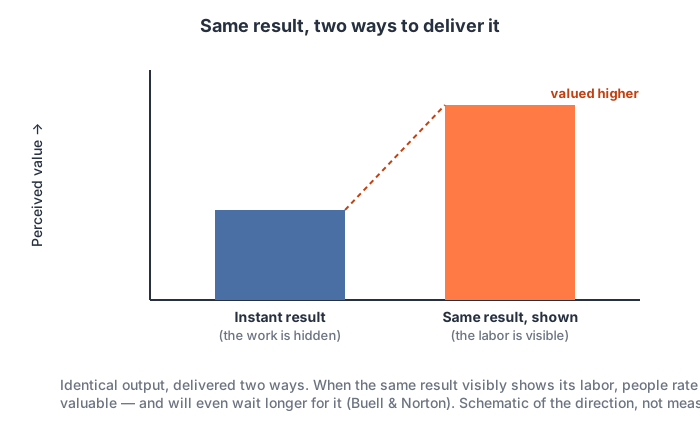
The labor illusion, schematically. Same result, delivered two ways. When the work is hidden, perceived value is lower; when the same result visibly shows its labor, perceived value rises — even when people wait longer for it. Schematic of the effect’s direction, not measured values.
Prevention has no counterfactual
This one isn’t a single paper so much as the logical shape underneath the maintainer’s problem, and it’s worth naming plainly. The value of prevention is measured against a disaster that didn’t happen — and a disaster that didn’t happen generates no data. The outage you stopped, the conflict you defused in a hallway before it reached email, the risk you caught in review, the bug that never shipped: the best possible outcomes produce zero indicators, because their entire nature is the absence of an event. You cannot point at nothing and say “I made that.” The better you are at prevention, the less there is to show, until your reward for a perfect record is a review that says “impact unclear.”
Passive face time: seen equals trusted
Kimberly Elsbach and colleagues studied what they called “passive face time” — simply being seen at work, with no information whatsoever about what you’re actually doing. The finding is stark: mere presence produces trait inferences. Being seen at your desk during normal hours led observers to judge someone as “dependable”; being seen there after hours led to “committed” [6]. No performance information was involved. The observers weren’t evaluating output — there was no output to evaluate — they were converting presence directly into character, spontaneously and unconsciously.
This is the mechanism that penalizes remote and async workers without anyone deciding to. Nobody in the calibration room says “let’s mark down the remote guy.” They simply have less passive face time to draw on for him, so fewer of these automatic “dependable/committed” inferences attach to his name, while his co-located peers accumulate them just by being visible. To stay with that example: the remote worker isn’t losing on output. He’s losing on a channel — presence — that he structurally cannot access, and that his evaluators don’t even know they’re using.
Glue work: vital, and career-invisible when unnamed
The practitioner layer, which I’ll cite as exactly that — Tanya Reilly’s talk and essay Being Glue — names the workplace version of all this [7]. Glue work is the coordination, unblocking, documentation, and mentoring that makes a team function. It’s genuinely valuable; teams fall apart without it. And it’s invisible at promotion time precisely because, when it works, nothing visibly happens — the project just… goes smoothly, and the smoothness gets attributed to everyone who shipped a visible piece. Reilly’s diagnosis is the sharpest in this literature — unnamed glue is credited to no one — and it anchors the glue worker’s move in the playbook below.
Put the five together and you get the full machine. Visibility is a negotiated indicator system (Star & Strauss), so some work is structurally invisible (Daniels, Hatton). We’re wired to reward displayed effort over delivered value (Buell & Norton), and to convert mere presence into trust (Elsbach). And the most valuable work of all — prevention — is the least visible, because its success is an absence. No wonder the quiet competent lose to the visibly busy. The surprising thing isn’t that it happens. It’s that it happens even when everyone involved is acting in good faith.
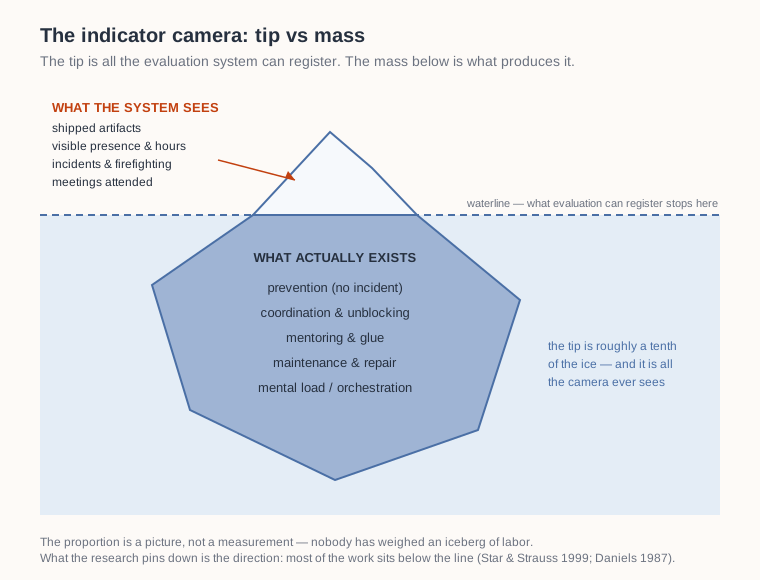
The indicator camera. Everything above the waterline is what the evaluation system can register; the mass below is what produces it. The proportion is the argument — and the most valuable work sits entirely below the line, where no camera points. Schematic of the asymmetry, not measured data.
The playbook
Enough mechanism. Here’s what to actually do on each side. As in the earlier parts, the two sides carry different loads — and, as always, the moves transfer straight from the office to the kitchen table.
A word on the spirit of the invisible-worker playbook before the moves, because it’s easy to misread. None of this is “learn to self-promote.” The labor illusion is precisely the bias that self-promotion exploits, and leaning into it is how you get an office full of people performing busyness. Every move below is about making real outcomes legible, not about displaying effort. The test for each one is: would this still be honest if the work behind it were trivial? If a move only works by making easy things look hard, it’s theater, and it’s out.
If your work is invisible
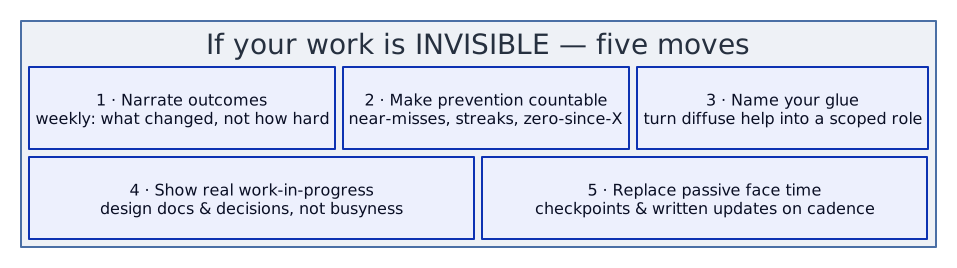
The invisible worker’s five moves. None of them is ‘work louder.’ Each converts real, submerged work into an honest indicator the evaluation system can actually register.
1 · Narrate outcomes, not busyness
Keep a running record of what changed because of your work, and surface it on a predictable cadence — a weekly three-bullet note of decisions unblocked, risks retired, people enabled. Not “here’s how hard I worked this week,” which is theater, but “here’s what is different in the world because I was here.” This converts invisible work into indicators without performing any effort, because it reports results, not struggle. It also gives your manager the raw material they need at review time, when their memory of six months ago is exactly as blank as yours would be.
2 · Make prevention countable
Prevention has no counterfactual, so build one. Track near-misses caught, review findings that stopped a bad merge, incidents avoided by class: “this category of outage — zero since we hardened it in March.” A denominator turns an absence into a number. You can’t point at the outage that didn’t happen, but you can point at “eighteen months, zero incidents in this system, here’s the maintenance that bought that.” The maintainer from the opening — to stay with that example — doesn’t need a crisis to prove her worth; she needs the streak itself framed as the achievement it is.
3 · Name your glue, and give it a boundary
This is Reilly’s advice, and it’s the single most useful move for the glue worker. Diffuse helpfulness is credited to no one; a named role is credited to you. “I’m running release coordination this quarter” turns a hundred invisible unblockings into one legible thing with your name on it. The boundary matters as much as the name: unbounded glue expands to fill all available time and still stays invisible. Name it, scope it, put it in your goals. And if it genuinely won’t be recognized no matter what, stop doing it invisibly, because silent glue just quietly subsidizes everyone else’s visible work at the cost of your own.
4 · Show the real work-in-progress
The labor illusion is not automatically evil — it’s only corrosive when the displayed effort is fake. Applied honestly, it’s just transparency: share the design doc, the decision log, the reasoning behind the choice, not as a performance of busyness but because the thinking is the work and it’s usually invisible. When you show real work-in-progress, you’re not manufacturing an illusion of labor; you’re making genuine labor legible. The line is bright: display work you actually did, never effort you didn’t need to spend.
5 · Replace passive face time deliberately
If you’re remote or async, you’ve lost a channel — presence — that your co-located peers get for free. The answer isn’t to fake presence (logging in performatively at odd hours is theater, and it’s exhausting). It’s to substitute a better indicator on a predictable schedule: visible checkpoints, short demos, written updates at a cadence people can rely on. This isn’t politics and it isn’t self-promotion. It’s replacing a lost signal channel with an honest one — and a crisp written update is, frankly, more informative than being spotted in a corridor ever was.
If you’re the one doing the judging
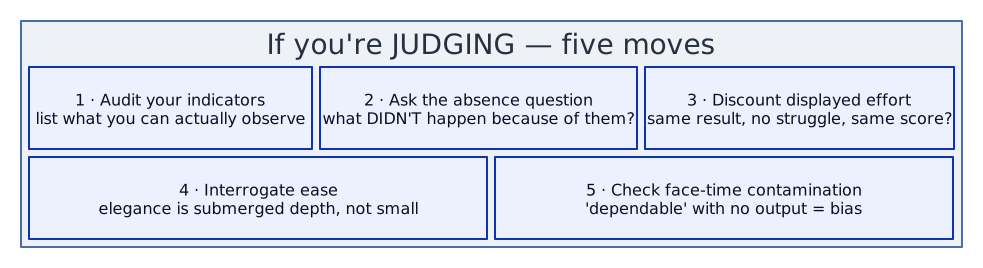
The judging side’s five moves. Most of them are about correcting for what your indicator system structurally cannot see — especially prevention, coordination, and the people who work where you can’t watch them.
1 · Audit your indicator system
Start by listing, honestly, what you can actually observe about each person you evaluate. For most roles the list is short: artifacts they shipped, meetings they were visible in, incidents they were involved in, hours they were seen. Now notice: if someone’s entire value is prevention or coordination, every item on that list is structurally blind to them. The audit isn’t a nice-to-have; it’s the only way to discover that your instruments can’t see half your team. Once you know where the blind spots are, you can go looking for the work deliberately instead of trusting a system that was never built to register it.
2 · Ask the absence question
Put one question into every calibration: “What didn’t happen because of this person?” It forces the counterfactual into the room, which is the only place prevention work can ever show up. The outage that didn’t occur, the conflict that never escalated, the new hire who ramped without friction — none of these have indicators, but all of them have a cause, and the cause is often the person your data says had a quiet quarter. The absence question is the single most effective correction a judge can make, because it directly targets the most valuable and least visible category of work.
3 · Discount displayed effort
Treat the labor illusion as a known bias and correct for it, the way you’d correct for any other. When you notice yourself impressed by how hard someone visibly worked, ask the control question: “Same result, no visible effort — same rating?” If the answer changes, you were rating the theater, not the outcome. Delivered value and displayed struggle are different axes, and a good evaluation tracks the first. The person who solved it in an afternoon without drama may have done the more impressive thing precisely because there was no drama.
4 · Interrogate ease
When something looks easy, that is data, not a verdict of triviality — and usually it points the opposite way. Elegance is often the visible signature of submerged depth: the clean solution looks small because expertise removed everything that would have made it look big. So when work reads as effortless, ask what made it effortless. Treat a suspiciously simple result as a flag to look harder, not a reason to score lower. The inverse labor illusion means your most skilled people will consistently be the ones whose work looks like it cost the least.
5 · Check for face-time contamination
Watch for Elsbach’s trait words in your own judgments. When “dependable” or “committed” show up in your assessment of someone — especially a remote or async worker — ask what behavioral evidence backs them. If the honest answer is “they’re around a lot” or “I see them online,” that’s not evidence; that’s passive face time converting presence into character. The correction is to demand output-based grounding for every trait inference: not “seems committed” but “here is what they delivered.” Presence is the easiest signal to see and one of the least informative, and it systematically advantages whoever happens to be in your line of sight.
The same iceberg, off the clock
Everything above wore a lanyard, because that’s where visibility gets formally scored. But swap the nouns and the two lists describe home life exactly, and the home version is where the asymmetry is oldest and most studied.

The mental load, mid-orchestration. Its whole output is that nothing ever hits a wall — which is exactly why none of it shows up on the visible-chore ledger.
The household mental load is the founding case — it’s literally what Daniels was writing about. The planning, the remembering, the anticipating, the running mental list of what the household needs and when: it’s invisible work par excellence, because its whole output is that nothing ever hits a wall. The visible chores get the acknowledgment; the invisible orchestration that decided which chores mattered gets none, for the same reason the maintainer’s review says “impact unclear.” Prevention with no counterfactual, at the kitchen table.
The moves transfer directly. Name the invisible work out loud, in both directions — not as an accusation but as a legibility fix (“here’s the mental list I’m carrying” is move 3, and “what are you actually keeping track of that I’m not seeing?” is the absence question). Make prevention visible: “the thing that never runs out doesn’t run out because someone’s tracking it.” And on the judging side of the relationship — because we all do this — ask the absence question about your partner’s contribution before you assess “who does more,” because the person doing the invisible orchestration will always look, on the visible-chore ledger, like they’re doing less.
Friendship has its own version. The friend who organizes the gathering, remembers the birthdays, checks in when someone goes quiet, keeps the group actually connected — that’s glue work, unnamed and uncredited, and it becomes visible almost exclusively when the person stops. The group notices the coordination only in its absence, which is the maintainer’s problem in a different costume. If someone plays that role in your life, the move is small and free: name it to them, out loud, once. It’s the one form of credit that costs nothing and lands more than almost anything else, precisely because they’ve never once been seen doing it.
And the reverse is worth holding, because most of us are the judge in some room without noticing. Somewhere, your routine is somebody’s iceberg — the process you run without thinking, the fix that’s second nature to you, is the thing they can’t see the mass beneath. The calibration question is one sentence, and it beats every assumption: “What am I not seeing here?” You don’t have to guess what’s below the waterline. You can just ask, and then act like the answer is real.
The one line to keep
If you remember nothing else, remember the shape, because it holds at every table:
You are judged by the tip of the iceberg — the work that shows — and most work doesn’t show. So on the visible side, the fix isn’t to work louder; it’s honest legibility: narrate outcomes, make prevention countable, name your glue, and never fake the effort. And on the judging side, the fix isn’t to try harder to be fair; it’s to distrust your own indicators — audit what you can actually see, ask what didn’t happen because of this person, and treat effortless-looking work as a sign of depth, not of triviality.
That’s the whole thing. Everything else is the evidence for why the tip is all you can see, and the naming that lets you reach for the right move when you’re the one below the waterline — or the one holding the camera.
This is the sixth entry in the asymmetry series — moments where two people share a situation and live in different worlds. The waiting one was timeline and information; the stakes one was magnitude; the commitment one was who has more to lose. This one was visibility. There are more I keep bumping into — feedback, knowledge, attention — and the lens keeps earning its keep. I’m not committing to a syllabus, but I’m not done looking either.
For now I’d rather hear from you, from whichever side you’re usually on. If your best work is invisible: what’s the one honest move that made it legible — the framing, the record, the named role that finally got it seen without turning into performance? And if you evaluate people: what’s the question you ask to find the work your indicators can’t see? Put it in the comments. Someone reading this is being judged by their tip right now, doing brilliant work below the waterline, and would take the help.
Sources
[2] Arlene Kaplan Daniels — Invisible Work (Social Problems, 1987)
[3] Erin Hatton — Mechanisms of Invisibility: Rethinking the Concept of Invisible Work (2017)
[6] Elsbach, Cable & Sherman — Passive Face Time and Perceptions of Dependability and Commitment (2010)
About the Author
Stefan Christoph is a Principal Solutions Architect at AWS, focused on agentic AI, media & entertainment, and helping builders move from demo to production. He writes about AI architecture, developer productivity, and the future of software.
This is a personal blog. Opinions expressed here are my own and do not represent the views or positions of my employer.
🎬 Also available as a blog walkthrough video on YouTube
❤️ Created with the support of AI (Kiro)