The Feedback Exchange Rate
 written by Stefan Christoph
TL;DR: Feedback runs on a hidden exchange rate. The giver spends five minutes on a remark and moves on; the receiver spends three weeks re-reading it, because bad lands heavier than good and the mind won’t put a critical comment down. That’s the first asymmetry, of impact. The second is flow: honest signal barely travels upward, because saying the hard thing feels dangerous to the person who has to say it, so each layer of a hierarchy softens the message until leaders hear a rosier version than reality. The third is time: the round trip is nearly free for the reviewer and expensive for the author, who pays it twice — in work that produces nothing while it waits, and in the context they have to rebuild before the comments can even be used. Stack them and you get a doubly regressive system: the people with the most power get the least accurate signal, and the people with the least power absorb the most feedback at the highest amplification. The research is clear that this is structure, not malice: negativity bias is threat-weighting (Baumeister), more than a third of feedback interventions actually make performance worse and the backfiring kind is aimed at the self rather than the task (Kluger & DeNisi), and people stay silent on untested rules they were never punished for breaking (the mum effect, implicit voice theories). So the fix is mechanics, not moralizing. Givers aim at the task, write at the weight they want received, and hunt the softening in what they’re told. Receivers re-weight consciously, convert self-signal back to task-signal, and read silence as filtered rather than as approval. This is Part 3 of a loose series on asymmetries. Most of the evidence is correlational and self-reported, so treat it as a well-lit map, not a law of physics.
A note on where this comes from: I’m not a psychologist. I read the research because I keep landing on both sides of this exchange — some weeks I’m the one whose offhand comment lodged in someone for a fortnight, some weeks I’m the one replaying a sentence at 2am. Every study I lean on is cited at the bottom. Where the evidence is thin or self-reported, I say so. One specific honesty flag for this post: the “exchange rate,” and any number I attach to it, is an illustration, not a measured constant. Nobody has shown that criticism lands at exactly four times its intended weight. What has been shown is the direction, and the direction is not in doubt.
Five conversations, three asymmetries
Picture five scenes.
It’s the reviewer’s morning. She writes a line on a document she’s marking up: “this section needs a clearer argument, the data doesn’t support the claim yet.” It’s accurate, it’s meant kindly, and it takes her ninety seconds. She writes eleven more comments like it, closes the file, and by lunch she genuinely could not tell you what she said in comment seven. For the person who wrote the document, comment seven is the one that plays on a loop. He reads it that evening, and again before bed, and the version he replays by 2am has grown teeth the original never had: the data doesn’t support the claim has become she thinks I can’t reason. Same fourteen words. Two completely different weights.
It’s the status meeting, climbing a building. On the ground floor, an engineer knows the truth: three blockers, none of them close to solved, the date is not going to hold. She tells her team lead, but softens it, because “we’re blocked and I don’t know the way out” is a hard thing to say out loud, so it comes out as “a couple of issues, working through them.” The team lead, who also doesn’t love delivering bad news, tells the department head “on track, some risks we’re managing.” The department head tells the executive “green.” Nobody lied, exactly. Each person just rounded toward comfortable. Four floors up, the person with the most authority to help is the one who has been told there’s nothing to help with.
It’s the founder who finds out too late. Two quarters after the warning signs were visible to half the company, someone finally says the thing everyone in the room already knew. The founder’s first reaction isn’t anger at the message. It’s the vertigo of realizing that the silence was the message, and she’d been reading it as calm.
It’s the document that comes back three weeks later. You sent the draft on a Tuesday, flagged it as blocking, and then moved on to something else because you had to. The reply lands on day twenty-two: four substantial comments, all fair, all worth making. And you sit there for twenty minutes reconstructing what you were even trying to do in section three — why you chose that structure, which alternative you’d already rejected and for what reason, the one thing you meant to check and never did. Writing the comments cost the reviewer a quarter of an hour. Acting on them will cost you most of an afternoon, and the larger part of that is rebuilding a context that was free three weeks ago.
And one that has nothing to do with work. Years ago, someone close to you said a single sharp thing — about your driving, your cooking, the way you handle money — and meant it as a passing irritation, forgotten by dinner. You have not forgotten it. It surfaces, unbidden, at odd moments, still carrying the sting it had the first time. Meanwhile the honest thing you have been meaning to say to them, the one that actually matters, has gone unsaid for months, because saying it has never felt safe enough.
Same exchange, five conversations — and the fifth one didn’t involve a job at all. In every scene, something small on one side arrives large on the other, or something true on one side never crosses to the other at all, or the crossing itself takes so long that it costs more than it’s worth by the time it lands. Those are the three asymmetries this post is about, and they compound. The remark that costs five minutes to give and weeks to absorb; the honest signal that can’t survive the trip upstairs; the round trip that freezes the work and makes the author rebuild everything before the answer can even be used. The first wounds people casually. The second starves the people in charge of the truth. The third quietly burns the thing everyone claims to be protecting, which is time. And they’re running at once, in the same rooms, through the same human wiring.
That wiring has a shape, and it’s the third one in this series.
The exchange rate
I’ve been collecting moments where two people stand at the same table and live in different worlds. Part 1 was about timeline and information: “we’ll call you,” and the specific misery of a wait you don’t control. Part 2 was about magnitude: your routine transaction is my life event. This one is about feedback, and it turns out to carry three asymmetries at once.
The first is impact. Giving feedback is an episode. You have a thought, you say it, you move to the next item, and the memory decays on schedule. Receiving it is a process. It doesn’t decay; it gets replayed, and the replaying reshapes it. The giver’s mental ledger records “I gave one small note.” The receiver’s felt ledger records something several times heavier. Neither is miscalibrated for themselves. They’re using different currencies, and there’s an exchange rate between them that neither party can see from their own side.
The second is flow. Feedback moves easily downhill and barely at all uphill. Downward feedback — manager to report, senior to junior, expert to novice — flows freely, and lands amplified by the impact asymmetry. Upward feedback is filtered toward zero, because the person who would have to deliver it finds a reason not to. Between the two people sits power distance, and power distance acts like a valve: open one way, nearly shut the other.
The third is time. Feedback has to make a round trip, and the trip is priced completely differently at each end. For the reviewer, a delay is close to free: the document sits in a queue, which is exactly where a busy person is supposed to put things. For the author, every day in that queue costs twice — the work isn’t moving, and the mental context they’d need to use the feedback is quietly draining away. This is the asymmetry that shows up in calendars rather than in feelings, which is precisely why it goes unnoticed.
Stack impact on flow and the system turns quietly perverse. The people with the most power get the least accurate signal, because everything reaching them has been softened on the way up. The people with the least power absorb the most feedback, at the highest amplification, because it flows toward them freely and lands heavy. The asymmetry is doubly regressive. It over-charges the powerless and under-informs the powerful, and it does both without anyone intending either.
Which is the first reframe, and it’s the same one that ran under Parts 1 and 2: most of the time, nobody is being cruel. The reviewer isn’t trying to wound. The engineer who softened the status isn’t a coward; she’s afraid, and the fear is doing exactly what fear does. The system produces bad outcomes out of ordinary, sympathetic human moves. So let me take the two sides one at a time, because — like the waiter and the decider, the volume side and the stakes side before them — they have completely different problems.
Two sides of the same remark
The giver
Your driver is that this costs you almost nothing, so you under-weight it by default. The remark is one item on your list. You said it, it’s handled, you’ve mentally filed it. You have no felt access to the fact that it’s now running on a loop in someone else’s head, because on your side there is no loop — the episode closed the moment you finished the sentence.
Your problem is twofold, and the two halves point in opposite directions. On the downward channel, you under-weight impact: you deliver a comment at the weight you feel it, not the weight it will land, and so a note you meant as minor arrives as a verdict. On the upward channel, you do the opposite — you over-weight the risk of speaking, so the honest thing goes unsaid or gets rounded toward comfortable. You wound casually going down, and you go quiet going up. Both feel reasonable from inside your own head.
Your failure mode going down is aiming at the person instead of the work, and leaving the loop open. “You’re not strategic enough” is aimed at the self, and the self can only replay it, not act on it. Your failure mode going up is the softening — the small, deniable rounding that feels like tact and functions like a lie by the time it’s been repeated four times up the chain.
The receiver
Your driver is proportion. This landed hard, it’s still landing, and you need to know what it actually means before you can put it down.
Your problem is that the replay isn’t neutral. Each time you return to the remark, the version you hold gets a little worse — more personal, more total, more permanent than the words that were actually said. You’re not remembering the feedback; you’re remembering your last, darkened memory of it. And separately, when the feedback you should be getting doesn’t arrive, you read the silence as approval, when it may just be the mum effect eating the signal before it reached you.
Your failure modes are two. One is absorption: taking a task-level comment as a self-level verdict, letting it grow in the dark, and paying interest on it for weeks. The other is misreading silence: treating “nobody said anything negative” as “everything’s fine,” when in an upward-filtered environment the absence of criticism is almost never evidence of its absence.
The thing that connects the two sides is a single problem of translation: can the giver send at the weight they want received, and can the receiver read what was said rather than what it grew into overnight — and read silence as filtered rather than as consent? To see why that’s hard, we have to go to the research. This is the long middle of the post, and it’s the why behind every move in the playbook; if you only want the what, jump ahead — the playbook will be waiting.
What the research actually says
The usual caveat, because it governs how much weight any of this bears. Almost all of this work is correlational and self-reported — people rating their own reactions, professionals surveyed about their reluctance, a meta-analysis of studies run many different ways. It’s real signal, but it’s a map, not a machine. The mechanisms are solid enough to plan around; the exact magnitudes are softer than tidy prose makes them sound. And the exchange-rate number — four, five, several — is the softest part of all. The negativity-bias literature supports “several-fold,” not a single canonical figure. Treat any specific multiplier in this post, including in the diagram below, as an illustration of a direction, not a measurement.
Bad is stronger than good
The foundational finding is Roy Baumeister and colleagues’ review, whose title is also its thesis: bad is stronger than good [1]. Across memory, impression formation, learning, and emotion, negative events are processed more deeply, remembered longer, and resist disconfirmation more stubbornly than positive events of equal size. A single piece of criticism outweighs a single compliment, and it isn’t close.
This is not a weakness to be corrected. It’s threat-weighting, and it’s adaptive: the ancestor who over-reacted to the rustle in the grass out-survived the one who savored the sunset. But it means the receiver’s felt ledger is running on evolutionary hardware that deliberately over-weights the negative. Expecting yourself — or your reports — to “just take feedback objectively” is asking a threat-detection system to behave like a spreadsheet. The reason a “balanced” review feels negative to the person receiving it is that balance, measured in raw counts, isn’t balanced at all once each side is weighted the way the brain actually weights it. The giver’s arithmetic and the receiver’s arithmetic disagree by design. That gap is the exchange rate.
More than a third of feedback makes things worse
Here’s the finding that should unsettle anyone who gives feedback for a living. Avraham Kluger and Angelo DeNisi’s landmark 1996 meta-analysis pulled together 607 effect sizes across more than 23,000 observations [2]. On average, feedback improved performance — but the average hid something alarming: in over a third of the cases, the feedback intervention made performance worse [2]. Not neutral. Worse than no feedback at all.
Their explanation is the part worth carrying. They called it Feedback Intervention Theory, and its core is about where the feedback points attention. Feedback that keeps attention on the task — “this argument needs data here” — tends to help. Feedback that pulls attention to the self — “you’re not a rigorous thinker” — tends to hurt, because it moves the person from working the problem to defending the ego, and a defended ego doesn’t learn [2]. The follow-up work sharpened the practical upshot: the same information can help or harm depending only on whether it lands as about the work or about the person [3].
This is the single most useful evidence-based finding in the whole field, and it maps straight onto the impact asymmetry. Self-directed feedback is exactly the kind the receiver replays, because you can’t act on “you’re not rigorous,” you can only be it or fear it. Task-directed feedback closes the loop by giving the receiver something to do. That one distinction powers the strongest move in the playbook below.
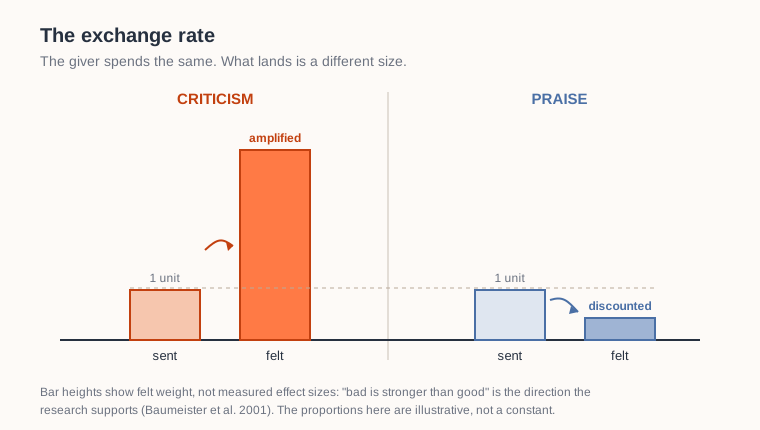
The exchange rate, illustrated. The giver spends the same either way (the two ‘sent’ bars are identical); what lands is a different size — criticism amplified, praise discounted. Bar heights show the direction the research supports, not a measured constant.
The mum effect: why bad news won’t climb
Now the flow side. In 1970, Sidney Rosen and Abraham Tesser ran a set of studies on a simple question: are people reluctant to pass on bad news? They were, reliably, even when the news wasn’t theirs and cost them nothing to relay. Rosen and Tesser named it the mum effect — the tendency to stay silent, soften, or delay when the message is negative [4].
The mechanism is about the giver’s discomfort, not the receiver’s fragility. Transmitting bad news feels self-endangering: you associate yourself with the badness, you brace for the reaction, you feel a low-grade guilt for being the bearer. So the message gets rounded toward comfortable [5]. And crucially, this compounds per hop. Each layer of a hierarchy applies its own small softening, so a message that started as “red, three blockers” arrives at the top as “green” — not through one big lie but through four honest roundings [5]. This isn’t folklore; it’s been documented directly in how software project status gets reported up the chain, where bad news reliably travels slower and lighter than good news [6].
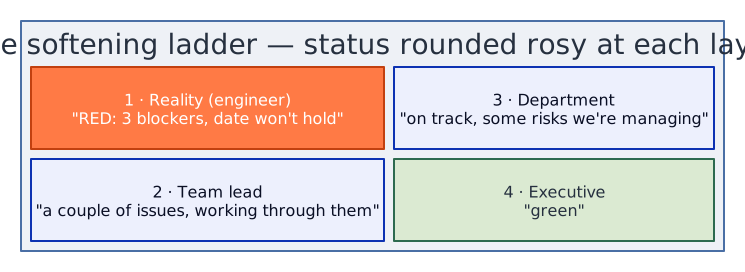
The softening ladder. The same status, rounded toward comfortable at each layer, arrives at the top unrecognizable. No single step is a lie — each is a small, deniable rounding.
Even people paid to fail people, don’t
If you think the mum effect is just a hierarchy problem, consider the people whose actual job is to deliver the hard verdict. In professional education — nursing, medicine, teaching — there’s a well-documented pattern called failure to fail: evaluators who have a clear duty to give a failing grade to an underperforming trainee, and don’t [7]. They pass people they shouldn’t, for the same reasons the engineer softened her status: the discomfort of the conversation, the fear of the fallout, the hope that it’ll come right on its own. When even a formal duty and a professional role don’t reliably overcome the reluctance, you learn how strong the reluctance is. The mum effect isn’t a lapse. It’s the default, and honesty is the thing that has to be actively built against it.
The silence is mostly preemptive
Why don’t people speak up, even when nothing bad has ever happened to them for doing so? James Detert and Amy Edmondson studied exactly this and found that workplace silence runs on implicit voice theories — taken-for-granted, rarely-tested beliefs about what’s safe to say, learned early and applied automatically [8]. “Don’t embarrass the boss in public.” “Don’t go over your manager’s head.” “Don’t bring a problem without a solution.” Most people can’t remember being punished for violating these. They self-censor on rules they never tested, against consequences they never experienced.
The environmental variable that governs whether people speak is what Edmondson calls psychological safety — the shared belief that the team is safe for interpersonal risk-taking [9]. It’s worth being precise about what it is and isn’t, because it’s the most misunderstood term in this whole area: it is not niceness, it is not lowering the bar, and it is not a personality trait [10]. It’s a property of a group that determines whether the honest thing gets said or swallowed. In a psychologically safe team, the mum effect loses some of its grip. In an unsafe one, it wins by default, and the person at the top wonders why they never hear bad news until it’s a crisis.
The round trip nobody prices
The third asymmetry has its own literature, and it sits in a different discipline from the other two — flow economics and cognitive psychology rather than social psychology. The delay between sending work out and getting it back is nearly free for the reviewer and expensive for the author in three separate ways, none of which is visible from the reviewer’s chair.
The first cost is that the work stops producing anything. This is the oldest argument in flow economics: Donald Reinertsen built Principles of Product Development Flow around cost of delay — the value lost per unit of time while something waits — and made the case that queue time, not work time, dominates most development cycles [11]. Industry measurements of flow efficiency, the ratio of active time to total elapsed time, routinely land somewhere around 15–20% [12]. Four days in five, the thing isn’t being worked on. It’s waiting, and frequently it’s waiting for a review. Software that isn’t shipped creates no value; a draft that can’t move creates none either.
The second cost is rebuilding the context. Altmann and Trafton’s memory-for-goals model showed that resuming a suspended task means re-encoding the problem state you were holding in your head, and that this takes measurable time — the resumption lag [13]. For programming work specifically, Parnin and Rugaber found developers spending 15 to 30 minutes recovering their working state before productive work resumed [14]. Three weeks after you sent a draft, that state is gone — not just the argument or the code, but the alternatives you’d already rejected and the reasons you rejected them. The reviewer spends fifteen minutes writing; you spend an afternoon getting back to where you were standing when you sent it. Review latency is studied in its own right in software engineering, where a request can sit for days without anyone deciding it should [15].
The third cost is that the feedback’s usefulness decays while it waits. Notes on work you have mentally left behind are harder to act on and easier to resent, and they arrive competing with whatever you moved on to. Which points at where this asymmetry comes from: it is not malice, and usually not even negligence. It is Part 1’s uncertain wait and Part 9’s overloaded queue doing their ordinary work on a review request — one item among two hundred, in a queue where nothing is on fire.
The double-regressive system
Put the pieces together and the shape from the opening sharpens. Impact asymmetry (Baumeister) means downward feedback lands heavy. Task-versus-self (Kluger & DeNisi) means the heaviest, most-replayed feedback is often the least useful kind. Flow asymmetry (the mum effect, failure to fail, implicit voice theories) means upward feedback barely moves. The net result is a system that simultaneously over-charges the people with the least power and under-informs the people with the most.
The person at the bottom absorbs a stream of feedback at a punishing exchange rate. The person at the top operates on a filtered feed that’s been rounded rosy at every hop. And the time axis tilts the same way rather than correcting it: the people whose work waits longest for a reply are usually the ones with the least standing to chase it, so they pay the delay in frozen work and rebuilt context while the queue-holder pays nothing. Each of them, reasonably, thinks the system is working: the receiver because the feedback certainly feels like a lot, the leader because the news certainly sounds fine. Nobody in the chain did anything obviously wrong. That’s what makes it hard to fix by finding better people. You fix it with mechanics.
The playbook
Enough mechanism. Here’s what to actually do on each side. As in the earlier parts, notice how the two sides carry different loads — and how cleanly the moves transfer from the review document to the kitchen table.
If you’re the giver
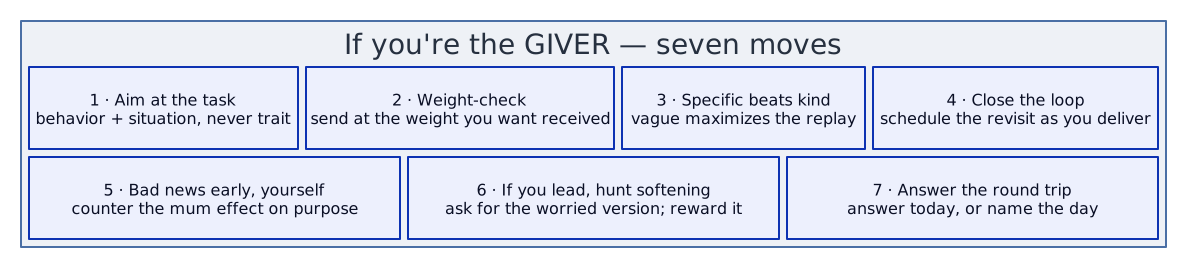
The giver’s seven moves. None of them is ‘be nicer.’ They’re ways to send at the weight you want received, to fight the mum effect in what you say and in what you’re told, and to stop the round trip from costing more than the note is worth.
1 · Aim at the task, never the self
This is the single strongest evidence-based move, straight from Kluger and DeNisi: keep the feedback pointed at the work, not the person. “This argument needs data” improves; “you’re not strategic” backfires. The test is whether the receiver can act on it. Behavior, situation, consequence — never trait language. If your feedback can only be replayed and not worked, you’ve aimed at the self, and you’ve handed the receiver an open loop instead of a next step.
2 · Weight-check before you send
Assume the exchange rate. Whatever weight the criticism has on your side, it lands heavier on theirs — several times heavier, if the negativity-bias research is any guide. So write at the weight you want received, not the weight you feel. This isn’t softening the content; it’s calibrating the delivery so the true signal arrives at true size instead of arriving as a verdict. The reviewer’s ninety-second comment would have cost her another thirty seconds to weight-check, and saved the receiver three weeks.
3 · Specific beats kind
Vague criticism is the cruelest kind, because it maximizes the replay and minimizes the usability. “This isn’t quite working” gives the receiver nothing to do and everything to worry about. “The second paragraph claims X but the data shows Y” can be fixed in an afternoon. The kindest feedback you can give is the most actionable one — specificity is what lets the receiver close the loop instead of ruminating on it.
4 · Close the loop you open
A critical remark without a follow-up leaves the echo running indefinitely. When you deliver the criticism, schedule the revisit in the same breath: “let’s look at it again Thursday.” You’ve converted an open loop into a task with an end, which is exactly what turns rumination back into action. Feedback given and then abandoned is feedback that lives on only as anxiety.
5 · Deliver bad news early, and yourself
The mum effect’s real cost is that bad news arrives late and second-hand — by which point it’s both worse and harder to trust. Countering it is a discipline, not a mood: the moment you notice yourself rounding toward comfortable, that’s the signal to say the harder, truer thing now, in your own voice, before it curdles. Early and direct is uncomfortable once. Late and filtered is expensive for everyone, for a long time.
6 · If you lead, hunt the softening
Assume every status you hear has been rounded rosy at least once per layer. So don’t wait for bad news to find you — go get the unfiltered version. Ask for the pessimistic case explicitly: “what would the worried version of this update say?” And reward the messenger visibly when they bring you something hard, because the reverse teaches the whole room a lesson instantly. One publicly punished messenger recalibrates everyone’s implicit voice theory, and you’ll be back to hearing “green” by next quarter. Psychological safety is something a leader spends, not something a leader has.
7 · Answer the round trip fast — or name the day
The cheapest thing you will ever do for someone’s work is look at it today. When you can’t, say when you will: “Thursday morning” costs you one sentence and converts an open-ended wait into a finite, explained one, which is Part 1’s biggest lever applied to a review queue. And when you do reply to something that has been sitting, price what the delay already cost — the author has to rebuild the whole context before your comments can land, so make them specific enough to be worth the reconstruction. A fast, rough answer is usually worth more than a slow, polished one, because the author still has the problem loaded.
If you’re the receiver
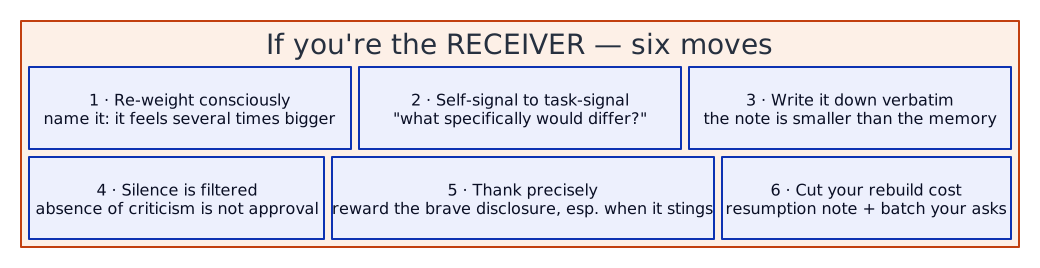
The receiver’s six moves. Most of them are about reading the remark at its true size rather than its amplified one — and the last one is about making the wait itself cheaper, since you cannot shorten someone else’s queue.
1 · Re-weight, consciously
Name the exchange rate as it’s happening: “this is going to feel several times its intended size — what did they actually say?” Naming the bias doesn’t switch it off, but it puts a small gap between the remark and the reaction, and that gap is where you get to choose your interpretation instead of inheriting the darkest one. You can’t stop bad from being stronger than good. You can stop treating the amplified version as the accurate one.
2 · Convert self-signal back to task-signal
If the feedback landed as “am I bad at this?”, translate it back into “what specifically would be different?” before you do anything else. Self-directed feedback is the kind that can only be replayed; task-directed feedback is the kind you can act on. If it genuinely can’t be converted — if there’s no concrete behavior underneath it — then that’s the giver’s debt, not yours, and asking for the specific (“what would a stronger version look like?”) is how you collect it. The vague comment is their failure of specificity, not your failure of competence.
3 · Write it down, verbatim
The remembered version of criticism grows teeth overnight; the written version doesn’t. So write down what was actually said, word for word, as close to the moment as you can. When you compare the verbatim note to the 2am replay a day later, the note is almost always smaller, more specific, and more survivable than the memory. You’re not journaling; you’re taking a snapshot before the replay starts editing the footage.
4 · Read silence as filtered, not as approval
In any environment with power distance — which is most of them — the absence of criticism is not evidence of approval. The mum effect probably ate the signal before it reached you. So don’t wait for honest negative feedback to arrive; it’s the least likely kind to travel. Solicit it explicitly, and make it easy to deliver: “what’s the single strongest argument against this?” gets you more than “any feedback?” ever will, because it gives the other person permission and a specific, low-cost thing to say.
5 · Thank precisely
The way you receive honest criticism trains your environment either toward candor or toward the mum effect. Punish the messenger — get defensive, argue, go cold — and you’ve just taught them to round rosy next time. Thank them precisely instead: “that specific point changed how I’m approaching this” reinforces the exact behavior you want more of. You are, with every reaction, either building your own psychological safety or dismantling it. Reward the brave disclosure, especially when it stings.
6 · Cut your own rebuild cost
You can’t control the reviewer’s queue, but you can make the wait cheaper for yourself. When you hand something off, write the note the resumption research says you’ll need: what you were trying to do, which alternatives you already rejected and why, and the one thing you meant to check. Ten minutes while the context is still free buys back most of the afternoon you’d otherwise spend reconstructing it. And batch what you send out, so you’re waiting on one round trip rather than five overlapping ones — each open loop is its own tug (Part 1), and five of them is not five times the progress.
The same exchange rate, off the clock
Everything above was framed for work, because that’s where feedback wears a lanyard. But swap the nouns and both lists describe the kitchen table just as well — and the exchange rate is often worse there, because the stakes are higher and there’s no process to hide behind.
Couples and close friendships run the same double asymmetry. The impact side is the throwaway remark that lodges for years: relationship researchers have long observed that criticism outweighs praise several-fold, which is why one sharp comment can undo a run of warm ones, and why the “balanced” conversation still leaves someone feeling got-at [1]. The flow side is the honest thing that never gets said — the resentment, the unmet need, the small betrayal — because saying it has never felt safe enough, which is the mum effect operating in your own living room. The transfer moves are the same ones: weight-check before you say the sharp thing; aim at the task, not the self (“the kitchen’s a mess again” lands, “you’re lazy” wounds and can’t be acted on); solicit what the other person isn’t saying rather than reading their silence as contentment; and — the one that buys the most — reward honesty when it finally comes, especially when it stings. Punishing the one brave disclosure at home buys you years of the mum effect in return. Rewarding it is how a relationship keeps a channel open that most relationships slowly lose.
The time axis runs at home too, in a slightly crueller form: “I’ll think about it,” with no date attached, is the same unpriced queue. The longer the answer takes, the more the asking itself costs — by the time it comes back, the person who raised it has usually rehearsed the worst version several times, and is answering that instead of you.
And the reverse is worth holding too: you are on the giving side of this exchange more often than you notice, dropping remarks whose weight you can’t feel. The person hearing your offhand comment is running the same amplifying hardware you are. The five minutes it costs you to weight-check what you’re about to say is nothing against the weeks it might otherwise run in someone else’s head.
The one line to keep
If you remember nothing else, remember the shape underneath it, because it holds at every desk and every table:
Feedback has an exchange rate — it lands several times heavier than it’s sent, honest signal barely travels upward at all, and every day it sits in a queue the author pays twice: once in work that isn’t moving, once in context they’ll have to rebuild. So the fix is mechanics, not moralizing. The giver aims at the task, sends at the weight they want received, and hunts the softening in what they’re told. The receiver reads what was said instead of what it grew into overnight, and reads silence as filtered, not as approval. And whoever holds the queue answers today or names the day.
That’s the whole thing. Everything else is the evidence for why it works, and the naming that lets you reach for the right move when the remark lands — or won’t leave.
This is the third entry in the asymmetry series — moments where two people share a table and live in different worlds. Part 1 was timeline and information; Part 2 was magnitude; this was feedback. There are more I keep bumping into: the asymmetry of knowledge (the expert who genuinely can’t remember not-knowing), of commitment, of attention. I’m not committing to a syllabus. But the lens keeps earning its keep.
For now I’d rather hear from you, from whichever side you’re usually on. If you give feedback: what’s your actual mechanism for sending at the weight you want received, not the weight you feel? And if you’re often the one replaying it at 2am: what’s the reframe that lets you read a remark at its true size instead of its amplified one? Put it in the comments. Someone reading this gave a note this morning that’s still echoing in someone tonight, and would take the help.
Sources
[1] Baumeister, Bratslavsky, Finkenauer & Vohs — Bad Is Stronger than Good (2001)
[4] Rosen & Tesser — On the Reluctance to Communicate Bad News (the mum effect): a role-play extension
[5] The Mum Effect — overview and the telephone-game skew (The Decision Lab)
[6] Bad-news reporting reluctance and hierarchical filtering in software project status (PMC)
[7] “Failure to fail”: the evaluator’s reluctance to give a failing grade (PMC)
[9] What is Psychological Safety? — a group property, not a personality trait (overview)
[10] Amy Edmondson — What People Get Wrong About Psychological Safety (HBR, 2025)
[11] Donald Reinertsen — Principles of Product Development Flow (2009): cost of delay and the economics of queues in development work (book); primer on cost of delay
[15] Pull Request Latency Explained: what actually drives how long a review request waits (arXiv)
About the Author
Stefan Christoph is a Principal Solutions Architect at AWS, focused on agentic AI, media & entertainment, and helping builders move from demo to production. He writes about AI architecture, developer productivity, and the future of software.
This is a personal blog. Opinions expressed here are my own and do not represent the views or positions of my employer.
🎬 Also available as a blog walkthrough video on YouTube
❤️ Created with the support of AI (Kiro)
📝 Last updated: September 2, 2026 — Added the third asymmetry: latency (cost of delay + context rebuild)