The Expert Can't Remember Not-Knowing
 written by Stefan Christoph
Four explanations, one melody
Picture four scenes.
It’s the architect’s third meeting on the same design. To her the diagram on the whiteboard is almost embarrassingly simple: a box, two arrows, a store, done. She has drawn its cousins a hundred times, and the boxes are not boxes to her — each one unfolds into a week of decisions she can see behind the lines. Across the table the customer is quiet, nodding at the right moments. She reads the nods as agreement and moves on. What the customer is actually doing is trying to work out what the middle arrow means without admitting he lost the thread two arrows ago. She hears the melody. He hears knocking.
It’s the doctor’s Tuesday afternoon. The words come out in an order he no longer has to assemble, because he has assembled them several hundred times: the mechanism, the options, the likely course. It is a clear explanation — he can hear that it’s clear. For the person in the chair it is the first time anyone has said these words about their body, and somewhere around the second sentence a single unfamiliar term landed and everything after it turned to noise while they were still stuck on the word. The doctor finishes, asks “does that make sense?”, gets a “yes,” and both of them leave believing the same conversation happened. It didn’t.
It’s the senior engineer’s “quick” onboarding walkthrough. Fifteen minutes, he promised, and to him it genuinely is fifteen minutes of the obvious — you just clone this, point that there, run the thing, and you’re up. Each “just” hides a decision that used to take him a day and now takes him no thought at all. The new hire writes down every step and still can’t reproduce it, because the steps that mattered were the ones the senior didn’t mention: the ones that stopped being steps for him years ago and became reflexes.
And it’s Sunday at the kitchen table, teaching a parent to do the thing on their phone. “Just tap the icon at the top.” Which icon. “The one at the top.” There are six things at the top. To you the right one is glowing and obvious; to them it is one indistinguishable shape among six, and “obvious” is not a property the screen has — it’s a property of your head that you’re mistaking for a property of the screen. You feel the flash of impatience, and then, if you’re honest, the small shame of it: they are not being slow. You have simply forgotten what this screen looks like to someone who doesn’t already know the answer.
Same gap, four times, and the last one didn’t involve any expertise you’d put on a résumé. There’s a famous little experiment that explains all four better than any theory, and it involves tapping a song on a table. On one side, someone who knows. On the other, someone who doesn’t — and the one who knows literally cannot reconstruct what the other one is seeing. That is not a failure of patience or of care. It is the structure of knowing something. And it has a name, and a famous, faintly absurd experiment behind it.
The tapping experiment
In 1990, a Stanford graduate student named Elizabeth Newton ran a study so simple it sounds like a party game. She paired people up. One person in each pair — the “tapper” — got a list of famously well-known songs (things everyone knows, the “Happy Birthday” tier) and tapped out the rhythm of one on the table with a finger. The other person — the “listener” — tried to name the song. Before the listener guessed, the tapper predicted the odds they’d get it right.
The tappers predicted listeners would recognize the song about 50% of the time [1]. The listeners actually got it about 2.5% of the time [1]. A twenty-fold miscalibration, and the tappers were genuinely shocked by it. They would tap, hear the whole song playing in their own heads, watch the listener’s blank face, and be baffled that this obvious tune wasn’t landing.

What the tapper hears versus what crosses the table. The melody is vivid on one side of the wood and almost absent on the other — and the tapper has no way to hear the difference.
Here is the honesty flag I promised, because it’s a good one to keep in mind for the whole post: Newton’s study is an unpublished doctoral dissertation. The 50%-versus-2.5% numbers are real and widely reported, but they were popularized largely through Chip and Dan Heath’s book Made to Stick rather than through a peer-reviewed journal you can go pull [2]. I’m using them as the emotional anchor of this piece precisely because the shape they describe is corroborated all over the more rigorous literature — but treat the exact figures as a vivid illustration, not a measured constant. The direction is not in doubt. The decimal places are.
What makes the tappers study perfect is why the tapper is so wrong. It isn’t arrogance. The tapper cannot not hear the melody. Once the song is playing in your head, there is no mental setting to switch it off and hear only the knocking the way the listener does. The knowledge — the tune — contaminates every prediction you try to make about someone who doesn’t have it. That is the whole asymmetry of knowledge in one image: the expert is a tapper who can’t stop hearing the song.
The one-way door
This is the piece that makes the asymmetry of knowledge different from the others in this series. It isn’t mainly about power, or stakes, or timing. It’s about memory. Expertise is a one-way door: once you walk through it, you can’t walk back and stand where the beginner stands, because the thing that would let you (the memory of not-knowing) is exactly what learning overwrites.
Psychologists call the general effect the curse of knowledge, and it was first pinned down not in a classroom but in economics. In 1989, Colin Camerer, George Loewenstein, and Martin Weber showed that better-informed people cannot successfully ignore what they know even when it’s in their own interest to — traders systematically overestimated how much their less-informed counterparts knew [3]. The finding generalizes ruthlessly: any knowledgeable person is unable to reconstruct the naive state of a mind that doesn’t yet hold the knowledge [4]. You don’t overestimate other people’s knowledge because you’re vain. You overestimate it because your own knowledge is running in the background and you can’t turn it off, exactly like the tapper’s tune.
Notice what that does to the most common phrase in the language of explaining: “I explained it clearly.” From inside your own head, of course you did — the explanation arrived wrapped in your entire mental model, and it all hung together beautifully. But the model didn’t cross the table. What crossed the table was the words, stripped of the structure that made them make sense to you. The felt clarity is the melody. It is real, and it is yours, and it is not the thing the other person received.
Two sides of the same table
Like the earlier posts in this series, this one has two people at the table with completely different problems. Let me take them one at a time.
The expert
Your driver is that you genuinely want to help, and you genuinely believe you’re being clear — because you are, to yourself. The clarity is not a lie you’re telling; it’s a feeling you’re having, and the feeling is honest. It’s just not evidence.
Your problem is that expertise actively destroys the thing teaching needs. As you got good, your knowledge got compressed: the intermediate steps chunked down into single moves, and the moves became invisible to you. There’s a sharp piece of education research on this, Mitchell Nathan’s work on the expert blind spot, showing that the more advanced someone’s training in a subject, the more they assume the formal structure of the field is the natural path to learn it, because they can no longer perceive the informal, messy path they actually took [5]. Deep knowledge makes you worse at teaching by default, not better. Your jargon has stopped feeling like jargon (the words are just words to you now), and you can’t simulate a listener who doesn’t have them, because you no longer have a version of yourself who didn’t.
Your failure mode is trusting the feeling and getting no signal to correct it. You explain, it feels clear, you ask “does that make sense?”, you get a polite yes, and you move on — carrying the melody the whole way, never learning that the other person heard knocking.
The layperson
Your driver is that you need to actually understand this, and you need the other side to meet you where you are.
Your problem is that you can’t evaluate the content directly — if you could, you wouldn’t need the expert — so you’re forced to judge on proxies: how confident they sound, how fluently they talk, how many credentials they have. This is exploitable in one direction (a confident fraud outscores a hesitant expert) and unfair in the other (genuine expertise often sounds hedged and uncertain, because honest people qualify their claims). You’re scoring a performance because the substance is out of reach.
Your failure modes are two, and they pull opposite ways. One is staying silent: you don’t ask the question because asking feels like admitting you’re not smart enough to be in the room, so the one move that would fix everything — saying “I’m lost” — is the move you systematically don’t make. The other is faking comprehension: nodding, “yes, makes sense,” getting out of the room with your dignity and none of the understanding. Both feel like the safe play. Both guarantee the gap survives.
The thing that connects the two sides is a single ugly fact: the gap is silent. To see why, we have to go to the research. This is the long middle of the post, and it’s the why behind every move in the playbook; if you only want the what, jump ahead — the playbook will be waiting.
What the research actually says
The usual caveat, because it governs how much weight any of this bears. Most of this work is correlational, self-reported, or — in the tappers’ case — from an unpublished dissertation. It’s real signal, and the mechanisms are consistent enough across studies to plan around, but the exact magnitudes are softer than clean prose makes them sound. Read it as a well-lit map, not a machine.
The gap is invisible from both sides at once
Start with the mechanism that makes this asymmetry so durable, because it’s a two-sided illusion. The expert’s side we’ve covered: felt clarity, the curse of knowledge, the tapper’s melody. But the listener has a matching bias pointing the other way, and it’s the reason they don’t speak up.
It’s called the illusion of transparency. Thomas Gilovich, Kenneth Savitsky, and Victoria Medvec showed that people overestimate how much their internal states leak out to observers — you feel your nervousness, your lie, your confusion so vividly on the inside that you assume it’s written on your face [6]. Apply that to the confused listener: they feel lost, feel it loudly, and unconsciously assume the expert can see it. “They’d slow down if I looked confused.” But the confusion leaks far less than it feels like it does. The expert sees a nod.
So stack the two biases and you get a beautifully sealed trap. The expert believes the explanation was clear (curse of knowledge) and receives no correction. The listener believes their confusion is obvious (illusion of transparency) and so doesn’t voluntarily produce the correction. The expert gets no error signal; the layperson withholds the one they could give; the gap sails through the conversation untouched, and both people walk away believing they were in sync.
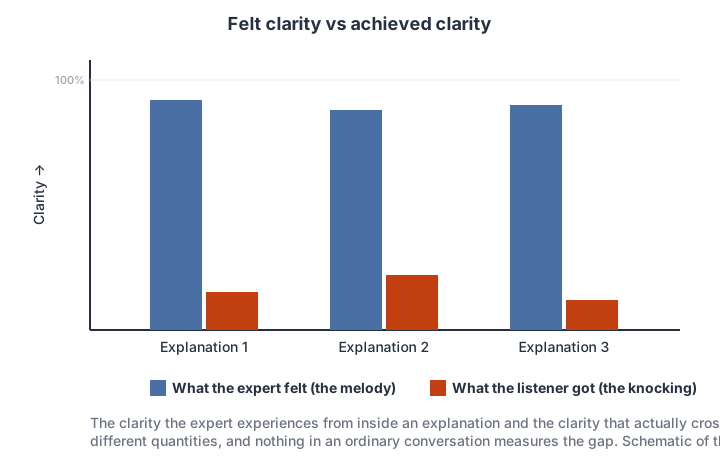
Felt clarity versus achieved clarity. What the expert experiences from inside the explanation (the melody) and what actually crosses the table (the knocking) are two different quantities — and nothing in an ordinary conversation measures the gap between them. Schematic of the asymmetry, not measured data.
Expertise replaces the memory of learning
The expert blind spot deserves a second pass, because Nathan’s framing is stronger than “experts forget what it’s like to be a beginner.” His claim is that advanced training actively substitutes the discipline’s formal structure for the memory of the informal route you actually travelled [5]. The mathematician stops being able to see why the axiom isn’t obvious. The developer stops being able to see why the command line isn’t self-explanatory. It isn’t that the memory has faded and could be recovered with effort. It’s that expertise wrote over it. This is why “just remember what it was like when you were learning” is such useless advice: the file you’re being asked to open was overwritten by the very process that made you good.
Which points, quietly, at where the only real repair lives — not in recovering your own beginner’s mind (the file is gone) but in borrowing someone else’s. That’s the logic behind usability testing: a formal ritual for curse-of-knowledge repair, built precisely because designers cannot introspect their way back to not-knowing their own product. It anchors one of the expert’s moves below.
Confidence is not competence, but it’s what gets scored
The layperson’s proxy problem has an uncomfortable edge that’s worth stating plainly. Because a non-expert can only judge the delivery, not the content, fluency and confidence beat accuracy and honesty in low-knowledge audiences. This is why the confident generalist can out-persuade the careful specialist in a room full of people who can’t tell the difference — and why calibrated, honest expertise, which naturally comes wrapped in hedges and “it depends,” reads as weakness exactly when it’s being most rigorous.
I’ll flag this as more synthesis than single-study finding — it draws on the judgment-and-decision literature and a good deal of lived observation rather than one clean experiment — but the direction is hard to argue with. The practical consequence lands on the expert, and it’s counterintuitive: if you’re honest and your honesty comes out as hedging, you will lose ground to people who are simply more confident than the evidence warrants. There’s a specific counter-move for this in the playbook.
Status makes the silence worse
One more layer, and it connects directly to the previous post in this series. The reason the layperson won’t say “I’m lost” isn’t only the illusion of transparency. It’s also that asking a question in front of an expert — especially in front of a group — feels like a status loss. The “stupid question” is the highest-value move available and the one people most reliably suppress, because the social cost of looking ignorant is paid now and in public, while the cost of not understanding is paid later and in private.
That’s the feedback asymmetry from Part 3 wearing a different coat: the person who has the signal the other side needs (here, “I didn’t follow that”) sits on it because producing it is uncomfortable, so the person who needs it never finds out. The expert’s curse and the layperson’s silence aren’t two separate problems. They’re one machine with an input side and an output side, and the machine’s default output is a gap that nobody in the room can see.
The playbook
Enough mechanism. Here’s what to actually do on each side. As in the earlier posts, notice how the two sides carry different loads — and how cleanly the moves transfer from the meeting room to the kitchen table.
If you’re the expert
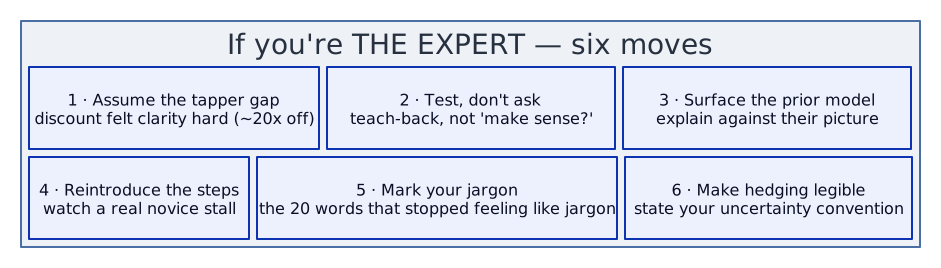
The expert’s six moves. None of them is ’explain more clearly.’ They’re ways to stop trusting felt clarity and start generating the error signal the curse of knowledge withholds.
1 · Assume the tapper gap
Whatever clarity you feel, discount it hard — the tappers were off by twenty times, so treat your sense of “that landed” as roughly worthless at the margin. This isn’t self-flagellation; it’s calibration. The feeling of having explained well is produced by your own model humming along in the background, and it will be present whether or not a single idea crossed the table. Start every explanation assuming the melody stayed in your head, and the rest of the moves become obvious.
2 · Test, don’t ask
“Does that make sense?” is worse than useless — it produces polite yeses and gives you a false error signal. Replace it with a request that forces the other person to reconstruct: “How would you explain this to a colleague who wasn’t here?” This is teach-back, borrowed from health communication, where clinicians have someone repeat instructions in their own words rather than confirm they understood. The magic is that teach-back manufactures exactly the signal the illusion of transparency withholds: the moment they try to say it back, the gap becomes visible to both of you, cheaply, while it’s still fixable.
3 · Surface their prior model first
Nobody arrives as a blank slate. The customer has a half-formed picture from a competitor’s pitch; the patient has a story from a relative; the new hire has a mental model from their last job. If you explain against an imagined empty page, you’re explaining against the wrong background and your words get filed under the existing (often wrong) model. So ask first: “What’s your current picture of how this works?” Then explain against that. In the onboarding case, “what did you expect the setup to look like?” surfaces the assumption you’d otherwise fight blind.
4 · Reintroduce the invisible steps
Write the explanation for the version of yourself that existed the day before you learned this — and when you find you can’t remember that person (you can’t; expertise overwrote them), go borrow a real one. Watch an actual beginner do the thing without helping. Take notes on where they stall. Every “just” in your explanation is a place where a step went invisible; a real novice will find them for you in minutes, which is the entire reason usability testing exists.
5 · Mark your jargon
Every field has roughly twenty words that stopped feeling like jargon to the people inside it but are opaque to everyone else. Keep a running list per audience, and flag those words as you use them — “this term means X” — rather than assuming they read as plainly to the listener as they do to you. One unexplained term isn’t one lost word; it’s the foundation for everything you build on top of it, so the confusion compounds through the rest of the conversation silently.
6 · Make hedging legible
Since laypeople read confidence as competence, calibrated honesty will lose to fluent overclaiming unless you translate it. Don’t drop the hedges — the hedges are the honesty — but explain the convention: “When I say ’likely,’ I mean I’d bet on it but wouldn’t stake the company; when I say ‘certain,’ I mean it.” That one move lets careful expertise stop sounding like weakness, and it inoculates the listener against the confident person down the hall who has no such convention because they’ve never examined their own uncertainty.
If you’re the layperson
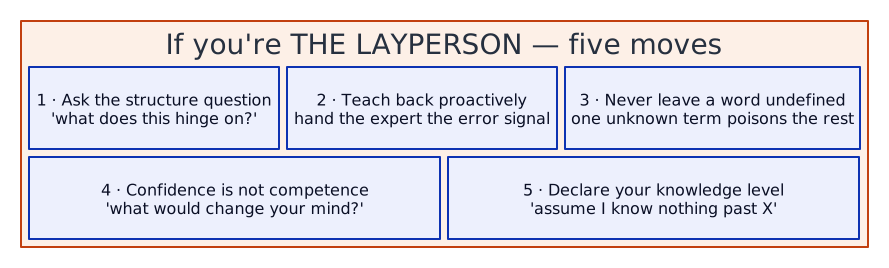
The layperson’s five moves. Your real skill here is not domain judgment — you don’t have it, that’s why you’re in the room — it’s question technique.
1 · Ask the structure question, not the content question
You can’t ask a smart content question, because you don’t have the content — so don’t try. Ask the question only an expert can answer and that forces them to decompress: “What are the two or three things this actually hinges on?” It reframes a wall of detail into a shape you can hold, and it makes the expert do the compression-reversal they won’t do unprompted. In the medical case, “what are the few things that actually change the decision here?” cuts a ten-minute explanation down to the part that matters to you.
2 · Teach back, proactively
Don’t wait to be tested — test yourself, out loud: “Let me say this back in my own words.” This is the same teach-back move as the expert’s, run from the other side, and it’s a gift in both directions. It catches your own misunderstanding while it’s cheap, and — this is the part people miss — it hands the expert the error signal their curse of knowledge is hiding from them. You’re not exposing your ignorance. You’re doing the expert’s job for them, and good ones are visibly grateful.
3 · Never leave with a word you can’t define
The single most useful habit: if a term went by that you couldn’t define, stop and ask, every time, no exceptions. It feels like friction and it feels like status loss, but one undefined word poisons everything downstream. You’ll nod through the next five sentences that depend on it and understand none of them. “Sorry, what does X mean exactly?” is the cheapest question in the world and the one most people are too proud to ask.
4 · Separate confidence from competence deliberately
Since you’re stuck judging on proxies, at least use better ones. Fluency and confidence are cheap; ask questions that a fluent fraud can’t fake and a real expert answers easily: “What would change your mind?” and “What’s the strongest argument against this?” Genuine expertise has rich, specific, slightly uncomfortable answers to both. Empty confidence has smooth, general, evasive ones. You still can’t judge the content — but you can tell the difference between someone who has wrestled with the edges and someone who has only memorized the middle.
5 · Declare your knowledge level
Do the calibration work the expert’s curse prevents them from doing: tell them where you actually are. “Assume I know nothing past the basics” or “I understand X but I’ve never touched Y” gives them the starting point they can’t infer on their own. Experts explaining to an unknown audience default to their own level, because that’s the only level they can feel. Naming yours drags the explanation down to where you can catch it.
The same door, off the clock
Everything above was framed for work, because that’s where the knowledge asymmetry wears a lanyard. But the door swings the same way at home, and — as the opening kitchen-table scene already gave away — the private versions are often the sharpest, because there’s no professional distance to soften them.

The same gap, no résumé required. “Just tap the icon at the top” is a tapped rhythm; the six things at the top are what actually crosses.
Family tech support is the tappers study at the kitchen table. “Just click the obvious button” is a melody playing in your head; the parent hears knocking, sees six identical shapes, and the impatience you feel is the tapper’s bafflement that this obvious tune isn’t landing. The repair is the same: surface their prior model (“what do you think that button does?”), mark the jargon ("’the icon’ means the little picture, third from the left"), and — hardest of all — reintroduce the invisible steps you deleted years ago, which mostly means slowing down enough to notice you deleted them.
Medical appointments run the entire machine at once: the doctor’s curse of knowledge, the patient’s status silence, and the illusion of transparency on both sides. The two moves that transfer most directly are the humblest ones — “assume I know nothing past the basics” from the patient, and teach-back from anyone — and they’re worth deploying precisely because the stakes are too high to leave the gap silent. (This is a communication move, not medical advice; the doctor-patient table is an example here, not a place I’m qualified to give guidance about.)
And long relationships develop their own local expert blind spots, which is maybe the most humbling version. “I explained how I feel” is often just tapping the rhythm — the whole emotional melody was playing in your head, and what crossed the table was a few words stripped of it. “What did you hear me say?” is the teach-back move, and it’s a staple of couples therapy for exactly the reason it works everywhere else: it makes the silent gap visible while it’s still cheap to close. Most of us are fluent at running one side of this asymmetry and clumsy at the other, and the room rarely tells us which.
The general calibration question, for any table, is one sentence and it beats every assumption you’d otherwise make: “Where are you starting from with this?” You don’t have to guess someone’s prior knowledge from inside your own. You can just ask, and then explain against the answer instead of against the blank slate that never exists.
The one line to keep
If you remember nothing else, remember the shape underneath all of it, because it holds at every table:
Knowing is a one-way door — the expert can’t un-know their way back to the beginner’s mind, so felt clarity is the melody in their head, not the knocking that crosses the table. The fix is mechanics, not effort: the expert tests instead of asks (teach-back), surfaces the prior model, and makes hedging legible; the layperson asks structure questions, teaches back, and never leaves with an undefined word. The gap is silent by default — someone has to generate the signal on purpose.
That’s the whole thing. Everything else is the evidence for why it works, and the naming that lets you reach for the right move when you’re standing at the table with the melody playing in your head.
This is the fourth entry in the asymmetry series — moments where two people share a table and live in different worlds. Part 1 was timeline and information; Part 2 was magnitude; Part 3 was the feedback exchange rate, the reason the confusion in this post never gets reported out loud. This one is knowledge itself — the door that only opens one way. The lens keeps finding new rooms, so I suspect I’ll be back.
For now I’d rather hear from you, from whichever side of the door you’re usually on. If you explain things for a living: what’s your teach-back move — the actual mechanism that tells you whether the melody crossed the table, not just whether it felt clear? And if you’re often the one nodding along while quietly lost: what’s the question that lets you break the silence without feeling like you’ve lost the room? Put it in the comments. Someone reading this is tapping a table right now, sure the song is obvious, and wondering why the blank faces.
Sources
[1] Elizabeth Newton’s tappers study (1990) — summary and figures
[3] Camerer, Loewenstein & Weber — The Curse of Knowledge in Economic Settings (1989, CMU PDF)
[5] Nathan & Petrosino — Expert Blind Spot Among Preservice Teachers (2003, AERJ)
[6] Gilovich, Savitsky & Medvec — The Illusion of Transparency (1998, PDF)
About the Author
Stefan Christoph is a Principal Solutions Architect at AWS, focused on agentic AI, media & entertainment, and helping builders move from demo to production. He writes about AI architecture, developer productivity, and the future of software.
This is a personal blog. Opinions expressed here are my own and do not represent the views or positions of my employer.
🎬 Also available as a blog walkthrough video on YouTube
❤️ Created with the support of AI (Kiro)