The Door Only Locks Behind One of You
 written by Stefan Christoph
The Door Only Locks Behind One of You
A note on where this comes from: I’m not a psychologist. I read this research because I keep watching decisions that were cheap on one side of the table and permanent on the other, and I wanted to understand the gap instead of just being unsettled by it. Every study is cited at the bottom, and where the evidence is thin or correlational I say so. This is also not HR or legal advice; layoffs and contracts show up as the research anchor, not as a how-to, and where I mention notice periods or severance I mean them as categories, not counsel.
Three doors, six people
Picture three moments.
A reorg is being finalized in a planning document. One line of it is a role that’s being cut. To the people deciding, this line is a two-way door: if the reorg turns out wrong, they can restructure again next quarter, backfill the role, rehire. It’s reversible, revisitable, one item in a spreadsheet of forty. To the person in that role, whose work visa is tied to the job, the same line is a door that locks behind them and does not open again in the same shape: a country to leave, a family plan to unwind, a life rebuilt somewhere else. Same decision. One side can walk back through it. The other cannot.
A platform ships a policy change: a rule tweak, a fee adjustment, a category that’s no longer allowed. To the team that ships it, it’s a config change with a rollback plan; if the metrics look bad in a month, they revert. To the small business that built its whole operation on that platform, the change is the end of the thing they spent three years growing. The platform’s door swings both ways. The business’s door has a lock on the far side only.
And a relationship ends on a Tuesday evening. To the person who decided to leave, the door has been closing slowly for months. They processed it in stages, grieved it privately, walked through it a little at a time, so that by the time they say the words out loud they are most of the way to the other side. To the person being told, the same door slams in an instant: no warning, no staged grief, a life that was intact at breakfast and isn’t by night. Both people will call it the hardest thing they’ve been through. They are standing at the same door, and it is a completely different door depending on which side of it you’re on.
That last one didn’t involve a company at all, and it’s the one that shows the shape most clearly. A decision is not one thing with one reversibility. It has a reversibility profile per party — and the profiles routinely disagree. The decider evaluates from a side where the door swings both ways. The affected party lives on the side where it only locks. Neither is misreading their own side. The problem is that the decider’s side is the one holding the pen.

Two people, one room, two exits. The revolving door and the vault door are the same decision — which one you get depends on which side of it you live.
The asymmetry, again
This is the seventh time I’ve stood at a table and watched two people live in different worlds. The previous part was the iceberg problem: how much of the work is invisible to the side that only sees the output. This one is about reversibility, which is in some ways the sharpest asymmetry of the set, because it isn’t about information or attention or effort. It’s about who has to live with the result after everyone else has moved on.
Here is the shape. A decision gets classified once, by the person making it, using the reversibility they can see: their own. “Is this reversible for us? Can we revisit it? Then let’s not overthink it.” That instinct is correct for their side and structurally blind to the other’s. The affected party is standing at a door with a lock on it that the decider never has to touch, and the decider’s whole toolkit (portfolio thinking, “we can always course-correct,” disagree-and-commit) is built for two-way doors and gets misapplied to a decision that is a one-way door for someone else.
The two-way / one-way door language itself comes from Amazon’s shareholder letters, where it’s used to argue that reversible decisions deserve speed and irreversible ones deserve deliberation. That’s a genuinely useful distinction, and I’ll use it here. What this post adds is one classification step — asking whose door you’re classifying — and the playbook below turns it into a habit.
Two sides of the same door
As in the earlier parts, the two sides have completely different problems, and lumping them together is how the advice goes wrong. So take them one at a time.
The person deciding
Your driver is that you carry the decision but not the consequence. That’s not a character flaw; it’s the position. You will make this call, and then you will go home to a life that is structurally unchanged, and the person on the other side will go home to one that isn’t. The gap between those two evenings is the whole asymmetry.
Your problem is that everything about your position underweights the far side of the door. You see the decision as one of many (the aggregation that Part 2 called the numbing interface: the spreadsheet turns lives into a distribution). You evaluate reversibility from your side, where it’s high. And loss aversion is working against you in a way you can’t feel from where you sit, which we’ll get to in the research.
Your failure mode is running a one-way-for-them decision through two-way-for-us process: fast, low-deliberation, “we can revisit,” when the person on the other side has nothing to revisit. It feels like decisiveness. From the far side of the door it reads as carelessness, and the maddening part is that both readings are honest.
The person it lands on
Your driver is proportion. This is one of the larger things that will happen to you this year, and you need it to be treated like it weighs what it weighs.
Your problem is that you’re in the loss domain (again, the research below), which roughly doubles the felt weight of the change, and you’re often reading the decider’s calm as a verdict on how much you mattered. Sometimes it is. More often it’s structural: they classified the door from their side, where it swings freely, and never saw the lock on yours.
Your failure modes pull in two directions. One is reading the whole thing as personal (“they did this because they don’t value me”) when it was mostly structural (“they did this because it was cheap for them, and never modelled that it was permanent for me”). The other is going passive: treating the one-way door as the end of your agency, when the research on regret says the opposite is your best move. Both feel like accurate responses to a bad situation. Both usually make the aftermath worse.
The thing that connects the two sides is a single question: can the decider classify the door from the other party’s side, and can the affected party read the decision structurally instead of personally? To answer either, we have to go to the research. This is the long middle of the post, and it’s the why behind every move in the playbook; if you only want the what, jump ahead — the playbook will be waiting.
What the research actually says
The usual caveat, because it governs how much weight any of this carries. Most of this work is correlational and self-reported: surveys of layoff survivors, lab studies of remembered regret, natural experiments around downsizing. It’s real signal, but it’s a map, not a machine. The direction is solid; the exact magnitudes are softer than clean prose makes them sound. I’ll flag the softest numbers as they come up.
Losses weigh about twice as much as gains
Start with the reason the decider systematically underfeels the other side. In Kahneman and Tversky’s prospect theory, people don’t evaluate outcomes on an absolute scale; they evaluate changes from where they currently are, and losses loom larger than equivalent gains [1]. Their estimates put the coefficient somewhere around two, meaning a loss feels roughly twice as bad as the same-sized gain feels good. I’d treat “about two” as a well-established ballpark rather than a precise constant; the exact figure varies by domain and study.
Here’s why it matters for the door. The affected party is squarely in the loss domain: they had a job, a home, a relationship, a business, and now they don’t. The change is coded as a loss and weighted accordingly. The decider is usually not in the loss domain at all: they’re evaluating a reallocation, a forgone option, a neutral move in a portfolio. So the same decision is felt at roughly double the intensity on the side that didn’t get to make it. This is not one party being dramatic and the other being callous. It’s two people standing in different domains of the same value function, and the asymmetry is built into how human beings weigh change.
Deciders and affected parties run on different regret clocks
Thomas Gilovich and Victoria Medvec’s work on regret has a finding that’s become well known: over time, people regret their inactions more than their actions [2]. In the short run, the things you did that went wrong sting the most; in the long run, the things you didn’t do (the risk not taken, the words not said) are what haunt. Actions have a short, sharp regret that fades; inactions have a dull regret that grows [3]. A 2022 replication supports the basic temporal pattern while adding the usual caveats about generalizability [4].
Now apply it to a one-way-door decision, because it produces a cruel asymmetry. For the decider, the harmful decision is an action — and action-regret fades fast. Six months later the reorg is last quarter’s news; organizational memory is shorter still. For the affected party, the decision isn’t their action at all; it’s a consequence they live on the long horizon, and if they respond passively, it can curdle into exactly the kind of inaction-regret (“I should have fought it, I should have moved sooner”) that the research says grows rather than fades. The two parties are on different clocks: the decider’s regret is set to fade, the affected party’s is set to linger. Which means the feedback that might teach the decider something never reaches them; by the time the real cost is being paid, they’ve stopped watching.
Process buffers the harm you can’t undo
This is the finding I’d most want a decider to carry, because it’s the one lever that still works after the outcome is fixed. Joel Brockner and colleagues studied how people react to negative outcomes (layoffs, in much of the work) and found a strong interaction between the outcome and the process that delivered it: when procedural justice is high, even strongly negative outcomes produce far milder adverse reactions than the same outcomes delivered through a process people experience as unfair [5]. The effect isn’t small, and it isn’t limited to the people who lose their jobs — the perceived fairness of the process also shapes the commitment and trust of the survivors who stay [6].
Two honesty flags on this one. The foundational Brockner interaction paper is paywalled, so I’m relying on its abstract and on the broader literature that cites and extends it rather than the full text; and this whole line is correlational and survey-based, so read it as a strong, repeatedly-observed association rather than a clean causal law. With that said, the direction is consistent enough to plan around, and one study pushes it somewhere striking: work on downsizing and mental health found that employees who experienced the process as procedurally just had substantially lower odds of depressive symptoms afterward than those who didn’t [7]. Same job loss. Different process. Measurably different harm, on an outcome as serious as depression.
The reframe is this: process is not a PR layer over a bad decision. It is, on this evidence, one of the few things that measurably changes how much the irreversible thing hurts — which is why it carries the biggest move in the decider’s playbook below.
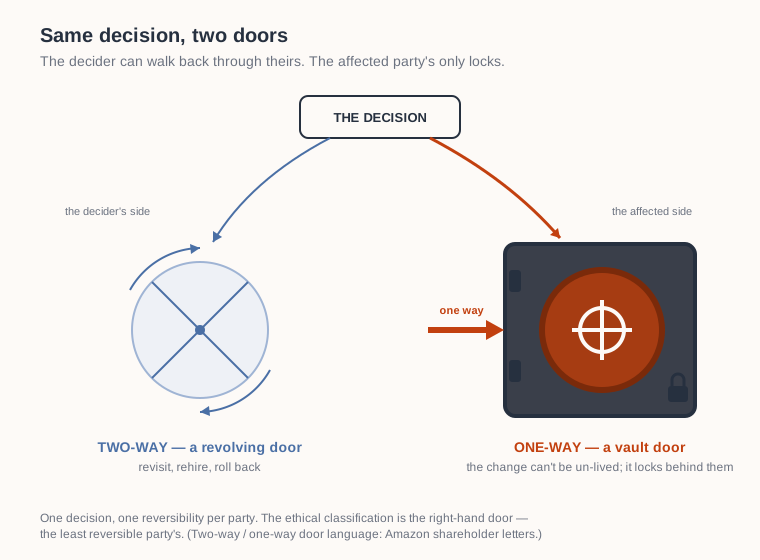
The same decision, two doors. The decider evaluates from the side where the door swings both ways; the affected party lives on the side where it only locks. The ethical classification is the one on the right.
Moral hazard: when the downside lands elsewhere
There’s an economic name for the structural version of all this. Moral hazard is what happens when the person making a choice doesn’t bear its full downside: they take more risk than they would if the cost landed on them, not because they’re bad but because the incentive is tilted. Nassim Taleb’s popular framing is “skin in the game” — the idea that decision-makers should carry some of the consequence of their decisions.
The useful thing about the moral-hazard lens is that it de-moralizes the problem for both sides. For the decider, it locates the fix in structure rather than in guilt — which is where the playbook’s skin-in-the-game move comes from. For the affected party, it reframes the injury: “they decided this cheaply because it was cheap for them” is a statement about structure, not about your worth. That reframe (the same de-personalizing move that ran through the earlier parts of this series) is one of the few things that actually helps in the loss domain.
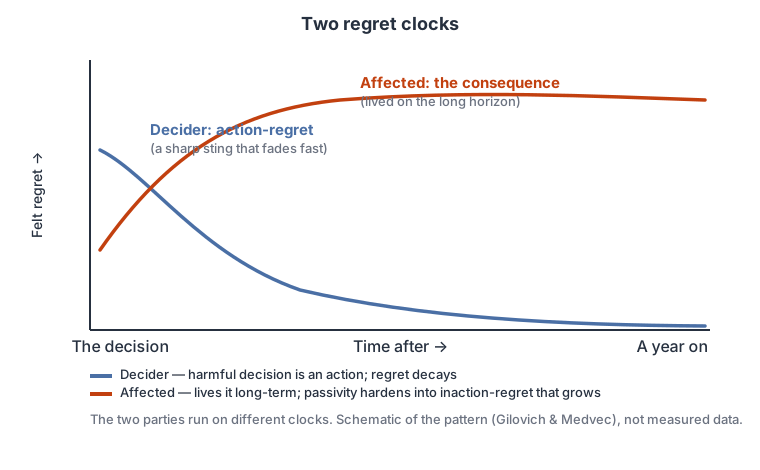
Two regret clocks. The decider’s regret for a harmful action fades fast; the affected party lives the consequence on a long horizon, where passivity can harden into the inaction-regret that grows. Schematic of the pattern, not measured data.
The playbook
Enough mechanism. Here’s what to actually do on each side. Notice, as in the earlier parts, how differently the two sides are loaded, and how cleanly the moves carry from the conference room to the kitchen table.
If you’re the one deciding
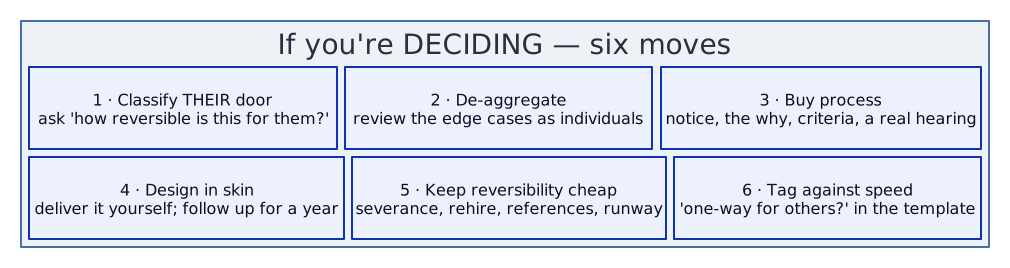
The decider’s six moves. None of them is ‘feel worse.’ They’re ways to see the far side of the door and to spend the one thing that still helps after the outcome is fixed: process.
1 · Classify the door for the other party, not yourself
Before any consequential decision, ask one question: how reversible is this for them? Then run the process at the level of their door, not yours. This is the whole post compressed into a habit. Most bad irreversible decisions aren’t made by people who weighed the permanence and proceeded; they’re made by people who classified the door from their own side, found it reversible, and never checked the far side. The check takes seconds. It’s the single move here that does the most work.
2 · De-aggregate at the decision point
Decide the policy at the portfolio level if you must, but review the marginal cases as individuals. The spreadsheet is for analysis; it should not be the interface for the final call, because aggregation is precisely what numbs you to the permanence on the other side (Part 2’s “never decide while numbed” applies directly here). The people at the edges of the distribution are the ones for whom the door is most clearly one-way. Look at them one at a time.
3 · Buy process, since you can’t buy back the outcome
This is where the Brockner findings become concrete duties: advance notice rather than ambush, an honest explanation of the why, consistent criteria applied the same way to everyone, humane delivery by a person rather than a portal, and a real path to be heard or appeal. None of these change the outcome. All of them change how much the outcome harms, on evidence that runs as far as depression odds. Process is the one lever that still scales after the door has locked, so spend on it deliberately, not as an afterthought.
4 · Design in some skin
Moral hazard shrinks with contact, so engineer contact in. Deliver the hard news yourself instead of delegating it. Own the transition support rather than outsourcing it. Track what happens to the affected party for a year, so the long-horizon consequence actually reaches the person who made the call and closes the feedback loop the regret clocks leave open. You don’t fix an incentive problem with exhortation; you fix it by moving some of the downside back onto the side holding the pen.
5 · Keep reversibility cheap where you can
You often can’t reopen the far side of the door completely, but you can frequently leave it ajar at low cost to yourself: severance that genuinely bridges to the next thing, rehire eligibility, honest references, a longer runway before the change bites. Partial re-opening of the other party’s door tends to cost the decider far less than it’s worth to the affected party — which is exactly the kind of trade a clear-eyed decider should take every time.
6 · Tag it against the speed culture
“Move fast, disagree and commit, don’t overthink reversible decisions” is correct advice for two-way doors and dangerous advice for one-way-for-others ones. So make the distinction explicit in how you work: put a literal “one-way for others?” line in your decision template, and when the answer is yes, exempt that decision from the speed norms and give it the deliberation its permanence deserves. The failure isn’t the speed culture; it’s letting it swallow the decisions it was never meant to cover.
If you’re the one it lands on
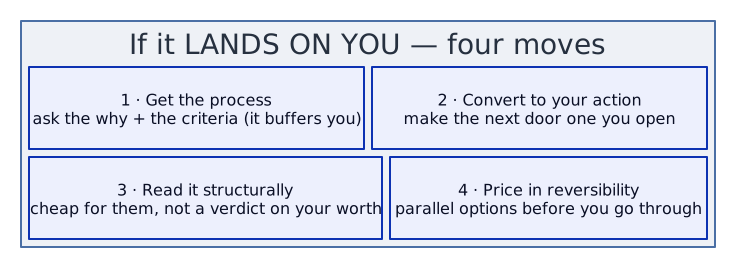
The affected party’s four moves. Most of them are about reclaiming agency the one-way door seems to take away — and reading the decider’s calm as structure, not verdict.
1 · Get the process, even if you can’t change the outcome
Asking for the why, the criteria, and the appeal path is not futile even when the decision is final. It does two things. It changes your own downstream psychology — the procedural-justice research says perceived fairness buffers the harm, so understanding how and why the decision was made measurably helps you, independent of the outcome. And occasionally, when a criterion was misapplied or a fact was wrong, it changes the outcome after all. Neither happens if you don’t ask.
2 · Convert the door into your own next action
The regret research points somewhere useful here. A forced change you endure passively sits in the slot where inaction-regret grows on the long horizon. A forced change you convert into your project (a chosen next search, a relocation you own rather than suffer, a retraining you decided on) moves into the action slot, where regret is sharper at first but fades. You cannot control that the door locked. You can control whether the next door is one you open. On the evidence, the people who make the transition theirs recover better than the ones who wait for the door to reopen.
3 · Read the moral hazard structurally, not personally
“They decided this cheaply because it was cheap for them” is a systems fact, not a statement about your value. The decider classified the door from their side and never modelled the lock on yours. Holding that as structure rather than personal verdict does real work: it de-personalizes an injury that the loss domain is busy amplifying, and it frees you from the exhausting project of proving to someone that you mattered — which, per the earlier parts, mostly triggers the defenses you’re trying to get through.
4 · Price irreversibility in before you go through the door
Where you have any room to negotiate before the decision, use it to buy yourself reversibility: notice periods, contractual protections, and — most reliably — parallel options, the same consequence-mitigation that ran through Part 5. The person with a warm alternative is standing at a two-way door even when the other party thinks they’re slamming a one-way one. You can’t always insure against irreversibility. Where you can, it’s the cheapest protection you’ll ever buy, and it’s almost always cheapest before you walk through.
The same door, off the clock
Everything above was framed for decisions with a lanyard on them, because that’s where the research lives. But swap the nouns and the two lists describe private life just as well, and the private versions are often the ones that hurt longest.

A one-way-for-someone-else decision, at child height. The parent holds the pen and most of the reversibility; the child gets the door — which is why the why, said at their level, matters so much.
The breakup from the opening is the purest case. The person who decides to leave has usually been walking through the door slowly for months: they classified it, grieved it, and reached the far side in stages. The person who’s told faces the same door as an instant one-way slam. This is why post-breakup incomprehension is so total — not because one person is heartless and the other dramatic, but because they are on completely different clocks, standing at what looks like the same door and is not. Recognizing the gap doesn’t close it, but it explains most of the mutual bewilderment, and it points the one who’s leaving toward the only thing that helps: process. The warning, the honesty, the chance to be heard. The same buffer that works at the desk works at the kitchen table.
Parenting is the moral-hazard case. A parent deciding a move, a school change, a rule that reshapes a child’s world is making a one-way-for-someone-else decision from a position where they carry the authority but not the lived consequence in the same way. The mechanisms transfer cleanly: classify the child’s door (how reversible is this for them, at their age, on their timescale?), explain the why at a level they can hold, and preserve what reversibility you can. “Because I said so” is a two-way-door process applied to a one-way-door decision. It’s cheap for the decider and permanent for the child, which is exactly the pattern this whole post is about.
And the reverse is worth holding too: most of us are on the deciding side of something without noticing the lock on the far side. The vendor you drop, the friend you stop calling, the plan you quietly cancel — cheap and reversible for you, possibly a one-way door for them. The calibration question is one sentence, and it beats every assumption: how reversible is this for the other person? You don’t have to guess. You can classify their door on purpose.
The one line to keep
If you keep nothing else, keep the shape, because it holds at every door:
A decision’s reversibility is not one number — it’s one per party, and the ethical classification is the other side’s. Decide at the level of the least reversible party’s door, which is almost never yours. And when the outcome truly can’t be undone, buy process — advance notice, honest reasons, consistent criteria, a real hearing — because fair process is the one lever that measurably buffers a harm you can’t take back.
That’s the whole thing. Everything else is the evidence for why it works and the naming that lets you reach for the right move while you still have the pen in your hand.
This is the seventh entry in a series on asymmetries — moments where two people share a table, or a door, and live in different worlds. Earlier parts covered timeline, stakes, feedback, knowledge, commitment, and effort visibility. There are more of these I keep bumping into, but I’m not committing to a syllabus; the lens keeps earning its keep, and I’ll follow it where it goes.
For now I’d rather hear from you. If you make decisions that land on other people: what’s your version of the door-classification check — the actual habit that makes you look at the far side before you decide? And if you’ve been on the receiving end of a one-way door someone else treated as reversible: what was the process choice, present or absent, that changed how much it hurt? Put it in the comments. Someone reading this is standing at one side of a door right now, about to misjudge the other.
Sources
[1] Kahneman & Tversky — Prospect Theory: An Analysis of Decision under Risk (Econometrica, 1979)
[2] Gilovich & Medvec — The Temporal Pattern to the Experience of Regret (1994, PDF)
[3] Gilovich & Medvec — The Experience of Regret: What, When, and Why (Psychological Review, 1995, PDF)
[4] Revisiting the Temporal Pattern of Regret — replication (Collabra: Psychology, 2022)
[6] Procedural justice and layoff survivors’ commitment: a quantitative review (2006)
[7] Downsizing, procedural justice, and depressive symptoms (PLOS ONE, PDF)
About the Author
Stefan Christoph is a Principal Solutions Architect at AWS, focused on agentic AI, media & entertainment, and helping builders move from demo to production. He writes about AI architecture, developer productivity, and the future of software.
This is a personal blog. Opinions expressed here are my own and do not represent the views or positions of my employer.
🎬 Also available as a blog walkthrough video on YouTube
❤️ Created with the support of AI (Kiro)