Asymmetry of Stakes: Staying Humane at Volume
 written by Stefan Christoph
A note on where this comes from: I’m not a psychologist or a clinician. I read the research because I keep sitting on both sides of this table — some weeks I’m the one processing a stack, some weeks I’m the one whose whole year hinges on a stranger’s Tuesday. Every study I lean on is cited at the bottom. Where the evidence is thin or self-reported, I say so. And this is not burnout advice; if the churn I describe never switches off for you, that’s a different conversation than a blog post can have.
Four tables, two magnitudes
Picture four scenes.
It’s the recruiter’s afternoon. This is the fortieth first-round interview this month, the fourth today, and there are two more after yours. She likes her job. She is also running on a schedule that has no slack in it, and by now the candidates blur into a distribution: strong, weak, somewhere in the middle. Across the table sits you. This is the role you reorganized your life to apply for, the one you told your partner about, the one whose outcome decides whether you move cities. You have practiced the answer to “tell me about yourself” in the shower for a week. She has heard forty versions of it. You are both, in your own frame, completely reasonable. And you can feel, in the small tells — the glance at the clock, the CV read for the first time in the room — that you are one of forty and she is one of one.
It’s the oncologist’s Tuesday. Clinic is full. This is a diagnosis he has delivered, in some form, several hundred times, and the words come out in an order he no longer has to assemble. For him it is a Tuesday with a hard conversation in it, bracketed by eleven other conversations. For the person in the chair it is the sentence that splits their life into before and after, the moment they will replay for years, the five minutes that every future Tuesday now dates from. He is not cold. He is saturated. Those are not the same thing, and the person in the chair has no way to tell them apart in the moment.
It’s the RFP evaluator’s stack. Fourteen bids, a scoring rubric, a deadline. Bid number nine is, to the evaluator, a slightly-above-average submission in a font she’s tired of looking at. To the two founders who wrote it, it is eight weeks of nights, the runway that keeps the company alive, the thing they will remember as the deal that made or unmade them. She will forget it by Friday. They will name their next pivot after it.
And it’s move-in day at the care home. For the staff member walking your family through the corridor, this is the third admission this week — the paperwork has a rhythm, the welcome speech has grooves worn into it, the room tour takes eleven minutes. For you, holding your mother’s arm, it is the end of a year of impossible conversations and the hardest decision your family has ever made together. The staff member is kind, practiced, efficient. That’s the job. And you notice, somewhere between the laundry schedule and the visiting hours, that the biggest day of your year is somebody’s routine Tuesday shift.
Same table, four times — and the fourth one didn’t even involve a business. On one side, a case sampled from a distribution. On the other, a singular, maybe unrepeatable event. Neither side can climb into the other’s frame, and (this is the whole post) neither side should. The recruiter who felt every interview at candidate-intensity would not survive to Thursday. The candidate who treated their one shot as routine would under-prepare and under-care. The asymmetry is not a bug to be fixed by trying harder. It is the structure of the situation. What can be fixed is what we do inside it.
That structure has a name, and it’s the second one in this series.
The asymmetry, again
I’ve been collecting moments where two people stand at the same table and live in completely different worlds. The first post was about timeline and information: “we’ll call you,” and the specific misery of an asymmetric wait. This one is about magnitude. The candidate waiting by the phone in that first post is, from the other chair, exactly the stakes side of this one — the person for whom the whole thing is singular, watching someone for whom it is routine.
Part 1 named three asymmetries stacked together: information, control, and stakes. That post spent its time on the first two. This post pulls the third one out and looks at it directly, because it turns out to have its own deep literature and its own set of moves, and because it shows up in more rooms than hiring ever will.
Here is the shape. On one side of the table, a person processes people at volume: the recruiter, the doctor, the loan officer, the caseworker, the admissions reader, the evaluator, the support agent. The job requires throughput. Each person in front of them is, statistically, a sample from a stream of similar people. On the other side, a person is having a life event: N equals one, the outcome shapes years, and there is no distribution to be a sample from. It is just this, once.
The asymmetry is invisible until it isn’t. It turns toxic at exactly one place — the interface, the moment the stakes side can feel that they are item forty of sixty. The recycled boilerplate with the wrong name. The clock-watch. The interviewer meeting your file for the first time as you sit down. At that moment the routine-ness itself becomes the injury, and it is a separate injury from the outcome. You can be rejected kindly and remember it well. You can be accepted carelessly and remember only that they never saw you.
Which is the first reframe, and it’s the same one that ran under Part 1: most of the time, nobody is being cruel. The recruiter is not savoring your dread. The doctor is not indifferent to suffering. They are saturated, and saturation is not the same as coldness, and the whole difficulty is that from the stakes side you cannot tell them apart. So let me take the two sides one at a time, because — like the waiter and the decider before them — they have completely different problems.
Two sides of the same table
The person at volume
Your driver is survival of the role. You cannot do this job at full emotional resolution forty times a day and still be standing at the end of the week. Some part of the flattening you feel is not a failure of character; it is the only way the throughput is possible at all.
Your problem is that the flattening is real and it does not announce itself. By case forty the felt difference between the people in front of you is genuinely small — not because they are the same, but because your capacity to register difference is saturated. The feeling isn’t lying to you. It’s just no longer fine-grained enough to be trusted at the margin, which is exactly where the important calls live.
Your failure mode is deciding while numbed, and letting the person feel the number. Two different things go wrong: you make marginal calls on a flattened signal, and — separately — you let the routine leak across the table, so the person leaves feeling processed rather than seen. Both feel like efficiency from your side of the desk. Only one of them is.
The person whose life it is
Your driver is proportion. This matters more to you than almost anything, and you need the other side to act like it matters at all.
Your problem is that you are reading their intensity as a verdict on you. When their manner is routine, the mind supplies a story, and the story is personal: they didn’t care about me, I didn’t land, I’m not memorable. It feels like reading the room. It is usually a misattribution — reading a structural fact (they cannot care at intensity forty times a day) as a personal one (they didn’t care about me specifically).
Your failure modes are two, pulling opposite ways. One is demanding intensity parity: the long escalating email, the urgency, the insistence that they feel the weight you feel, which triggers exactly the protective numbing you’re trying to break through. The other is deflation: reading the routine as rejection and pulling your own effort, care, or candor before you have any actual information. Both feel like responses to reality. Both usually make the outcome worse.
The thing that connects the two sides is a single question of translation: can the volume side register this one without breaking, and can the stakes side read the process instead of the temperature? To see why that’s hard, we have to go to the research. This is the long middle of the post, and it’s the why behind every move in the playbook; if you only want the what, jump ahead — the playbook will be waiting.
What the research actually says
The same caveat as always, because it governs how much weight any of this bears. Almost all of this work is correlational and self-reported — people rating their own empathy, professionals surveyed about exhaustion, a few natural experiments. It is real signal, but it is a map, not a machine. The mechanisms are solid enough to plan around; the exact magnitudes are softer than tidy prose makes them sound. One more honesty flag specific to this post: the “fortieth interview” is an illustration, not a measured finding. Nobody has shown that empathy craters at precisely case forty. What has been shown is the direction, and the direction is unambiguous.
Compassion doesn’t scale — it fades
The founding, counterintuitive result is Paul Slovic’s: our compassion does not rise with the number of people who need it. It falls. And it starts falling almost immediately — the decline is detectable when the count goes from one identifiable person to two [1]. Slovic’s line for what happens to compassion when people become a count is the one worth carrying: statistics are “human beings with the tears dried off” [1]. Brain-imaging work backs the behavior with biology — neural responses to suffering measurably flatten as the number of victims grows [2].
Sit with what that means for the volume side. It is not that the professional at case forty has decided the fortieth person matters less. It is that the machinery of compassion is built to spotlight the individual and gives out under multiplicity. The recruiter from the opening scene — to stay with that example — isn’t overriding a strong feeling of difference between candidates thirty-nine and forty. There genuinely is very little feeling left to override. The same is true of the care-home staff member at admission three of the week. The flattening is the default trajectory of a normal human nervous system asked to care at volume, not an anomaly to be scolded out of people.
Some of the numbing is chosen
Later work sharpens this in a way that matters for the advice. It isn’t only that compassion passively saturates. Part of the collapse is motivated — an anticipatory move. When people expect that caring will be overwhelming or costly, they pre-emptively turn the feeling down before it can arrive [3]. The numbing is, in part, a decision made just ahead of the moment, to protect a finite resource.
That’s important because it cuts both ways. It means some of the flattening is under the professional’s control, which is the opening for every move in the playbook. But it also means the reflex kicks in hardest precisely when the stakes side pushes hardest — the escalating email, the demand to be felt. Anticipating the emotional cost, the volume side mutes in advance.
The cost of caring
If Slovic explains the fade, Charles Figley explains the damage. His work on compassion fatigue and secondary traumatic stress documents what happens to helpers who are exposed to others’ distress at volume: PTSD-shaped symptoms — intrusive thoughts, avoidance, emotional numbing — arriving not from their own trauma but from sustained contact with everyone else’s [4]. He calls it “the cost of caring,” and the cruelty in it is structural: the trait that makes someone good at the job — their empathy — is the exact channel through which the harm arrives [5].
This is the part that should retire “just care more” as advice permanently. You cannot tell someone to open the valve wider when the valve is how the injury gets in. A professional showing numbing at volume may not be careless. They may be carrying an occupational injury that the job’s core requirement inflicted. The humane response is not exhortation; it’s the structural protection we’ll get to — because you do not fix an injury by demanding the injured party try harder with the injured part.
Empathy erodes in training
The most sobering evidence is longitudinal. Mohammadreza Hojat and colleagues tracked medical students and found a significant decline in empathy during the third year — precisely the year the curriculum turns from classrooms to real patients [6]. The paper’s title says it plainly: “the devil is in the third year.” The erosion shows up exactly when the caring is supposed to begin in earnest.
The clinical frame for the endpoint is Christina Maslach’s model of burnout, whose three dimensions are exhaustion, reduced accomplishment, and depersonalization: relating to people as cases rather than persons [7]. Depersonalization is worth understanding precisely: it is a protective strategy that overshoots. It starts as a reasonable way to survive volume and hardens into treating the person as a file. The arc the research keeps finding, idealistic entry, third-year erosion, settled detachment, is not a story about people getting worse. It’s a story about a defense that was adaptive becoming a habit that no longer switches off.
The managed heart
Arlie Hochschild gave the interface layer its language. In her study of service work she distinguished two ways of producing the feeling a role demands. Surface acting is painting the display on — the professional warmth that isn’t connected to anything underneath. Deep acting is recruiting the genuine feeling — finding a real point of contact with this specific person and letting the display follow from it [8].
The finding that matters: surface acting predicts exhaustion, and people on the other side can usually tell. Deep acting costs less over time and lands better. This is the hinge for the volume side’s first and best move. The instruction is not “fake more warmth” — faked warmth is both draining and detectable. It’s “find the real hook, even a small one,” because a genuine thirty-second connection is cheaper to produce and more convincing to receive than an hour of painted-on pleasantness.
Compassion doesn’t fatigue — distress does
Here is the reframe the whole playbook rests on, and it comes from a strand of researchers arguing with the term “compassion fatigue” itself. Their claim: it may not be compassion that fatigues. It may be empathic distress [9]. The distinction is sharp and useful. Empathic distress is catching the other person’s suffering — resonating with it, drowning in it. Compassion is warm concern plus a sense of agency: I see this, and I can do my part well for this person. The first burns you out. The second may actually be protective.
If that’s right, and it lines up with the contemplative and clinical literature on the two states, then the entire “you must feel less to survive” framing is wrong. The sustainable move is not to lower the volume of caring. It’s to change its shape: from drowning-with to standing-with-and-acting. Feel differently, not less. That single distinction is why the volume-side playbook is not a set of instructions for caring harder, and not a set of instructions for going cold, but something in between that most advice misses entirely.
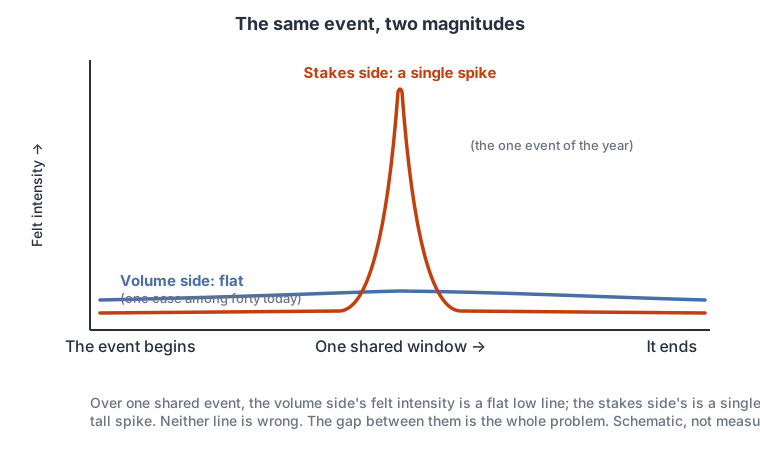
The same event, two magnitudes. Over one shared window, the volume side’s felt intensity is a flat low line (one of many that day); the stakes side’s is a single tall spike. Neither line is wrong. The gap between them is the whole problem. Schematic of the asymmetry, not measured data.
The playbook
Enough mechanism. Here’s what to actually do on each side. As in Part 1, notice how the two sides carry different loads — and how cleanly the moves transfer from the conference room to the kitchen table.
If you’re the one at volume
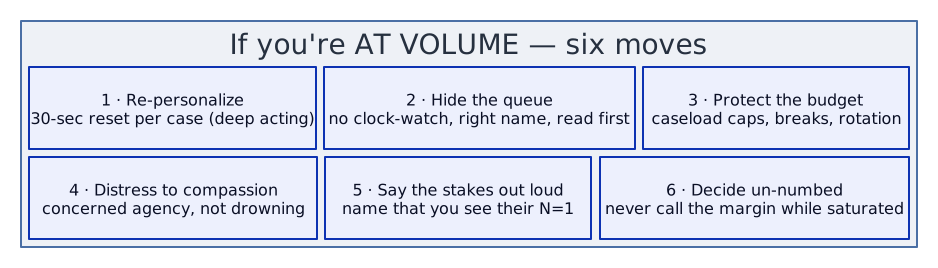
The volume side’s six moves. None of them is ‘care more.’ They’re ways to register this one person without breaking, and to keep the routine from leaking across the table.
1 · Ritualize the re-personalization
Build a deliberate reset into every case: thirty seconds to read the name, find one specific detail, and ask one genuine question about it. This is Hochschild’s deep acting made mechanical — you’re not manufacturing warmth, you’re locating a real hook so the warmth has somewhere to come from. A ritual matters more than an intention here, because intentions are the first thing saturation eats. The reset is cheap, it’s repeatable, and it’s the single most valuable thing the volume side can do.
2 · Design the interface to hide the queue
The stakes side judges the whole institution by micro-signals: the clock-watch, the template with the wrong name, the visible “next” energy, the CV read cold in the room. None of these change the outcome; all of them change whether the person leaves feeling seen. So engineer them out. Correct names. No visible clock. Read the file before, not during. The person does not need to be your only case — they need to not be able to feel that they aren’t.
3 · Protect your empathy budget structurally
Compassion fatigue is a systems problem, and treating it as personal weakness just produces hidden numbing — the depersonalization that overshoots. The structural fixes are the real ones: caseload caps, real breaks between high-intensity cases, rotation off the hardest work. If you run a team that processes people, this is your job, not theirs. You cannot exhort your way out of a budget problem; you have to fund the budget.
4 · Shift from empathic distress to compassion
When you feel yourself either drowning in a case or going cold to survive it, there’s a third position, and it’s the sustainable one: concerned agency. Not I feel everything you feel (that’s the distress that fatigues) and not I feel nothing (that’s the detachment that hardens), but I see that this matters enormously to you, and I can do my part well. It sounds like a small semantic move. The research suggests it’s the difference between a stance you can hold for a career and one that ends it.
5 · Say the stakes out loud
One sentence directly counters the routine-ness injury: “I know this matters a great deal to you, and I want to give it the attention it deserves.” It costs nothing and it does something specific — it tells the stakes side that you know their N equals one even though yours is forty. You don’t have to feel it at their intensity to name that you see it. Naming it is often most of what they needed.
6 · Reserve real decisions for real attention
Batch the admin; never decide a case while numbed. Numbing flattens exactly the distinctions that matter at the margin — which means the moment you’re most saturated is the moment your judgment is least fine-grained, and that’s precisely when the close calls get made if you let the queue set the pace. Separate the deciding from the processing. Make the marginal calls when you’re un-numbed enough to actually see the difference you’re deciding on.
A boundary line worth keeping: everything here is about the ordinary, occupational version of numbing — the normal churn of caring at volume. If the numbness never lifts, or the intrusive symptoms of secondary trauma are genuinely present, that’s not a workflow tweak, it’s a health matter, and it deserves a real conversation with someone qualified. This post is not that conversation.
If you’re the one whose life it is
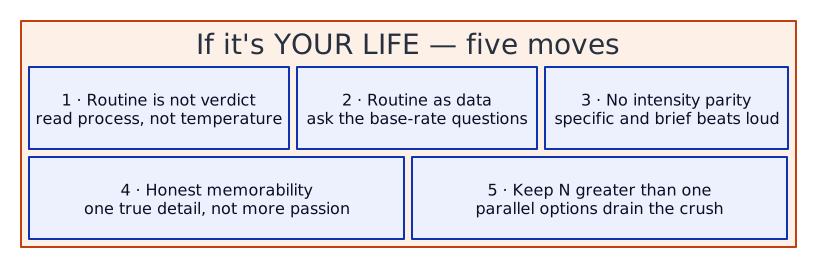
The stakes side’s five moves. Most of them are about reading the situation accurately — separating what their routine means about you (usually nothing) from what it means about them (they’ve done this a lot).
1 · Separate routine from verdict
Their efficiency is not your evaluation. This is the core reframe, and it’s genuinely hard in the moment because the routine feels like a judgment. It isn’t one. Read the process signals instead — the things from Part 1, the timeline and the follow-through — not the emotional temperature. The temperature is telling you about their day, not about your outcome. And here’s the reframe that makes it land: their routine is also their competence. You want the surgeon for whom your operation is routine. Routine hands are steady hands. Do not read the calm of practice as the coldness of indifference; most of the time it is the opposite.
2 · Use their routine as data
The volume side has seen four hundred cases like yours. That’s not only a threat; it’s an unusually good source. Ask the base-rate questions only volume can answer: “What distinguishes the people who do well here from the ones who don’t?” “What do people in my position most often misjudge?” In the interview chair that becomes “what’s the most common way candidates misread this role?”; at the care home it’s “what helps new residents settle in fastest?” — same move, any table. You are turning the very thing that flattens you into an individual (their throughput) into an advantage. Their routine is a dataset. Query it.
3 · Don’t demand intensity parity
This is the move that feels most natural and backfires hardest. Insisting the other side feel your stakes — the long escalating email, the urgency, the “do you understand how important this is to me” — triggers the motivated numbing we met earlier. Anticipating the emotional cost, they mute. So don’t push volume. Push specificity and brevity. A short, concrete message gets more genuine attention than a long, intense one, because it asks the saturated side for less and gives it something real to hold.
4 · Manufacture memorability, honestly
You will remember this encounter for years; the person across the table may forget it by Friday. That holds for the interview, the pitch, the appointment, the viewing — memory follows stakes, and the stakes are yours. You can’t fix the asymmetry of memory, but you can survive the queue — with one concrete, specific detail rather than higher intensity. Not the generic line everyone in their queue produces (in the interview case: “I’m so passionate about this,” which every candidate says and no one remembers), but the one true, particular thing that only you would say. Specificity survives saturation. Intensity drowns in it.
5 · Keep N greater than one
Your best protection against the crush of N equals one is to make N more than one. Parallel options, other conversations, a warm pipeline — this is Part 1’s consequence-mitigation, and it does double duty here. It protects you materially if this one doesn’t land, and it drains the desperate intensity out of any single table, which — usefully — makes you read as calmer and land better at every table. The person with alternatives is the person who doesn’t demand intensity parity, because they don’t need to.
The same asymmetry, off the clock
Everything above was framed for work, because that’s where the stakes asymmetry wears a lanyard. But swap the nouns and the two lists describe the kitchen table just as well, and one version of it is common enough — and painful enough — to name directly.
The asymmetry runs inside families and friendships all the time. The relative who’s a nurse, asked about every symptom at every gathering. The friend who does IT, cast as permanent unpaid support. The person whose crisis lands on someone for whom it is the fifth crisis this month. In each case one side is at volume and the other is having the event, and the same misreading happens: the volume side’s fatigue gets read as not caring, when it’s the cost of caring at a frequency no one signed up for.
The sharpest version is caregiving. Caregiver burnout is compassion fatigue at home, with none of the structural protection the workplace at least pretends to offer — no shift ends, no caseload caps, no rotation, no supervision. The person caring for an aging parent or a chronically ill partner is running the volume side of this asymmetry around the clock, and the structural fixes are exactly the ones that transfer: respite is a caseload cap, a rotation among family members is a break between cases, and saying the stakes out loud — “I know this is your whole world and I’m doing my best” — works at the bedside as well as the desk. If that’s the table you’re at, the numbing you might feel toward someone you love is not evidence that you’ve stopped loving them. It’s evidence that the valve is doing what valves do under sustained pressure, and that you need the structural relief that no amount of trying-harder substitutes for.
And the reverse case is worth holding too, because most of us are on the volume side of something without noticing. Your routine — the move you’ve done five times, the diagnosis you’ve lived with for years, the process you run every week — may be a genuine life event for the person hearing it for the first time. The calibration question is one sentence and it beats every assumption: “How big is this for you right now?” You don’t have to guess their magnitude from your own. You can just ask, and then act like the answer is true.
The one line to keep
If you remember nothing else, remember the shape underneath all of it, because it holds at every table:
Numbing at volume is structural, not callous — so the fix is mechanics, not moralizing. The volume side registers this one without breaking (re-personalize, hide the queue, feel differently rather than less) and protects its budget as a system, not a virtue. The stakes side reads the process, not the temperature — routine is competence, not verdict — and keeps N greater than one so no single table owns them.
That’s the whole thing. Everything else is the evidence for why it works, and the naming that lets you reach for the right move when you’re standing at the table.
This is the second entry in the asymmetry series — moments where two people share a table and live in different worlds. Part 1 was timeline and information; this was magnitude. There are more I keep bumping into: the asymmetry of attention (you’ll remember this for years, they forgot it by Friday — which is half-hidden inside this one), of feedback, of knowledge. I’m not committing to a syllabus. But the lens keeps earning its keep.
For now I’d rather hear from you, from whichever side you’re usually on. If you work at volume: what’s your re-personalization ritual — the actual mechanism that lets you see person number forty as a person, not just intend to? And if you’re often the one whose life it is: what’s the reframe that lets you read a routine manner as competence instead of a verdict? Put it in the comments. Someone reading this is sitting at one side of this table right now, misreading the other, and would take the help.
Sources
[1] Paul Slovic — “If I look at the mass I will never act”: psychic numbing and genocide (2007)
[4] Secondary Traumatic Stress and compassion fatigue — an overview (PMC)
[5] Charles Figley — Compassion Fatigue: Toward a New Understanding of the Costs of Caring
[7] Hojat et al. — The underlying construct of empathy, optimism, and burnout in medical students (IJME)
[8] Emotional labor and the distinction between surface and deep acting (Hochschild, The Managed Heart)
[9] Compassion does not fatigue: the empathic-distress-versus-compassion distinction (PMC)
About the Author
Stefan Christoph is a Principal Solutions Architect at AWS, focused on agentic AI, media & entertainment, and helping builders move from demo to production. He writes about AI architecture, developer productivity, and the future of software.
This is a personal blog. Opinions expressed here are my own and do not represent the views or positions of my employer.
🎬 Also available as a blog walkthrough video on YouTube
❤️ Created with the support of AI (Kiro)
📝 Last updated: September 2, 2026 — Diagram sizing fix (playbook grids render smaller)