

Democracy · 14 min read
Democracy Is Defended Long Before Anyone Needs Weapons
 Stefan Christoph
On this page
The Question at the Dinner Table
Just the other day I was at a table with colleagues from different countries inside and outside Europe. Politics comes up fast these days. People worry about the move to the right in Germany, and Germany isn’t the only European country where it is happening.
The question I get asked at tables like this one is simple: what is going on in Germany? In September I wrote a post the morning after the Saxony-Anhalt state election, asking what people in IT and media can actually do [1]. That post reacted to one election. This one looks at something slower, the attitudes underneath, measured the same way for more than twenty years. So instead of a short answer to the dinner question, here are a few charts. I think they say more than I could.
What the Leipzig Study Measures
The Leipzig Authoritarianism Study (Leipziger Autoritarismus Studie) has run every two years since 2002. The 2026 edition is the 13th, led by Oliver Decker and Elmar Brähler with Ayline Heller and Johannes Kiess, and it was presented in Berlin on 11 November 2026 [2]. The full 230-page volume is open access under CC BY-SA 4.0, which is why I can redraw its charts here.
A few things about the method matter for how much weight the numbers can carry [2, pp. 20–21]:
- The sample is random. The survey institute picks 258 sample points across Germany, then households and people within them at random. That’s more expensive than the online panels many polls use, and a random design is what allows estimates for the whole population at all. It doesn’t remove every error, though: with a 36.6% response rate, the people who declined may differ from those who took part.
- 2,507 people aged 16 and over took part, 36.6% of those the institute tried to reach. East Germany was oversampled (506 people) so that East–West comparisons are possible. With about 500 people in the East, small East–West differences can still be chance.
- Interviewers visit people at home, but respondents fill in the political questions themselves on paper and can hand the questionnaire back in a sealed envelope. That lowers the pressure to give socially acceptable answers.
- Fieldwork ran from 16 March to 3 June 2026. The Saxony-Anhalt election was on 6 September. So the data describe the mood before that result came in.
How to read these numbers
Most questions are statements rated on a five-point scale. “Explicit” agreement means 4 (“mostly agree”) or 5 (“agree completely”). “Partly” means the middle answer, 3. The authors read the middle answer as hidden agreement, and critics have called that reading too generous. In chapter 8 the authors test it with response-style models and find that no dimension of far-right attitudes was overestimated. For antisemitism, the real level is probably higher than reported [2, pp. 214–215]. In this post I always give explicit and partly agreement separately.
The Leipzig levels are also higher than those of Germany’s other large series, the “Mitte” study by the Friedrich-Ebert-Stiftung: 6.9% versus 3.3% with a closed far-right worldview. The main reason given is the survey mode. Leipzig uses a paper questionnaire in an envelope, while the Mitte study uses telephone interviews, where people state their views to a stranger [3]. So compare trends within one series, and be careful when comparing levels across series.
Support for and Satisfaction with Democracy Are at Record Lows
Since 2006 the study has asked three questions about democracy: do you support the idea of democracy, democracy as set out in the constitution, and democracy as it actually works in Germany? In 2026 all three are at their lowest since the first measurement [2, pp. 53–55].
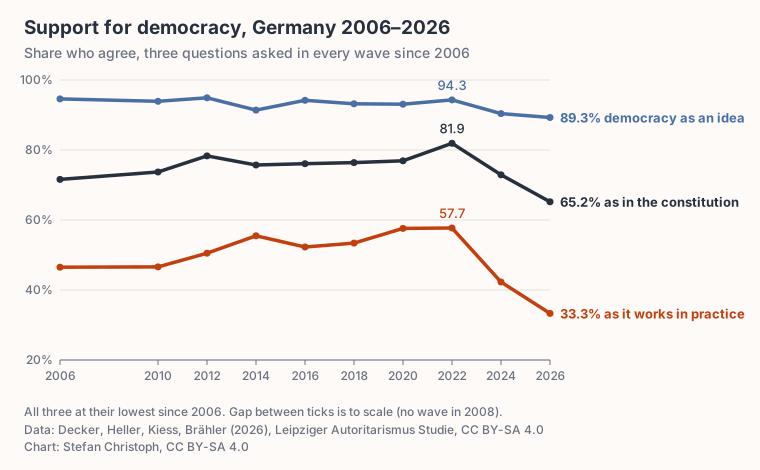
All three lines peak in 2022 or earlier and fall in both later waves. The drop is steepest for the two concrete questions.
Support for the idea of democracy fell to 89.3%, the first time below 90%. Most of that drop happened in the East, where it fell from 94.6% in 2024 to 85.7%. Support for democracy as set out in the constitution went from 81.9% in 2022 to 72.9% in 2024 and 65.2% in 2026. In the East it is 59.8%. And only a third, 33.3%, are satisfied with how democracy works in practice. In the West that’s 36%, in the East 22.8%, so roughly one in five. Nine in ten people still back the idea, but far fewer are happy with the version that comes with institutions, parties and day-to-day results.
The 2022 high was itself unusual. The authors read it as a pandemic effect: a strong executive satisfied an authoritarian need in large parts of the population [2, pp. 70–71]. That’s their interpretation, and it means part of the fall since 2022 is a return from a peak. But the 2026 values are also below every wave before the pandemic.
Far-Right Attitudes Rose for the Second Time in a Row
The study uses 18 statements across six dimensions, from support for a right-wing dictatorship to xenophobia and trivialising National Socialism. Someone has a “closed far-right worldview” if their average agreement across all 18 is at least 3.5 out of 5. That’s a high bar.
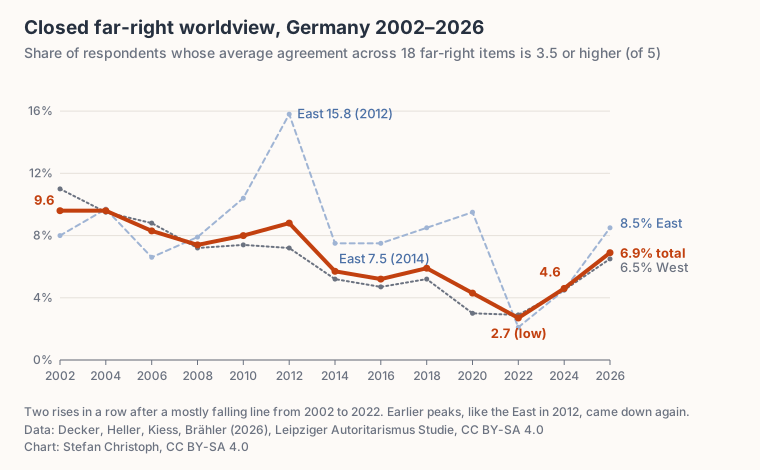
Twenty years of a mostly falling line, then two rises in a row. The East line shows how fast a peak can come down again.
From 9.6% in 2002, the share fell to 2.7% in 2022. Then it rose to 4.6% in 2024 and 6.9% in 2026, 8.5% in the East and 6.5% in the West [2, p. 38]. That East–West gap is not statistically significant this year [2, p. 33]. The authors write that they last saw rises like this in two consecutive surveys around the 2008 banking crisis [2, p. 46]. Chauvinism reached an all-time high of 19.9%. Agreement with traditional antisemitic statements more than doubled since 2022, to 6.2% [2, p. 46].
One statement gets a lot of attention, so I’ll quote it with both numbers. “What Germany needs now is a single strong party that embodies the national community as a whole.” 23.2% agree explicitly, and another 24.3% agree partly. In the East it is 30.9% explicit and 28.9% partly [2, pp. 26–27]. The original German says “Volksgemeinschaft”, a word with an unmistakable Nazi history, and the authors point out that this makes the high agreement all the more alarming.
Two New Questions: A Radical Break and a Better Past
For the first time, the 2026 study asks about two kinds of longing. The authors call the first one “activist apocalypse”: the wish for destruction, combined with the hope that something better comes out of it. The second is “regressive nostalgia”, frustration that comes from comparing today with an idealised past.
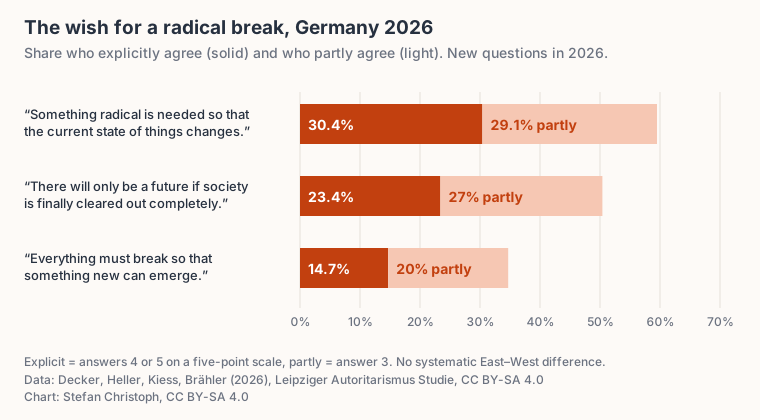
Even the most drastic statement, “everything must break”, gets explicit agreement from one in seven.
30.4% explicitly agree that “something radical is needed so that the current state of things changes”, and another 29.1% partly agree. 14.7% explicitly agree that “everything must break so that something new can emerge” [2, p. 67]. There’s no systematic difference between East and West here. Regressive nostalgia applies to 15% of respondents, more among people with lower education or income. The perceived decline of the national economy is more strongly linked to it than people’s view of their own finances.
Both are linked to party preference. Among AfD supporters, 22.5% wish for this kind of apocalyptic politics, among supporters of the Freie Wähler (Free Voters, a smaller conservative party) 21.3%, and among CDU/CSU and BSW supporters 11.6% [2, pp. 92–93]. In the authors’ models, regressive nostalgia goes with a higher likelihood of preferring the AfD.
These are correlations from one survey wave. They don’t show that nostalgia or the wish for a break makes anyone vote a certain way. The arrow could run the other way, or both could have common causes. The apocalypse scale is also new. It was developed in an online panel and has one wave of field data so far, so I’d treat it as an early signal.
What Did Not Get Worse
Several measures moved in the other direction.
Willingness to use violence is the lowest the study has ever measured. 9.9% say they are willing to use physical violence themselves to get their way, and in the East that share fell from 24% in 2022 to 8.5%. In the East, though, acceptance of other people’s violence rose to 21.2% [2, p. 57].
Antifeminism is down as well. 18.3% agree with antifeminist statements, the lowest since the study started asking in 2020, and the East–West gap has closed (17.8% East, 18.4% West). Solidarity holds up too. All three statements about the value of acting together get explicit agreement from at least three quarters of respondents, and more than 90% if you include partial agreement.
Within the far-right group, the survey shows no clear change in the AfD’s share. Among people with a closed far-right worldview who say they would vote, the AfD share was 57.1% in 2022, 56.8% in 2024 and 58.5% in 2026; the authors write that the AfD could no longer substantially expand its following in this group. The share in that group who say they would take part in an election rose, from 55.7% in 2020 to 69.4% [2, p. 46]. These are stated intentions, not measured turnout. The group is small, 170 people in the sample, so the exact figures are uncertain.
And there’s the long view. The total share with a closed far-right worldview was close to 10% in 2002 and came down to under 3% twenty years later. The East went from 15.8% in 2012 to 7.5% two years later. Peaks have come down before. The survey doesn’t say why they came down, so it can’t tell us whether this one will. The study’s title, which I come to next, makes the authors’ case that it can be stopped.
What “Aufhaltsam” Means
The study’s title is Der aufhaltsame Aufstieg des Autoritären. It borrows from Bertolt Brecht’s play Der aufhaltsame Aufstieg des Arturo Ui, written in exile in 1941, which tells the rise of the Nazis as the story of an American gangster boss. In everyday German you would say “unaufhaltsam”, unstoppable. Brecht made up the word “aufhaltsam”, stoppable, so that readers would stumble over it. The authors explain it this way: the rise of National Socialism, the war and the murder of Europe’s Jews followed no automatic course. They could have been stopped, and should have been [2, pp. 11–12].
Some English coverage rendered the title as “The Unstoppable Rise of Authoritarianism” [4]. That turns the message upside down. The authors mean that the rise can still be stopped. That’s an argument from history and a call to act, and I share it, but the charts alone don’t prove it.
Germany Is Not the Only Case
My colleagues at that table were right that this isn’t only a German story. I don’t want to compare German survey numbers with attitude surveys from other countries, because the methods differ too much (see the box above). But there’s one source that compares countries on the same scale. The V-Dem Institute in Gothenburg rates the state of democracy in 179 countries. Its 2026 report finds that nearly a quarter of the world’s countries were autocratizing in 2025, and that six of the ten newly autocratizing countries are in Europe and North America, among them Italy, the United Kingdom and the USA [5]. V-Dem also lists countries moving the other way, Poland and Brazil among them.
V-Dem looks at institutions such as free elections, courts and a free press through expert ratings, while Leipzig asks people in Germany what they think. These are separate developments, and neither source shows that one causes the other. I find it worth keeping both in view.
The Conscription Debate and My Civilian Service
In Germany there’s another debate running alongside all this: conscription. Germany suspended compulsory military service, and with it the alternative civilian service, from 1 July 2011 [6]. In December 2025 the Bundestag passed a law for a new, voluntary military service. All 18-year-olds get a questionnaire (mandatory for men), medical screening becomes mandatory again for men born from 2008, and compulsory service on demand would need a separate new law [7]. In November 2026 the defence minister said a return to conscription isn’t needed for now, with around 190,000 soldiers serving. CSU leader Markus Söder wants “real conscription” back, CDU politicians say it must return if volunteers aren’t enough, and young people have demonstrated against it [8].
I’m not going to take a side on conscription here. One thought from that debate stayed with me, though. On the German news podcast Apokalypse & Filterkaffee, the guest Levi Penell said that for a while after Russia’s invasion of Ukraine he seriously considered going to the front if it came to that [9]. His reasoning: people who no longer want democracy can simply vote it away, but anyone who wants it back has to fight for it with weapons. So by his own conviction he should be ready to defend it. And in the same breath he admitted he is terribly afraid of that, and that the fear would probably win.
Same for me. If it came to that, I’d be too scared to volunteer for the front line.
At 18 I did civilian service with disabled people. At the time I was sure we didn’t need armies anymore. Looking back, that was naive. But I still think 18-year-old me got one part right. In my view, an important part of defending a democracy happens long before anyone needs weapons. It happens in whether people still trust the constitution, whether they reject “a single strong party”, and whether they think acting together can fix things. The Leipzig charts don’t measure defence itself, but they do measure attitudes that bear on it. Those attitudes are slipping in satisfaction with democracy as it works, in the wish for a strong party and in the longing for a radical break. The low willingness to use violence and the high agreement on solidarity are the favourable signs.
In September I collected a few starting points for what people in IT and media can do [1], and I won’t repeat them here. This time I’ll end with a question.
The survey describes attitudes; what to do about them is up to us. Where do you see people keeping trust in institutions and acting together in your corner of the world, and are you part of it?
Sources
- [1] Worried About Germany? You Should Be. What Can We Actually Do? (my post, 7 September 2026). The reaction to the Saxony-Anhalt election and five starting points for IT and media people.
- [2] Decker, Heller, Kiess & Brähler (eds.), Der aufhaltsame Aufstieg des Autoritären. Leipziger Autoritarismus Studie 2026 (Psychosozial-Verlag, 2026, DOI 10.30820/9783837964806, CC BY-SA 4.0). All study numbers in this post and the data for the three charts; page numbers refer to the printed volume.
- [3] Wie verbreitet sind rechtsextreme Einstellungen in Deutschland? (Mediendienst Integration). Compares the Leipzig and FES Mitte studies and explains the gap with the survey mode.
- [4] The 2026 Leipzig Authoritarianism Study: the growing desire for authoritarian destruction in Germany (Leipziger Internet Zeitung, English edition). Cited here only for the English rendering of the title; numbers in this post come from the study itself.
- [5] Democratic Backsliding Reaches Western Democracies, with U.S. Decline “Unprecedented” (V-Dem Institute, press release on the Democracy Report 2026).
- [6] Aussetzung der allgemeinen Wehrpflicht beschlossen (Deutscher Bundestag, 24 March 2011). Conscription suspended from 1 July 2011.
- [7] Bundestag stimmt für neues Wehrdienstgesetz (Deutscher Bundestag, 5 December 2025). The Wehrdienst-Modernisierungsgesetz: voluntary service, questionnaire, screening, compulsory service only by a new law.
- [8] Pistorius rechnet derzeit nicht mit Rückkehr zur Wehrpflicht (tagesschau, 7 November 2026).
- [9] Rote Amore Fraktion (mit Levi Penell) (Apokalypse & Filterkaffee, 12 November 2026, German). The passage is at about 23:30–24:12; paraphrased and translated by me.
❤ Created with the support of AI (Kiro)