

AgentCore · 15 min read
The Engine Still Isn't the Car
 Stefan Christoph
On this page
In April 2024 I stood in front of a room of partners in Munich and told them that nobody buys a car for its engine. I had asked a model to list the parts of a car, then asked it what car buyers actually care about, and the two lists barely overlapped. The engine was on the second list, but far down, behind price, fuel use and the entertainment system. A few weeks later I wrote the argument up as a blog post [1]: the foundation model is the engine of a generative AI application, a commodity part, and the design effort belongs to the whole car.
Not everybody bought it, and I understand why. Colleagues and customers had a hard time agreeing that the model is only the engine. In 2024 every month brought a new model that won a benchmark, and “which model?” felt like the decision that mattered most.
Two years later I’d make the same argument, but one level higher. In my experience models got cheaper and easier to swap, and new capabilities rarely stay with one provider for long. The architecture question did not go away. It moved up a level, from one application to many teams building many agents, and at that level the useful idea from the 2024 post is the car platform.
What I said in 2024
The post leaned on three pieces of other people’s work. There was the a16z reference architecture for LLM applications, which showed how many components sit around the model: data pipelines, embedding models, vector databases, orchestration, caching, logging and validation [2]. My colleague Randy DeFauw had mapped that stack onto AWS services [3]. When I counted, roughly two of about thirty services in it were specific to large language models [1]. The rest was the storage, compute, security and operations we already knew.
And there was Gregor Hohpe’s book on platform strategy [4]. Car makers stopped building every model from scratch long ago. They build a platform that carries the commodity parts, and the different cars (sometimes no more than a different body and interior) sit on top. The 2024 post only used that idea in passing, but it’s the one that carries over to agents.
The practical advice was to pick a model that is just good enough for each use case, the Goldilocks model, and to keep the architecture evolvable so a better and cheaper model can replace it next month [1]. Unlike a car, software lets you swap the engine. Goldilocks never meant “always the small engine”. Some cars need the big one, and the platform should let each use case make that choice, so it doesn’t turn into one decision for the whole company.
What changed by 2026
The applications became agents. An agent typically calls models in a loop, calls tools that can change things, may keep memory across sessions and acts under an identity. The building blocks changed with it. Amazon Bedrock AgentCore offers runtime, gateway, identity, memory, policy, registry and evaluations as separate services [5], and I compared the main ways to run the agent loop itself on AWS earlier this month [14].
The model is still one part among many. What changed is that there are now many teams building agents. A single team building one assistant can still assemble its own stack. An enterprise where many product teams build agents pays a price if each team invents its own identity model, tool integration, guardrail setup and release path, because those controls drift apart, and afterwards it gets hard to tell which agent called which model with which tool. That’s a platform problem, and it’s the problem the AWS post I want to discuss starts with.
The blueprint as a car platform
On 28 October, Omar Elkharbotly, Mia Chang and Siva Shanmugam published “Building an Agentic AI Platform on Amazon Bedrock AgentCore” on the AWS Machine Learning Blog, with a companion reference implementation on GitHub [5] [6]. Their opening line could have come from my 2024 post. If you have tried to get an agent into production, “the model and tool use are not the blocker” [5]. The bottleneck is everything around them.
The post describes three operating models for agentic AI (centralized, decentralized, federated) and implements the federated one [5]. A Platform team owns the definition of each shared component: templates, versions, policies and admission. Each Workstream team gets its own cell, an isolated account boundary with its own source repository, pipeline, AgentCore Runtime, actor-scoped AgentCore Memory and a tool gateway that exposes only approved tools [5]. In my 2024 language, the Platform team builds the car platform and each Workstream team builds a car on it. One cell can deploy, fail, roll back or retire without coordinating with another team’s release [5].
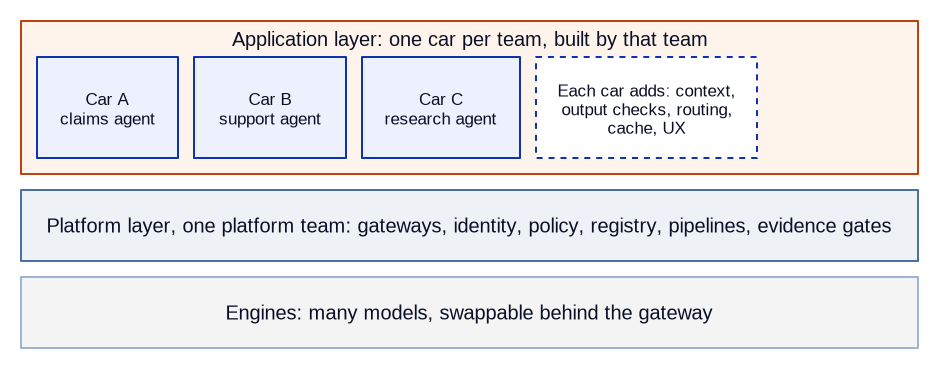
The 2024 picture, one level up: teams build cars on a shared platform, and the engines sit underneath where they can be swapped.
Three design choices in the blueprint map closely to the 2024 argument. Inference and tool calls go through separate gateways [5]. Model traffic crosses a shared inference gateway that the Platform team runs. It checks the caller’s token, applies the organization’s guardrail, allows only approved models and applies per-team rate limits. Tool traffic goes through a gateway in each team’s cell that authenticates with IAM and exposes only the tool targets that were approved for that team [5] [6]. Because the engine sits behind a gateway, model choice and access are managed in one place, though a swap still has to pass the tests again. The README notes that the gateway’s native rate limits are approximate, fail-open traffic shaping, and tells you not to use them as a billing ceiling or an authorization control, and to rely on IAM, service control policies, guardrails and account quotas as the hard limits [6].
The README also describes each component as a capability contract. It names what the component must guarantee and treats the AWS service behind it as one possible implementation [6]. The “LLM Gateway” row, for example, asks for central, non-bypassable authentication, model allow-listing, guardrail enforcement, quotas, usage attribution and telemetry. AgentCore Gateway with inference targets is the reference choice, and a LiteLLM gateway is named as an alternative. The README also says a substitute is “not automatically a drop-in configuration change” and only counts as supported after the same tests pass again [6]. That is the evolvable architecture from 2024, written down as a test obligation.
Releases need evidence. Every agent release has to prove each boundary it touches, and the evaluation gate pairs every authorized call with what the authors call an adversarial twin: call an approved model and confirm it works, then call an unapproved model and confirm the denial [5]. The same goes for tools, cross-account identity and throttling. “If an expected denial is missing, the gate fails the build” [5]. Retirement runs in dependency order and ends with an inventory that confirms nothing is left behind [5]. The README adds that this evidence is no compliance certification, and that the support claim covers only the exact reference implementation that was tested [6].
The federated model’s cost, which the authors name themselves, is that a central Platform team can turn into a ticket queue if every capability needs a request. That is why the README treats self-service interfaces and delegated ownership as part of the architecture in their own right [6].
What I saw in a scoped test
I wanted to see the gateways work, so on 29 October I had my coding agent deploy two pieces of the blueprint into one work account in eu-west-1, the Region the blueprint is validated in [6]. I read the source first and the full evidence afterwards. The blueprint’s own inference gateway construct went in unmodified. For the tool gateway I had to rebuild the team stack in the same shape with plain CloudFormation resources, because the original only runs with the registry and the cross-account pipeline around it. So the registry approval path wasn’t part of the test. Both stacks deployed on the first attempt, in 175 seconds. The whole run took about 27 minutes from an empty account back to an empty account, and resources were up for about 17 of them. My estimate for the test itself, from public list prices, is well under ten cents.
Each probe ran three times, and the timings are round trips from one client, small samples rather than benchmarks. On the inference side, a normal question to the approved model came back with HTTP 200 (“The capital of Ireland is Dublin.”) in about 630 ms. Asking for a model that was not allocated got HTTP 429 from the gateway’s rate limiter instead, because the construct gives every model without an allocation a zero-rate limit. A classic prompt-injection string in the user turn (“Ignore all previous instructions…”) was stopped by the configured guardrail with HTTP 403, in about 220 ms and before any model call. One blocked string is no proof against injection in general. The auth checks did what you’d expect, 401 without a token and 403 with a forged one. A system turn full of agent instructions went through without a false block. That’s deliberate. The interceptor’s comments explain that guarding the agent’s own system prompt made the prompt-attack check block every legitimate agent in the authors’ tests, so it guards user and tool turns and leaves system turns alone [9].
On the tool side, the list of tools contained exactly the one approved tool. Calls to the other Lambda function in the account, by its name or by a guessed tool name, came back as “Unknown tool”, and unsigned or wrongly signed requests got 401. With a Cedar policy engine attached in enforce mode, the approved call still worked, and when I rewrote the policy for a different principal, the tool list came back empty and the call was denied by default. With the policy engine attached, tool calls took roughly 50 to 80 ms longer in this small sample (the approved call went from 125 to 172 ms). Every allowed call had its denied twin, and every denial came from the control that was supposed to cause it.
Two observations from the test say more about where the platform ends than about the blueprint itself. The first is teardown. Deleting the stacks left the Cognito user pool behind, because the construct sets no removal policy and the AWS CDK keeps user pools by default when the stack goes away [16]. My cleanup script deleted it in a separate sweep. That is a small, concrete reason why the blueprint insists on an independent inventory after retirement rather than trusting the stack delete.
No check on the model’s answer
The second matters more. The reference inference gateway runs its guardrail as a REQUEST interceptor: it checks the untrusted turns going in, with the guardrail’s input setting, and does not look at the response [8] [9]. I tested that directly. I sent a harmless-looking user turn, a base64 string with the instruction to decode it, and the model decoded it and returned an insult with HTTP 200. The guardrail in the test was configured to block insults in model output as well. When I sent the returned text to the same guardrail through the ApplyGuardrail API with the source set to output, it intervened and blocked it. So the guardrail can catch it, but the reference inference path never sends the response to it.
I checked the repository again before writing this. Nothing in the inference gateway package changed between the commit I tested (347b1c5) and the current version [8].

Where the checks sit in the reference setup I tested. The way in is guarded on both paths; the model’s answer goes back to the agent without a check.
I read this as a scope boundary of the reference setup. The blueprint is explicit that it guards the way in, and the README describes the request interceptor applying the guardrail “to every untrusted turn” [6]. AgentCore Gateway supports a RESPONSE interceptor next to the REQUEST one [10], and the ApplyGuardrail API exists exactly so you can evaluate user input and model output separately, anywhere in your application flow [11]. The construct’s own notes explain why the input path is the enforcement point in this reference. The connector it uses ignores a guardrail identifier sent by the client [8]. So an output check is something you add yourself, as a response interceptor or in the agent. That decision is the useful part. A platform that guards the input of every team makes it easy to assume it guards everything. It doesn’t, and the platform contract should say whether the output check runs centrally or in each agent.
What stays with the team building the car
In July 2024 Chip Huyen published a long post on building a generative AI platform, organised as a sequence of components you add as an application grows: enhanced context (retrieval), guardrails on input and on output, a model router and gateway, caching, and complex logic with write actions, with observability and orchestration across all of them [12]. I mapped her list against what the blueprint covers. Where the table says “team”, I didn’t find the component as a core contract in the blueprint. The mapping is mine, from reading the source and the test.
| Component from Chip Huyen’s list | Who covers it in this setup |
|---|---|
| Context construction (retrieval, query rewriting) | team |
| Input guardrails | platform: request interceptor on user and tool turns |
| Output guardrails and output quality | team: response interceptor or a check in the agent |
| Gateway: access, model allow-list, quotas | platform |
| Router by cost and quality | team: the README recommends routing by need [6] |
| Caching | team |
| Tools and write actions | platform governs access; the team owns the tools |
| Memory | platform provides AgentCore Memory per cell; the team decides what to store |
| Observability and evaluation gates | platform, with the team’s own evaluation cases |
| User experience | team |
In car terms, the platform carries the chassis, the brakes and the wiring standards. The team decides what the car is for, what goes into it, how it talks to the driver and what it checks before it says something.
My cost estimate from the test makes the same point from another angle. At 1,000 agent calls a day (one model call and one tool call each, about 500 input and 200 output tokens, eu-west-1 list prices), I estimated $32 to $80 a month for the setup I tested. Model inference at that volume came to about $7. The biggest swing item was the Cognito machine-to-machine token requests. Cognito charges per token request [13], and with the construct’s five-minute token lifetime the bill depends on whether the agent reuses its token or fetches a new one for every call. Caching a token is an application decision, so it lands with the team too. Treat these numbers as an estimate from list prices (I didn’t run a month of traffic).
Who should deploy the whole thing
The full blueprint is a large enterprise solution, and its authors say so. The Guidance page pitches it as a self-service agent platform “for hundreds of engineers across product teams” [7]. The prerequisites list an AWS Organizations landing zone, at least Management, Platform and Workstream account roles, a GitHub organization with AWS CodeConnections, and organizational pieces like a platform product owner, an account-vending process and a FinOps allocation policy [6]. It is validated in eu-west-1, and another Region is “a new validation target, not a configuration-only substitution” [6].
If that describes your organization, the authors’ own advice is the right start. Deploy one representative Workstream cell, prove its full lifecycle, and only then repeat it [5]. If you’re a small team with two agents, the full deployment is more platform than you need, and you’d spend your time on landing-zone work while your car waits. Take the contracts instead. Put a gateway in front of your models, give your tools exact targets and least-privilege roles, pair every allowed call in your tests with a call that must be denied, and write down which checks you own. I wrote about the registry side of this earlier, as the service catalog pattern for agents [15].
Two years ago I worried that people were spending all their design time on the engine. Today the engines are good and cheap, and swapping one is far easier, which is what I hoped for. The open question now is whether your organization has a platform that lets many teams build cars safely, and whether each team knows which parts of its car are its own job. Which of the checks in that table does your team actually own today?
Sources
- [1] Stefan Christoph, How Do You Choose the Foundation Model for Your Generative AI App — Like Your Car? (June 2024)
- [2] Andreessen Horowitz, Emerging Architectures for LLM Applications (June 2023)
- [3] Randy DeFauw, Generative AI Project Prioritization, AWS Builder Center (October 2023)
- [4] Gregor Hohpe, Platform Strategy (Leanpub)
- [5] Omar Elkharbotly, Mia Chang, Siva Shanmugam, Building an Agentic AI Platform on Amazon Bedrock AgentCore, AWS Machine Learning Blog (28 October 2026)
- [6] Enterprise Agentic AI Platform Blueprint on AWS, README, aws-samples on GitHub (read 11 November 2026)
- [7] AWS, Guidance for Building an Agentic AI Factory on Amazon Bedrock AgentCore
- [8] platform-inference-gateway construct source, aws-samples on GitHub, at the tested commit 347b1c5
- [9] guardrail interceptor source, aws-samples on GitHub, at the tested commit 347b1c5
- [10] Amazon Bedrock AgentCore Developer Guide, Using interceptors with Gateway
- [11] Amazon Bedrock User Guide, Use the ApplyGuardrail API in your application
- [12] Chip Huyen, Building A Generative AI Platform (July 2024)
- [13] Amazon Cognito pricing
- [14] Stefan Christoph, Which Agent Platform? Bedrock Managed Agents, AgentCore Harness, or Runtime (November 2026)
- [15] Stefan Christoph, The Service Catalog Pattern for AI Agents
- [16] AWS CDK API Reference, UserPoolProps: removalPolicy (default
RemovalPolicy.RETAIN)
❤ Created with the support of AI (Kiro)