

AIAgents · 22 min read
Just One More Thing: How AI Is Changing the Way We Work
 Stefan Christoph
On this page
Agents That Interrupt Like Columbo
If you’ve watched Columbo, you know the move. The detective shuffles towards the door, the suspect relaxes, and then he turns around: “Just one more thing.” The case cracks open. It is brilliant television, and a terrible way to run your afternoon.
That is what working with several AI agents felt like for me. I’d start a research job, draft something else while it ran, and just as I found my focus the first agent turned around with a question. I answered, lost my place, and the next one did the same. I wrote about it in June in From Columbo to Coworker [1], and the talk builds on that post.
Most of us don’t work like this yet. For many people, AI at work is a chat window opened now and then. For some it’s a daily helper for a draft or a summary. Agents that take on a whole piece of work and come back with a result are still rare. So I didn’t bring a forecast for everyone. The talk showed one practitioner’s working day, mine, with what works and what doesn’t yet. That day fits work you can describe in advance. If most of your day is reacting, on call or at a service desk, the morning session gets shorter and the check-in threshold matters more.
A small confession, which is also in the talk: my agents drafted the first version of this talk in one long run while I did other work. The slides, the speaker notes and some extra material came out of that run. A second AI model reviewed it, then a colleague did, and I made every decision along the way. So the talk itself was made the way it says to work.
If you were in the room, this is the post behind the QR code. If you weren’t, the sections follow the talk’s order, and the links at the end go deeper.
Running the Day Like a Team Lead
I showed two versions of the same working day on the same clock. The first is the doorbell day: a few agent work packages running quietly at the top, and underneath, small interruptions all day long. “Quick fix.” “Which region?” “Clarify scope.” Each one takes a minute. Together they eat the day. By noon I had built nothing and answered a lot of doorbells.
Parallel work is the whole point of agents. The trouble is that every one of them can interrupt you at any moment, and you quietly become their scheduler.
The second version is the day I’m working towards. The agents get fewer pieces of work, and much bigger ones, so one launch replaces several small requests. The coordination work is still there. It moves into a few scheduled windows: a morning session where I prepare and launch the work (I call it seeding), and one or two pickups later in the day (I call them harvests). In between, I get long blocks of focus for my own work and for people. That’s the target, and on good days I get close to it. I haven’t measured it. It’s one person’s experience since June, so treat it as a pattern to try.
Bigger work packages start with grooming. I keep a list of work I want to hand over, and before anything runs I go through it with the agent in a short session. A task is ready only when four things are clear: what done looks like, what it may touch, what’s out of scope, and which sources to use. The longest packages don’t run on my laptop. They go to a remote machine, run on their own while I do other things, and wait there until I collect them. When something goes wrong, the lesson goes into a playbook or a rule, so it is less likely to happen again [3].
Four Parts of the Day
We know this situation from leading people. A good team lead doesn’t sit next to each person and wait for them to look up. They run a structure, and I borrowed it. It has four parts:
- In the morning session I look at what came back, decide what matters today, and describe the next pieces of work properly.
- Then the agents go away on their work packages, longer and well-described: research, a draft, tomorrow’s meeting preparation, my travel expenses. Meanwhile I do my own work or talk to people.
- Check-ins have a high threshold. An agent may call me in only when it really can’t continue, or when a decision belongs to me. Everything else waits. Where a choice is open, I’d rather it prepares options than asks me. The price is that some work waits for hours until the pickup. I accept that, and a well-described package can park its question and carry on with the parts that don’t depend on it.
- At the pickup I collect what came back, go through it in one batch, one decision after the other, and decide what goes out.
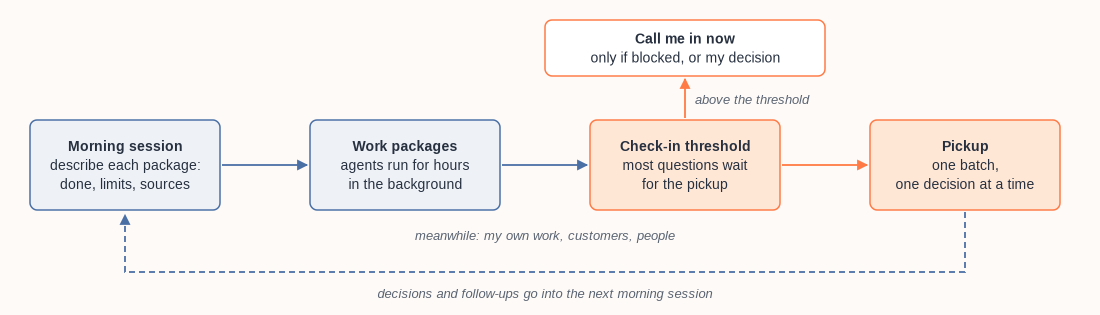
The working day as a loop. The first two parts are the set-up. The threshold and the pickup are where the focus comes back.
The morning session and the work packages are the set-up. The threshold and the pickup decide how much focus I get back: the higher the bar for check-ins and the more I batch the pickup, the longer I can stay with my own work. All of it depends on a good description in the morning. Badly described work comes back fast, and wrong, or full of questions. One part still doesn’t hold for me. When an agent asks, I usually answer, because the question is cheap and right in front of me. If you want to see a full day like this where most of the work isn’t code, I wrote about a day with a coding agent in which I didn’t write a single line of code [4].
A Week in the Calendar
In my calendar, every day starts with a short morning session. Right after it, the agents start their work packages, which run while I’m in meetings or doing my own work. One or two short pickups a day go into the calendar as real blocks, like a meeting with myself, and at the end of the day my agent writes me a short recap. Everything between the morning session and the pickup is mine: customers, focus, people.
What Changed in the Pickup
Two things changed since the first version of this routine. My morning pickup now runs on one screen, with the brief on the left and one card per decision on the right, worked through one after the other. And each decision now gets carried out right away, during the session. An item that is decided but not done is the worst kind, because it looks finished. The first version of the routine, with its ceremonies and a list of what didn’t work yet, is in From Columbo to Coworker [1].
The pickup is also where the bottleneck moves. Agents can produce more than I can check well, so when the pile grows I start fewer packages and keep checking each one properly.
What Changes in How We Think
The Slow First Time
The first time I taught my agent to prepare customer meetings, it took me much longer than preparing the meeting myself. The next morning, the briefings were ready while I was still drinking my coffee. The first run included the cost of writing and correcting the instructions. For a recurring task that stays stable, those instructions are reused and refined on later runs. It’s the same with a new colleague: if you never invest time in onboarding them, they won’t become productive either. “It’s faster if I just do it myself” is often true the first time, and I called it the most expensive sentence in AI [5].
Skills That Matter More in My Work
Earlier in my career, I was judged mainly on producing the thing myself: the report, the analysis, the plan. In my work, four other things now matter at least as much. Define what good looks like before you ask. Give the context the agent can’t know. Check what matters, every time. Decide, and own it. A good product owner works much the same way, describing what should be built and judging whether it is good. Judging quality is easier if you have done the work yourself. For people early in their careers, producing the thing by hand stays part of how they learn to judge it, and I don’t think agents remove that. Which of our work is actually easy to check is a harder question than it looks, and I think we often misjudge it [6].
What I Stopped Doing
I no longer prepare every customer meeting from scratch. My agent writes a one-page briefing the evening before, and I read it with my coffee and add what only I know. I no longer read every channel so I don’t miss anything, because a morning brief tells me what changed and what needs me today. The agent matches my travel receipts to the trip and drafts the expense report, and I check and submit it. And I no longer write code from scratch. I describe what I want, the agent builds a first version, and I review it. That frees time for customers, trade-offs, writing, deciding and small prototypes. My edge moved towards judging quality, asking better questions and making decisions. Everything the agent drafts, I check before it leaves my desk.
What Sits Behind My Agent
Around the agent sit three kinds of things. Playbooks, one for each recurring job, written in plain text: the morning brief, meeting preparation, travel expenses, writing a blog post. Standing rules that always apply, for example that nothing leaves without my approval. And connections to mail, calendar, chat, the CRM and a browser. Underneath are a notes vault where results are filed, a remote machine for the longer work packages, and review gates that results pass before they wait for my sign-off. Most of my effort goes into writing and maintaining those playbooks and rules, and none of that is programming.
What Changes for People and Teams
Productivity and Company Results
Personal productivity doesn’t automatically become company results. In McKinsey’s State of AI survey from August 2026, 80% of respondents say AI has improved their productivity, and 37% say AI has contributed positively to their organisation’s EBIT [29]. Those are two different questions in the same survey, one about people’s own work and one about company results, so the gap between the two numbers is only a hint. It doesn’t measure a loss, and the survey doesn’t show how one turns into the other. My argument is that turning individual speed into company results also takes teams changing how they coordinate, review and ship the work, and a big part of that is people.
In a Bitkom survey from April 2026, 48% of employed people in Germany say they use AI at work, and 45% fundamentally reject AI support in their job [30]. The two figures can coexist because they may describe partly different people, and the press release doesn’t say how much the groups overlap. The survey shows substantial AI use and substantial rejection in the same workforce, but the press release doesn’t explain respondents’ motivations.
Four Fears About Agents
McKinsey names four fears at the heart of resistance to agents [31]. I put each one as the question people ask themselves, with my answer drawn from the same research:
- “Will I look incompetent?” Make learning safe and normal, with hands-on sessions and colleagues who show their own work, including where the agent got it wrong.
- “What is left for me?” Show which parts of the job change and which stay, and invest in getting people there.
- “Who is to blame?” Set clear rules for when a person checks, decides or overrides.
- “Where is this going?” Lead honestly. McKinsey offers a sentence a leader can say: “I don’t know exactly where we’re going, but I’m learning alongside you.”
None of these answers arrives with a model upgrade. I went deeper on them in the post for my earlier talk, More Than Technology [2].
Who Approves Each Action
The check-in threshold from my working day becomes a team decision. Some things an agent can do on its own, such as sorting incoming requests or summarising a long thread. Some things it prepares and a person decides, such as a reply to a customer or a change to a plan. And some things it never does without a person: anything you sign, anything you can’t take back. Write that down as a team and revisit it as trust grows. As one person in McKinsey’s study put it: “If the agent gives me the wrong answer and I act on it, it’s still my mistake” [31]. In one week this autumn I gave four talks to four very different rooms, and every one of them came back to this question [7].
Trust can grow in steps. First the agent only watches: it reads and tells you what it noticed, and it can’t send or change anything. That’s a lower-risk start, though not a risk-free one, because it still reads your data, and in my experience it is one of the most useful steps [8]. Then it drafts and you send. Then it acts after your approval. Last, it acts alone within limits you agreed. That last step is optional: I keep a task at an earlier step unless the benefit and the track record justify moving it further.
From Personal Rituals to Team Rituals
My setup feels like a small team, but it’s one person with his agents, his context and his notes. When a colleague picks up a topic I worked on, they start cold. Many personal AI tools still work that way, as single-player tools [9]. Most work happens in teams, so the next step is to turn personal rituals into team rituals: a shared morning session, a shared pickup that includes where the agent was wrong, and shared context the next person inherits. After a year of remote work, my own group was more group than team, and cooking one paella together gave us a taste of a team [10].
Agent Adoption in AWS’s Go-to-Market Organisation
Even at AWS, adoption was people work. McKinsey published how AWS’s go-to-market organisation adopted agents [32]. One agent was well used by the people it was built for, and adoption stalled when access expanded to colleagues whose work it didn’t fit. AWS responded with people work: field champions who help peers, immersion sessions so leaders bring AI into their own work, and AI-powered reports in the weekly and monthly business reviews. Some managers now spend less time reviewing data and more time coaching, which wasn’t an explicit goal. If you plan a rollout, budget for the change work as well as for the tools. And if you also want to measure whether people use AI, measure adoption and don’t rank people by it [11].
How We Build: Onboarding an Agent
For a room where most people use IT and few build it, “how we build” means getting an agent to do something useful. You get there much the way you onboard a new colleague, by answering four questions:
- What is your job? Every Monday, a prioritised overview of my week, at most half a page.
- What may you see? My calendar and my inbox.
- What may you never do without me? Never send anything, never accept or decline a meeting.
- When do you work? Mondays at seven.
Those answers are the brief, and the platform supplies the model, the connections and the permissions. Writing the answers and keeping them up to date is most of the work. Many of the safety rules in my setup were written the day after something went wrong [12], which is also how a new colleague learns.
How This Talk Was Built
On day one I wrote a short brief: who the audience is, what they care about, and what I didn’t want on the slides (no product pitch, no competitors, only a few numbers, each with a source). Then came one work package, a single long run on a remote machine while I did other work. It did the research, wrote the story, built the slides and the speaker notes, and prepared extra modules for the discussion. There were no check-ins. Wherever a choice was mine, such as the title, the opening or which numbers to show, the agent built the options side by side on a review page for me to pick from. At the next day’s pickup I chose between options, cut the alternatives I didn’t want, and confirmed or corrected every statement about myself. Then came the checks. Every number has a source, a second AI model reviewed the work and I decided which findings to apply, and a colleague’s review shaped the version I gave. I count that checking as part of building, and I wrote about a pipeline built around it [13] [14].
Building in the Business Units
A pile of home-grown internal tools can tempt you to stop building, and I think that would be the wrong lesson. Good ideas often start where builders work directly with the people they build for, out in the business units. Give those teams a shared, governed frame, so good local solutions can be found, reused and spread.
A Prototype Built in One Night
Werner Vogels tells the story of a principal scientist on the AWS Quick team who spent a whole night with Kiro building the first prototype of what would become the AWS Quick desktop app [33]. When he demoed it, the team’s first question was “how do I get this on my laptop right now?” and the second was “what can I help with?” Within hours, the main parts had owners. In Vogels’s account, it was a prototype people could try that prompted those requests. Getting from that prototype to something a department can rely on is separate work, and I wrote about what it takes [15].
Three Experiments at Amazon
Amazon tested what happens when teams change the way they work along with the tool [34]. Six senior engineers rebuilt the Amazon Bedrock inference engine in 76 days, a project originally estimated at 30 developers over 12 to 18 months. Six engineers on a Prime Video team, with tasks broken down in advance, produced 556 commits in a 10-day sprint, against what the post calls a baseline of 96, without saying over which period that baseline was measured. And in pilots where Amazon Stores teams worked on their regular backlogs, with no handpicked engineers, the median gain was 4.5x in normalised deployment velocity, meaning features deployed per sprint compared with each team’s own history. Those pilots are part of an experiment across more than 50 teams. The teams that changed both their tools and their practices did best. In the words of the post: “The workflow matters, not just the tool.” These are first-party results, and the Bedrock comparison is against an estimate, not a measured baseline. I wrote earlier about what that means for how teams are organised [16].
AWS Quick, Kiro and an Assistant for Everyone
AWS Quick
Now imagine this working pattern available to everyone, including people who aren’t developers and don’t build their own setup. AWS Quick is one example of how that becomes possible without building the platform yourself [17]. You may know it as Amazon Quick. Since November 2026 it’s called AWS Quick [18]. I showed it in three steps. It connects to your context: files, data and enterprise applications [19]. Teams build their own agents and automations on it, with Quick Flows for simple, repeatable workflows and Quick Automate for complex, multi-step processes across systems, both without code [19] [20]. And what a team builds is shared with colleagues in Spaces, where knowledge, data, apps and agents come together [19].
A Day With AWS Quick
In the morning, the activity feed starts with a daily briefing: overnight activity, your day plan and calendar, decisions that need your attention, and follow-ups that are due [21]. During the day you ask for a report, and Quick pulls the data together [19]. At the end of the day, agents keep working even when your laptop is closed [22], and you can follow their progress, give more input and review their output [23]. That maps onto my threshold and my pickup. Once everyone has an assistant like this, the people questions from earlier apply to everyone too.
My Own Dashboard
In the talk I also showed my own dashboard, with made-up data: today’s sessions, the work packages they started, what came back, and the decisions waiting for me. When a run has failed, that’s where I look first.
Kiro
My setup runs on Kiro. Kiro describes itself as an AI-powered development environment that helps you build software from prototype to production, and the same agent meets you in several places [24] [25]. The IDE is an editor with the agent built in, which can plan bigger work as a spec first [25]. The CLI runs the Kiro agent in your terminal, also headless for scripts and automation [26]. Kiro Web is the autonomous agent: you give it a task, it works in a sandboxed session, and it opens a pull request for you to review [25] [27]. Powers package tools and know-how that activate when a task needs them [28]. Kiro’s own description lines up with my working day: agents that keep going while you’re away (my work packages), workflows that split long tasks into checked steps, and agents that flag what needs review (my pickup) [24]. You pick the model per task, or let Kiro choose. The agents that drafted and checked this talk run on Kiro CLI.
Questions for the Discussion
The talk ended in an open discussion, started with three questions:
- Which part of your week could become a morning session plus a work package?
- What would you never let an agent decide without you, and is that written down for your team?
- What would your team need from IT to make this safe and easy?
If you want one experiment for next week, pick one recurring task and answer the four onboarding questions for it. Let it run for a week, collect the result at a fixed time and not whenever it pings you, and show a colleague what worked and what didn’t.
How do you organise your working day with AI agents? Has anything held the line on the small interruptions for you?
Sources
Start here
- [1] From Columbo to Coworker · the problem and the first version of the routine (June 2026).
- [2] More Than Technology: How Agentic AI Changes Minds, Culture, and the Way We Build · my earlier talk on the same three lenses, with slides and sources.
The working day
- [3] How My Setup Learns While You Sleep · how lessons from failed runs are kept.
- [4] The Coding Agent That Doesn’t Code · a full working day with an agent, almost none of it code.
Minds
- [5] “It’s Faster If I Just Do It Myself” — The Most Expensive Sentence in AI · the slow first time, and why it pays back.
- [6] Which of Your Work Is Actually Verifiable? · which work is easy to check, and why we misjudge it.
People
- [7] Four Talks, Four Rooms, One Question: Who Clicks Last? · the question every room came back to.
- [8] The AI That Only Watches · the read-only first step.
- [9] Your AI Pair Programmer Is Playing Single-Player · why personal AI isn’t team AI yet.
- [10] What a Paella Taught a Group About Becoming a Team · group or team, and what moves one towards the other.
- [11] AI Usage Metrics Make a Good Smoke Detector and a Bad Scoreboard · measuring adoption without ranking people.
How we build
- [12] My Agent’s Rulebook Was an Accidental Threat Model · the safety rules written after things went wrong.
- [13] A Content Pipeline That Doesn’t Trust Itself · second-model review and verified claims.
- [14] The AI Content Pipeline: How I Publish 3x a Week Without a Content Team · the pipeline end to end.
- [15] The Other Half of Two-Pizza · from prototype to production.
- [16] The Post-Agile Operating Model: How AI Changes How Teams Ship · how team structures change.
AWS Quick and Kiro
- [17] AWS Quick · the product page.
- [18] Amazon Quick is now AWS Quick, AWS What’s New (Nov 2026) · the new name.
- [19] AWS Quick FAQs · Flows, Automate, Spaces and agents.
- [20] Flows, AWS Quick user guide · building a flow.
- [21] Stay on top of your work with your proactive feed, AWS Quick user guide · the activity feed and daily briefing.
- [22] Amazon Quick desktop app, About Amazon (Sep 2026) · agents that keep working while the laptop is closed.
- [23] Get back hours every day with autonomous agents in AWS Quick, AWS Machine Learning Blog · following and reviewing agent runs.
- [24] Kiro · the home page.
- [25] Kiro documentation · one agent behind the IDE, CLI and Web.
- [26] Kiro CLI documentation · the agent in your terminal, headless runs.
- [27] Kiro Web documentation · the autonomous agent and its pull requests.
- [28] Kiro Powers documentation · know-how that activates on demand.
Sources (external)
- [29] McKinsey: The state of AI in 2026: On the road to ROI (Aug 2026) · 80% report better productivity; 37% report a positive EBIT contribution.
- [30] Bitkom: Ein Drittel nutzt KI mindestens einmal pro Woche (press release, 28 Apr 2026) · 48% use AI at work; 45% fundamentally reject AI support in their job.
- [31] McKinsey: How to close the agentic adoption gap (Aug 2026) · the four fears and both quotes; the four answers are my synthesis.
- [32] McKinsey: Lessons from our alliances: What AWS’s agentic journey can teach CEOs about rewiring for AI (Aug 2026) · AWS’s go-to-market adoption story.
- [33] Werner Vogels: A return to two-pizza culture (All Things Distributed, 30 Jun 2026) · the one-night prototype and its owners.
- [34] Swami Sivasubramanian: How frontier teams are reinventing AI-native development (AWS Machine Learning Blog, 10 Jun 2026) · the three experiments and “The workflow matters, not just the tool.”
❤ Created with the support of AI (Kiro)