HTTP 402: The 30-Year Placeholder That AI Agents Finally Activated
- 9 minutes readTL;DR: HTTP 402 “Payment Required” has been reserved since 1997 but never used — because humans can’t approve per-page charges fast enough. AI agents can. The x402 protocol (Coinbase, 2025) revives 402 for stablecoin micropayments at ~$0.0001 per transaction. AWS now offers AgentCore Payments as a managed implementation. For publishers, this creates a third revenue stream beyond ads and subscriptions: validated agents pay per-article, automatically, with budget controls.
The Internet’s Most Famous Unused Feature
In 1997, the HTTP specification reserved a status code for a feature the early web assumed would arrive any day:
402 Payment Required — This code is reserved for future use.
That’s it. That’s the whole spec entry. For thirty years.
The intent was clear: some resources cost money. When a client requests one without payment, the server should respond with a structured refusal explaining how to pay. But the “how to pay” was never defined, and the web moved on without it.
Other status codes tried to fill the gap. 401 Unauthorized handled authentication. 403 Forbidden handled authorization. 429 Too Many Requests handled rate limits. But none of them said: “You need to pay for this.” That job stayed vacant.
Until now.
Why Every Prior Attempt Failed
The history of internet micropayments reads like a graveyard of good ideas killed by the same problem:
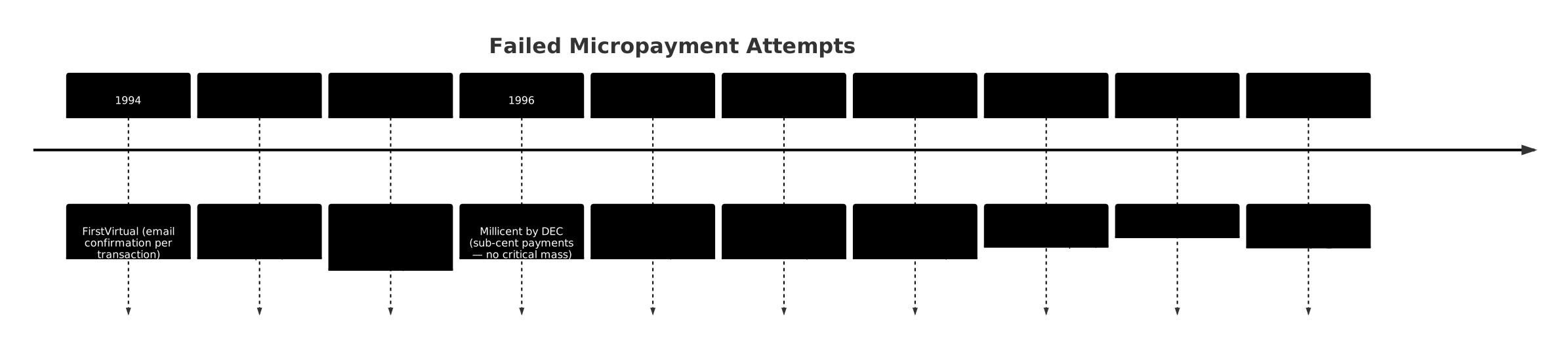
30 years of failed micropayment attempts — until AI agents removed the human-approval bottleneck.
Every single one ran into the same wall: humans don’t want to approve per-page charges.
Think about it. Even if a server returned 402 saying “pay $0.10 for this article,” the human behind the browser couldn’t realistically do that hundreds of times a day. The cognitive load alone kills it. The transaction UI kills it. The psychological friction of “should I really pay for this?” kills it.
The technology was ready for decades. The user model never caught up.
Why AI Agents Change Everything
An AI agent doesn’t have psychological friction.
It can evaluate a 402 response, check its budget, authorize the payment programmatically, and retry the request — all in milliseconds. Hundreds of tiny payments per second? Fine. Thousands? Also fine.
The human’s role changes from “approve every charge” to “set the spending rules.”

The shift: from human-in-the-loop approval to agent-with-budget autonomy.
Once an agent has a wallet and a budget, 402-based payments stop being a UX problem and start being a plain HTTP round trip.
How x402 Actually Works
The protocol is elegantly simple. It’s just HTTP [1]:
Step 1: Agent requests a resource.
GET /premium-article HTTP/1.1
Host: publisher.example.com
Step 2: Server responds with 402 + payment instructions.
HTTP/1.1 402 Payment Required
Content-Type: application/json

{
  "accepts": [{
    "network": "base",
    "asset": "USDC",
    "amount": "0.01",
    "payTo": "0xa0b8...ef8B",
    "resource": "/premium-article"
  }]
}
Step 3: Agent signs a stablecoin payment and retries.
GET /premium-article HTTP/1.1
Host: publisher.example.com
X-PAYMENT: <base64-encoded-signed-payment-proof>
Step 4: Server verifies on-chain, delivers content.
No account creation. No API key provisioning. No subscription management. No billing page. Just HTTP, the way the spec always intended.
A few things worth noting: USDC is a stablecoin pegged 1:1 to the US dollar. There’s no crypto volatility here. End-users fund their agent’s wallet once (via credit card, Apple Pay, or bank transfer) and set a spending budget. The agent then transacts autonomously within those limits. If the budget runs out mid-task, the agent receives a denial and should return partial results or ask the user to top up.
The low transaction costs (~$0.0001) are possible because x402 settles on Layer 2 chains like Base and Solana, not on Ethereum mainnet where gas fees would make micropayments uneconomical. This is a deliberate design choice.
As of April 2026, x402 has processed 75M+ transactions at $24.24M total volume — roughly $0.32 per transaction on average [1]. That’s genuine micropayment territory.
What This Means for Publishers
I’ve been thinking about this intersection of AI agents and content monetization for a while [2][3]. Back in October 2025, I wrote about how publishers need to treat AI agents as first-class customers — enabling them with content and providing agent-friendly experiences [4]. A few months later, I made my own website AI-agent friendly by serving markdown via CloudFront content negotiation [5].
x402 completes the picture. The stack now looks like this:

The publisher stack for the agent era: serve, gate, verify, deliver.
For publishers, this creates a third revenue stream that doesn’t cannibalize the other two:
- Ads still work for human browsers
- Subscriptions still work for loyal human readers
- Agent micropayments work for the growing share of traffic that comes from machines
The key insight: you don’t need to choose. Block unknown scrapers. Monetize validated agents. Keep serving humans as before.
Ten Protocols, Zero Interoperability
It’s not just one protocol. In Q2 2026, there are 10 active agentic commerce protocols — and no two ship the same payment model [6]:
| Protocol | Backers | Best For | Production Status |
|---|---|---|---|
| x402 | Coinbase + Cloudflare | Machine-to-machine micropayments | 75M+ txns/month |
| MPP | Stripe + Tempo | Multi-rail streaming payments | 100+ services at launch (Mar 2026) |
| ACP | OpenAI + Stripe | Shopping agent checkout | Launched → pivoted to app model |
| UCP | Google + Shopify + Walmart | Google Merchant Center ecosystem | Behind feature flags |
| AP2 | Google + 60 partners | Authorization & trust framework | Spec published, maturing |
The protocols are complementary, not competing. They operate at different layers of the stack: x402 handles settlement, ACP handles checkout, AP2 handles authorization. Most production deployments will use 2-3 together.
McKinsey projects that agentic commerce will mediate $3–5 trillion of global commerce by 2030 [7]. The infrastructure is being built right now.
One consideration worth flagging: on-chain transactions are pseudonymous (wallet addresses, not names), but with enough data, access patterns could theoretically be correlated. For publishers in privacy-sensitive markets, this is an active area of protocol development. It doesn’t block adoption today, but it’s worth tracking.
If You’re Running This on AWS
x402 is an open protocol. You can implement it anywhere. But if you’re building on AWS, there’s now a managed service that handles the heavy lifting: Amazon Bedrock AgentCore Payments (Preview since May 7, 2026) [8].
What AgentCore Payments Does
AgentCore Payments is to x402 what CloudFront is to HTTPS: a managed layer that handles the operational complexity:
| You’d normally build… | AgentCore Payments provides… |
|---|---|
| Wallet SDK integration | Managed wallet provisioning (Coinbase CDP or Stripe/Privy) |
| Budget enforcement logic | Infrastructure-enforced spending limits (agents can’t bypass) |
| Credential management | Secure storage via AgentCore Identity + Secrets Manager |
| Payment orchestration | Full x402 lifecycle: 402 detection → signing → retry → settlement |
| Audit trail | CloudWatch logs + X-Ray traces for every transaction |
| Endpoint discovery | 10,000+ x402 endpoints via Coinbase Bazaar MCP server |
Architecture: Agent Side (Buy Side)
For developers building agents that need to pay for content:
# Install the AgentCore SDK with Strands Agents support
# pip install 'bedrock-agentcore[strands-agents]'

from bedrock_agentcore.payments import AgentCorePaymentsPlugin
from strands import Agent

# The plugin auto-intercepts HTTP 402 responses
payments_plugin = AgentCorePaymentsPlugin(
    payment_manager_arn="arn:aws:bedrock-agentcore:eu-central-1:123456789:payment-manager/pm-abc",
    session_id="session-xyz",
    instrument_id="instrument-123",
    auto_payment=True  # Set False for human-in-the-loop approval
)

agent = Agent(
    model="anthropic.claude-sonnet-4-20250514",
    tools=[...],
    plugins=[payments_plugin]
)

# Agent hits a paywalled endpoint → gets 402 → pays automatically → gets content
agent("Research the latest tariff rates from premium data sources")
The AgentCorePaymentsPlugin handles the entire x402 flow transparently. Your agent code doesn’t change; it just works when it hits a paid endpoint.
Architecture: Publisher Side (Sell Side)
For publishers who want to monetize content for AI agents, AWS provides a reference implementation using CloudFront + Lambda@Edge [9]:
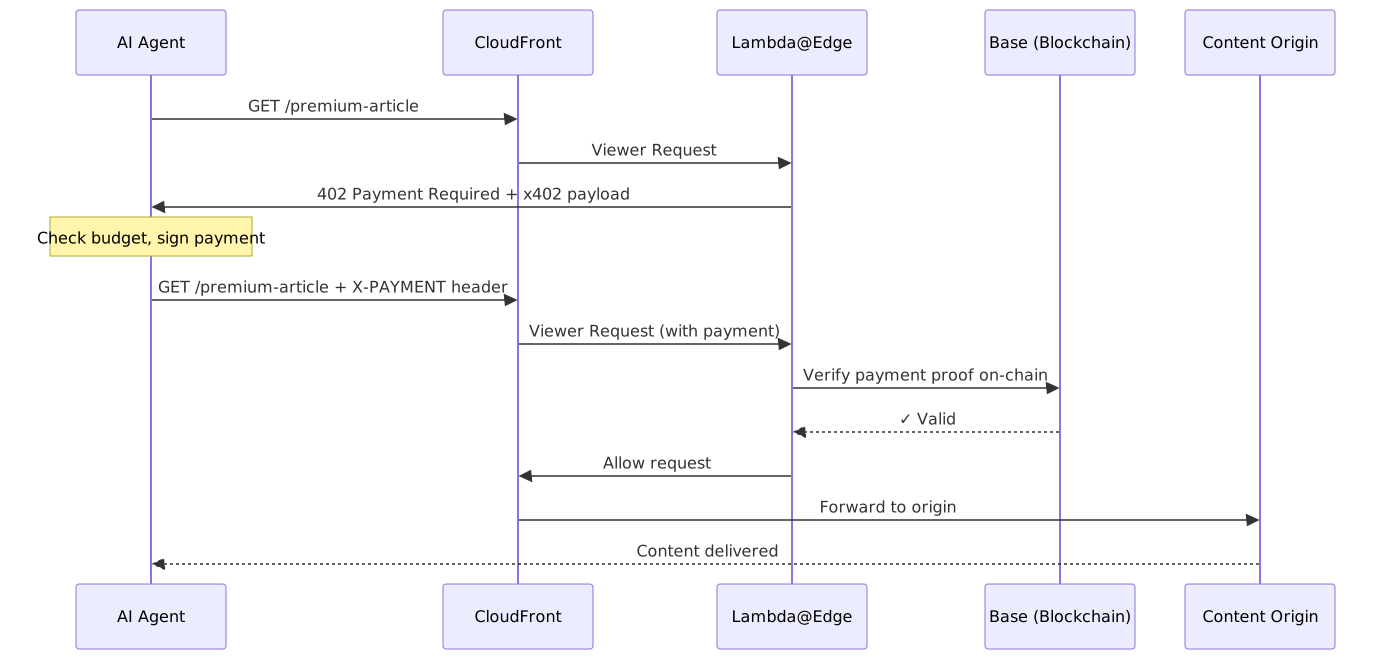
The full x402 payment flow: request → 402 → pay → verify → deliver.
The merchant-side implementation uses:
- CloudFront as the CDN and entry point
- Lambda@Edge to intercept requests, return 402 responses, and verify payment proofs
- AWS WAF (optional) to block non-x402 bot traffic entirely
AWS published two sample repositories you can deploy today:
# Full agent + merchant integration (both sides)
git clone https://github.com/aws-samples/sample-agentcore-cloudfront-x402-payments

# Merchant-side only: monetize any HTTP app with x402
git clone https://github.com/aws-samples/sample-x402-content-monetization-with-cloudfront-and-waf
Resource Hierarchy
The setup follows a clean resource model:
PaymentManager (1 per application)
├── PaymentConnector: CoinbaseCDP
│   └── Credentials → AgentCore Identity → Secrets Manager
├── PaymentConnector: StripePrivy
│   └── Credentials → AgentCore Identity → Secrets Manager
├── PaymentInstrument (wallet per end-user)
│   └── Funded via: crypto transfer, card, Apple Pay, Google Pay, ACH
└── PaymentSession (budget + expiry per interaction)
    └── maxSpendAmount: "$5.00", expiryTimeInMinutes: 60
Spending Controls
Budget enforcement happens at the infrastructure layer, not in agent code. This is a critical design choice: even a compromised or misbehaving agent cannot exceed its session budget.
Session budget: $5.00 | Expiry: 60 minutes
├── Transaction 1: $0.01 → ✓ Approved (remaining: $4.99)
├── Transaction 2: $0.03 → ✓ Approved (remaining: $4.96)
├── Transaction 3: $6.00 → ✗ DENIED (exceeds remaining budget)
└── After expiry: all further requests → ✗ DENIED
Preview Status & How to Get Access
⚠️ AgentCore Payments is currently in Public Preview. Features and APIs may change before General Availability. Do not use for production workloads yet.
What “Preview” means:
- Available for experimentation and prototyping
- Free during Preview (no charges for the Payments service itself)
- APIs may have breaking changes before GA
- Available in 4 regions: us-east-1, us-west-2, eu-central-1, ap-southeast-2
To get started:
- Ensure your AWS account has access to Amazon Bedrock AgentCore
- Sign up for a wallet provider: Coinbase CDP (free) or Stripe/Privy
- Use the Base Sepolia testnet for development (free test USDC from faucet.circle.com)
- Follow the getting started tutorial — 8 progressive tutorials from setup to multi-agent orchestration
- Read the official documentation
Supported Networks
| Blockchain | Environments |
|---|---|
| Base (Coinbase L2) | Sepolia (testnet) + Mainnet |
| Solana | Devnet + Mainnet |
Settlement is in USDC (stablecoin pegged to USD) — no crypto volatility risk for either party.
What You Can Do Today
If you’re a publisher or content provider:
- Make your content agent-friendly — serve structured formats (markdown, JSON) alongside HTML [5]
- Understand your AI traffic — how much of your traffic today comes from agents vs. browsers?
- Prototype the merchant side — deploy the CloudFront + x402 sample on testnet
- Set a target — what percentage of revenue could come from agentic streams in 3 years?
If you’re building AI agents:
- Handle 402 responses — your agent should be able to evaluate and pay for resources programmatically
- Try AgentCore Payments — the Strands plugin makes it a one-line integration
- Set budget controls — per-session and per-day spending limits are essential
- Use testnet first — Base Sepolia gives you free USDC to experiment without real money
The 30-year placeholder finally has a job. And it’s a big one.
What’s your take? Are you seeing AI agent traffic on your content? How are you thinking about monetization beyond ads and subscriptions? And if you’re building agents — are you handling 402 responses yet?
Sources
[1] x402 Protocol Specification — x402.org
[2] Stefan Christoph, “AX — Agent Experience” (Sep 2025) — LinkedIn
[3] Stefan Christoph, “Pocket Money for AI Agents” (Oct 2025) — LinkedIn
[4] Stefan Christoph, “Surfing the AI Wave — Publishing” (Oct 2025) — LinkedIn
[5] Stefan Christoph, “Making My Website AI-Agent Friendly” (Mar 2026) — schristoph.online
[6] Digital Applied, “Agentic Commerce Q2 2026: 10-Platform Matrix Report” — digitalapplied.com
[7] McKinsey, “The Agentic Commerce Opportunity” — mckinsey.com
[8] AWS, “Agents that transact: Introducing Amazon Bedrock AgentCore Payments” — aws.amazon.com
[9] AWS, “x402 and Agentic Commerce: Redefining Autonomous Payments in Financial Services” — aws.amazon.com
❤️ Created with the support of AI (Kiro)