

Leadership · 8 min read
What a Paella Taught a Group About Becoming a Team
 Stefan Christoph
On this page
A Year Together Without Meeting
For about a year I have worked with a group of solutions architects spread across EMEA, and none of us had met in person. From 9 to 11 November 2026 we had our first in-person offsite, in Barcelona.

Barcelona, sunrise on 10 November.
A year of working together tells you a lot about people. It tells you much less about how they work next to you, at the same table, on the same thing.
Group or Team?
Earlier this year, at breakfast during a conference, a colleague walked me through a book called The Rocket Model by Gordon Curphy and Robert Hogan (2012). I haven’t read the book cover to cover. The definitions below come from Curphy’s own public summary on the Hogan Assessments blog [1].
Curphy defines a team as three to 25 people who:
- work toward a common set of goals
- work jointly
- share common leadership
- hold joint accountability for performance
- see themselves as part of a team with common goals and shared fates
A group is a set of people who don’t share these five characteristics to the same extent. His prototype of a group is a regional sales team. Every rep has their own territory and their own targets, and one rep’s success doesn’t depend on what the others do. In his words, “the region’s performance is merely the sum of each rep’s individual efforts” [1].
Curphy puts the fifth characteristic, identity, on the same list as the other four. I think it follows from them. If the work isn’t joint and the outcomes aren’t shared, a team identity has nothing to attach to, however good the name or the logo.
Curphy also makes two points that matter for my situation. Leading a group is real work: “This is not to say that leaders play passive roles when managing groups. In fact, far from it!” [1] A group leader still has to make sure people work from the same assumptions about customers and competitors, have the right skills and enough resources, stay motivated, share information and get their differences resolved quickly. And being a team is not automatically better. In another post Curphy writes that “the tasks should dictate if an individual, group, or team is the most effective way to operate” [2].
So where are we? More group than team, I’d say. Maybe a little more than a group.
When I wrote about Lencioni’s The Advantage earlier this year, the question was how a leadership team becomes cohesive [5]. Curphy asks an earlier question. Do these people need to be a team at all, and for which task?
One Paella in a Fixed Time
On Tuesday, 10 November, from 18:00, we took a paella team class at Gastronomic Arts Barcelona (GAB LAB), just off La Rambla, across from Plaça Reial [3].
The setup was simple. We had one common task, one paella, and a fixed amount of time to make it. Our instructor, who works at the venue, showed each step and then handed the work over to us. Everyone could join in.
Each of us learned specific steps, cleaning the seafood for example. At the same time the group scaled. Working in parallel, we were much faster at preparing and cooking.
Working side by side, we also got to know each other’s strengths and weaknesses, something a year of working apart had not shown us. We built bonds that evening, and I think we can work better together because of it. It was a beautiful evening.
Now look at Curphy’s list again. For those few hours we had one goal, we worked jointly, we had one leader, and we all shared the fate of the same pan. That comes close to his definition of a team, and it was the task that set it up. One evening doesn’t make a team, of course. But now we know what those conditions feel like.
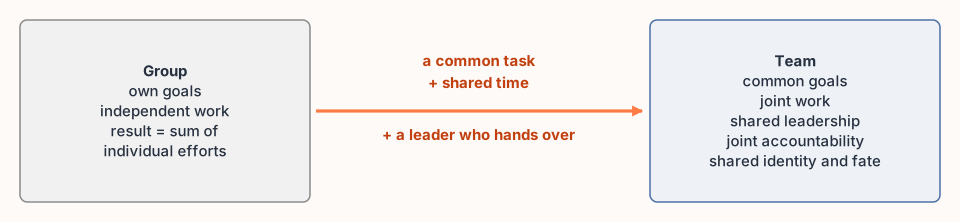
What moved us from the left box towards the right one, at least for an evening.
How Our Instructor Led
What stayed with me most was how our instructor led. She showed how each step is done. Then she built trust by letting everyone just do things. When something went wrong, she corrected carefully, so that we learned by ourselves.
That is leadership by example, and it runs as a loop, once for every step of the dish.

Show, hand over, let it go wrong a little, correct, and on to the next step.
For the person leading, the third box is the hardest. Letting a step go wrong a little costs time, and doing it yourself is quicker in the moment. But that box is also where people start to own the step.
The “a little” matters. With one shared pan, a single mistake can spoil the dish for everyone, so not every step can be handed over in the same way. Wherever you lead, let go on steps where a mistake is cheap to notice and fix, and stay close on the ones that are expensive or can’t be undone.
The Same Loop With AI Agents
I design agent workflows for a living, and I use a similar loop there: give an example, look at a draft, and turn useful feedback into instructions or checks.
When an agent hands back work that isn’t good, the tempting move is to take the task away and do it yourself. That may fix this one result. But the instructions and checks stay the same, so the same problem can come back on the next run.
The better move is the instructor’s. Show the agent what good looks like and give feedback on what went wrong. Leave room to fail on the next attempt, on a draft and not on the step that ships, then correct again. With agents, showing usually means a worked example or a clear instruction, and correcting means feedback the agent can act on in its next attempt.
Here the kitchen and the agent differ. We kept what our instructor taught us. An agent that starts each session with fresh context doesn’t keep a correction unless the workflow saves it somewhere the agent reads next time, such as its instructions, examples, checks or memory. Otherwise you correct the same mistake again and again. Where a human has to stay in that loop, and who that human must be, is a separate question that I wrote about in [4].
Where the Idea Came From
The idea for this post came on an evening run in Barcelona on Wednesday, 11 November. It was November, and I was running in shorts and a T-shirt at about 20 °C.

Evening of 11 November, in a T-shirt.
On that run, the group-or-team question from the conference breakfast and the evening at the paella pan came together.
Will This Group Become a Team?
Will this group act as a team? I don’t know yet. It took a real step in Barcelona.
And we don’t always need to be a team. As Curphy puts it, the task should decide [2]. What we need is a group that can work together. Depending on the task, a few of us can become a team, for an evening or for a project, the way we did at the paella pan.
If you organise an offsite for a distributed group, plan at least one block around a real common task: one visible result, a fixed time, and someone who shows each step and then hands it over. Social time and presentations have their place, but on their own they don’t give people joint work. That is what our year apart was missing.
💬 Does one person’s result in your distributed group depend on what the others do, or is it the sum of individual efforts? If your group needs to be a team, what is the one common task you could give it?
Sources
- [1] Gordon Curphy, “Important Differences Between Groups and Teams,” Hogan Assessments blog · the five characteristics of a team, three to 25 people, the regional sales group, and what leading a group involves.
- [2] Gordon Curphy, “The Rocket Model: Teams at the Top,” Hogan Assessments blog · “the tasks should dictate if an individual, group, or team is the most effective way to operate.”
- [3] Venue page for the private paella cooking class · location just off La Rambla, across from Plaça Reial.
- [4] The Matryoshka of Humans in the Loop · my earlier post on where the human in an agent loop has to sit.
- [5] What a 2012 Management Book Taught Our AI-Era Team · my earlier post on Lencioni’s The Advantage and leadership-team cohesion.
❤ Created with the support of AI (Kiro)
📝 Last updated: November 18, 2026 — Redrew the diagrams in a compact, consistent style