Your Personal Brand, in the Age of AI
 written by Stefan Christoph
Everyone gives the same advice: build your personal brand. Almost no one tells you how. You are left with a slogan and a blank page.
This post is the how, in two halves. First, how to define your brand, using a canvas and an AI that interviews you to fill it. Then the part most advice skips: how to live it, consistently, without it becoming a second job.
Prefer to watch? Here’s the talk version of this post (~11 minutes):
What a personal brand actually is
It is not your logo or your job title. Jeff Bezos put it best: “Your brand is what other people say about you when you’re not in the room.” So your personal brand is the reputation you shape on purpose. It is the consistent impression of what you stand for and the value you bring, as other people experience it.
Two things trip people up before they even start.
How much of you goes in? Think of a dial, not a switch. At one end sits pure business: credentials, results, polished, and forgettable. At the other, fully personal: warm, human, and eventually credibility-diluting. The mix is a choice. You want enough personal to be human and memorable, enough professional to be trusted. Set the dial deliberately and keep it consistent. Authentic is not the same as oversharing.
Which version of you? You have one brand, a consistent core, shown with different facets depending on the room. The work facet is your expertise and results; the human facet is your values and story; the community facet is how you show up for others. These are not different personas. They are the same values, dialed for context.
Generic is invisible
Ask most people to describe their brand and you get: “I help people.” “I’m passionate about tech.” “I’m a team player.” If it could be anyone, it is no one. Generic is invisible.
The fix is specificity, and specificity is genuinely hard to pull out of your own head. You are too close. You need structure, and someone asking the right follow-up question.
The Personal Brand Canvas
A one-page canvas for a person is not a new idea. Business Model You adapted the Business Model Canvas to careers, and Strategyzer’s Value Proposition Canvas maps a “customer” to a “value proposition” (treat your audience as the customer and your brand as the value proposition). What is new here is not the canvas. It is the AI interviewer that fills it by probing past your first, generic answer.
This version has nine blocks:
- Purpose & Values — why you do this, and the values you won’t compromise.
- Vision & Goals — where you are headed (12 months, 3 years); the change you want to create.
- Audience — who you serve or reach, specifically, and who it is not for.
- Unique Value — your “only-ness”: the intersection few others occupy.
- Strengths — what people repeatedly come to you for.
- Passions — what genuinely energizes you (this is your content fuel).
- Story & Proof — your narrative arc, backed by evidence.
- Personality & Voice — three to five adjectives; how you show up.
- Channels & Content Pillars — where you will show up, and the recurring themes you will own.
From those nine, the canvas synthesizes what you actually use: a one-line positioning statement, a tagline, three or four content pillars, and a concrete next action.
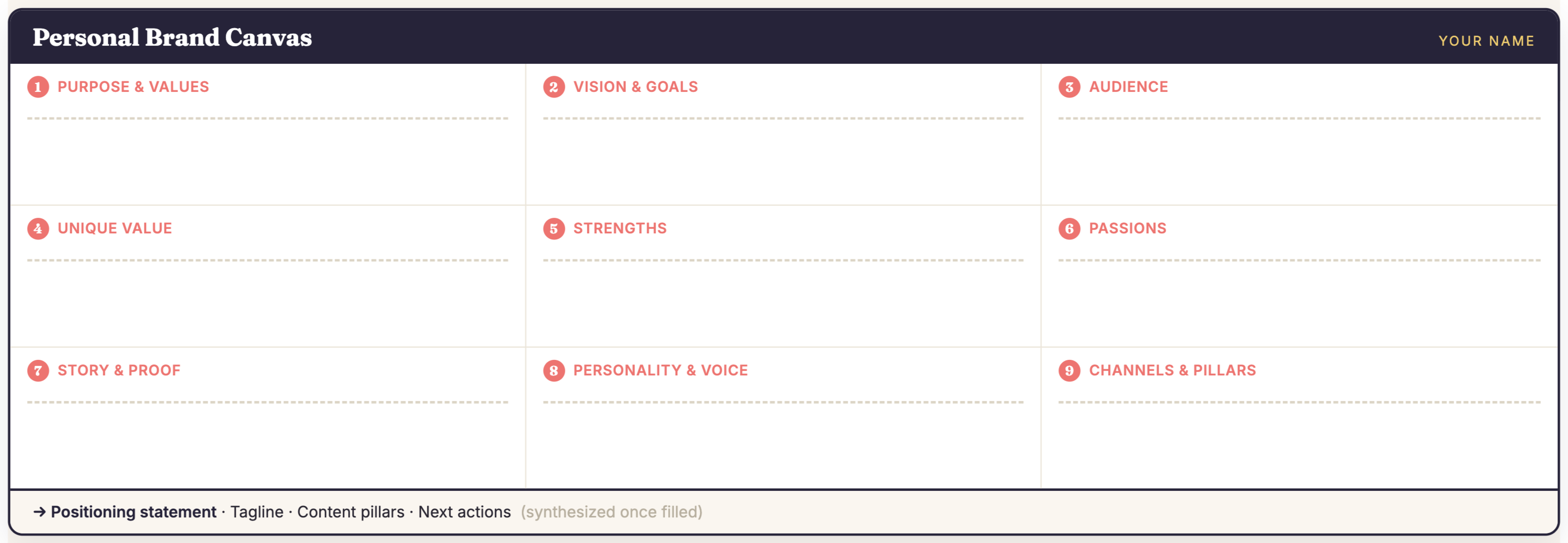
The canvas you start with: nine prompts and a synthesis strip the interview fills in.
Why an AI interview, not a blank template
Hand someone a blank nine-box template and you get nine boxes of “I help people.” The value is not the template. It is the follow-up.
Here is the kind of exchange the interview drives, drawn from the worked example below:
You: “I help young people get into work.” AI: “Help whom, to do what they couldn’t before?” You: “Kids from my town, no network, no one to explain how it works, getting their first real foothold.”
Generic becomes specific. One good probing question turns a cliché into something only you could say. Do that nine times and you have a brand that is unmistakably yours. A good interviewer also pushes back on inflated claims, not just vague ones: say something is rare or that you are great at it, and it will ask you to prove it.
A worked example: Nadia
Nadia is a fictional composite: 22, just finished a business degree, works at a small charity helping young people into work, fascinated by how AI is reshaping early careers.
Here is a short, sped-up clip of the skill interviewing her. The probing on the left sharpens each answer while her canvas fills in on the right:
After a twenty-minute interview, her blank canvas becomes this:
- Purpose: so no young person is locked out of the AI economy for lack of a network. Values: access, honesty, momentum.
- Audience: 17 to 24, entering work without a network, and the youth-workers who guide them. Not for senior execs.
- Unique value: in the room with 19-year-olds every week, able to read a business case, and genuinely fluent in how AI is changing entry-level work. Few people combine all three.
- Story & proof: first in her family through university; now runs her charity’s digital-skills programme, including a 6-week pilot that placed its first cohort and an “AI for job-hunting” clinic she built after teaching herself the tools.
- Pillars: “AI + your first job,” “access & the skills gap,” “field notes.”
And the payload, her positioning statement:
I help young people entering the workforce, and those who support them, to navigate an AI-shaped job market with clear, practical steps, by translating the future-of-work conversation into what actually matters for a first job, because opportunity shouldn’t depend on where you started.
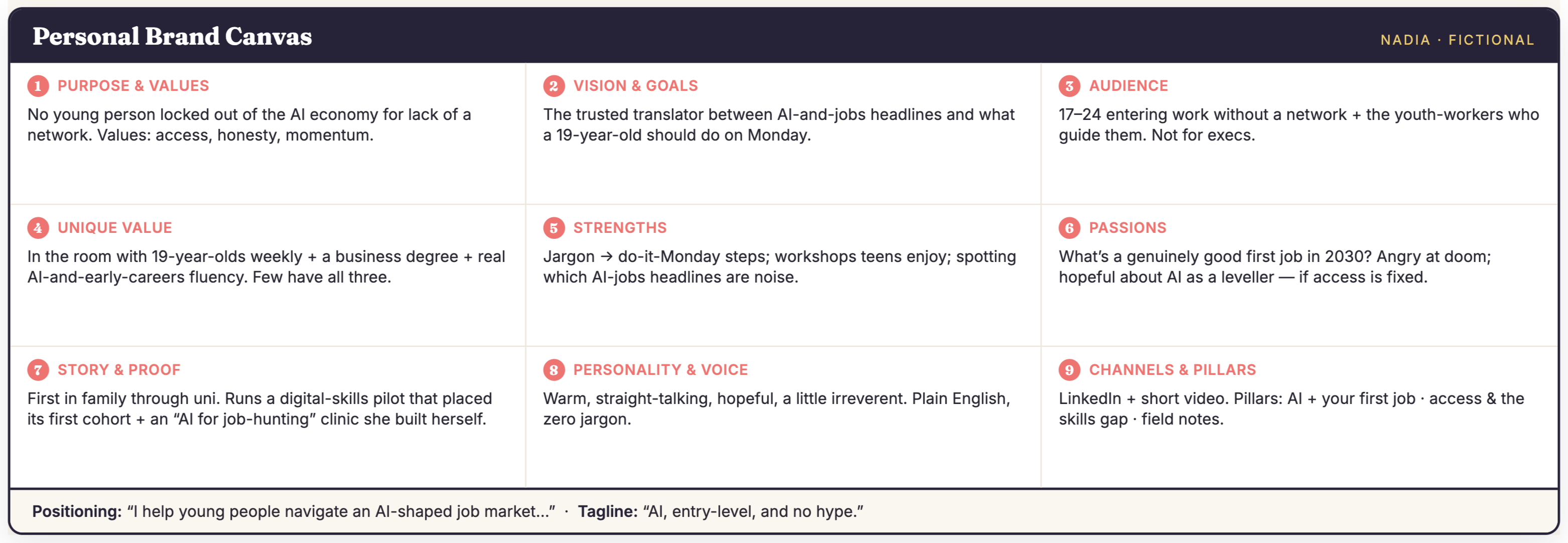
Nadia’s filled canvas: every block specific, evidenced, and in her own words.
Compare that to “I help young people get into work.” Same person. One is invisible; one is a brand. Notice that her AI claim in Unique Value is not left hanging: it is backed by the clinic in Story & Proof. A claim the canvas can’t back is a claim it makes you cut.
Try it yourself
The skill is open source: github.com/stechr/schristoph-blog-samples/tree/main/personal-brand-canvas. Inside you’ll find the interview workflow (SKILL.md), the per-block probing questions and follow-up ladders (question-bank.md), a “what good looks like” guide with weak-to-strong examples (block-guidance.md), the one-page template, and Nadia’s full worked example.
Two ways to run it:
- With an AI agent (I use Kiro). Point the agent at the skill and say “run the Personal Brand Canvas on me.”
- In any chatbot, no setup. Paste this prompt into your assistant of choice, answer honestly, and let it push back when you are vague:
You are a personal-brand coach running the Personal Brand Canvas. Interview me
ONE block at a time through these nine blocks: Purpose & Values, Vision & Goals,
Audience, Unique Value, Strengths, Passions, Story & Proof, Personality & Voice,
Channels & Content Pillars. For each block: ask one question, then probe my answer
with a specific follow-up until it is concrete and could only describe me. Reject
generic answers ("I help people") AND unsupported claims ("that's rare") by asking
for evidence. Reflect each block back in one line, then move on. At the end,
synthesize: a one-line positioning statement ("I help [audience] to [outcome] by
[approach], because [purpose]"), a tagline, three content pillars, and three
concrete next actions.
One tip: fill one canvas per audience.
The harder half: living the brand
Here is what most branding advice skips. A canvas on a page changes nothing. A brand is what you consistently do, where people can see it.
That is where almost everyone falls down. Strategy is easy; showing up is hard. Most people define a brand, post twice, and go quiet. What builds a brand is consistency, in your voice, on a cadence, and consistency is exactly the friction AI can remove.
Your canvas already gave you content pillars. Those pillars become a repeatable engine: pillars to ideas and hooks, to drafts in your voice, to posts on a cadence. AI kills the three things that stop you (the blank page, “no time,” and “is this good enough?”) while you stay the author.
For a professional brand, LinkedIn is where authority and network compound. Nadia’s three pillars become her weekly posting themes. Show up in your niche, consistently, and the brand you defined on the canvas becomes the brand people actually know.
How I do it
My home base is this blog, schristoph.online. It holds the full idea, in depth, searchable, and mine. LinkedIn is the teaser that drives traffic to it. The blog is the asset; social is the megaphone. Cadence: three posts a week.

One idea to published, in my voice. AI-assisted, human-in-the-loop at every gate.
Behind that is a content pipeline: one idea to a published post in my voice, through ideate, draft, quality gates (FAQ, fact-check, an independent critic), publish, LinkedIn teaser, and measure. AI-assisted, human-in-the-loop at every gate. I have written about it in depth:
- The AI Content Pipeline: How I Publish 3x a Week Without a Content Team, the architecture.
- The deep-dive series: ingestion, research, collaborative writing, editing, and publishing.
- The code is open source: github.com/stechr/kiro-content-pipeline.
Full disclosure, because it is the point: this post, and the talk it accompanies, came through that pipeline. Define it, then live it.
Define it. Live it.
Don’t stay generic. Define your brand with the canvas, live it with a content engine, and show up: specifically, consistently, as you.
Start here. Run the Personal Brand Canvas on yourself, get past “I help people,” and see what a brand that is actually yours sounds like.
About the Author
Stefan Christoph is a Principal Solutions Architect at AWS, focused on agentic AI, media & entertainment, and helping builders move from demo to production. He writes about AI architecture, developer productivity, and the future of software.
This is a personal blog. Opinions expressed here are my own and do not represent the views or positions of my employer.
🎬 Also available as a blog walkthrough video on YouTube
❤️ Created with the support of AI (Kiro)