


Asymmetries — Part 1 of 10
On this page
A quick note on where this comes from: I’m not a psychologist. I read the research because I keep ending up on both sides of this particular table, and I wanted to understand why a three-word sentence can occupy a week of someone’s head. Every study I lean on is cited at the bottom. Where the evidence is thin or self-reported, I say so. If I’ve stretched a finding past what it can carry, tell me — the comments are the point.
Four rooms, one sentence
Picture four scenes.
You just finished a final-round interview. It went well, or you think it did. On your way out someone smiles and says, “We’ll be in touch.” No date. You get to your car and the replay starts: the question you fumbled, the pause that felt too long. By evening you’ve decided they hated you. By morning you’ve decided you have it. Neither is information. Both feel like it.
You submitted the proposal three weeks ago. The buyer said, “No need to follow up, we’ll reach out when we’ve decided.” So you don’t. But you draft the follow-up email anyway, in your head, twenty times. You reread your own submission looking for the flaw. You check whether the competitor posted anything on LinkedIn that hints they won.
You’ve been talking with a potential partner for months. Then: “We need more time to get clear on what we want.” You nod, because it’s reasonable. And then you spend the drive home trying to decode “get clear” — is that a soft no, a real maybe, or a stall while they talk to someone else?
And one that has nothing to do with work. Someone close to you says, “I need some space to sort out this project. Can we not talk about it for a while?” You agree, because you love them and it’s fair. And “not talking about it” becomes the only thing you can think about.
Same sentence, four rooms: we’ll call you. In every one, the ground under your feet shifts in the same way. The other person now holds the clock and the information. You hold neither. And the not-knowing turns out to be its own distinct kind of hard — not a smaller version of hearing “no,” but a different animal entirely.
That shift has a shape, and the shape has a name.
The asymmetry lens
I’ve started collecting moments where two people stand at the same table and experience completely different weather. This is the first one, and it runs on three asymmetries stacked on top of each other.
The first is information asymmetry. The deciding side knows the state of the process: who else is in the running, what the next step is, whether the delay is budget or bureaucracy or genuine deliberation. The waiting side knows nothing, and nature abhors that vacuum.
The second is control asymmetry. The deciding side owns the timeline, and the waiting side has been explicitly told not to influence it. “Don’t call us” is not a neutral instruction; it removes the one lever you had.
The third is stakes asymmetry. For the decider, you are one of several candidates, one of several bids, one of several conversations. For you, this might be the job, the deal, the relationship. The same delay is background noise on one side and a held breath on the other.
Stack those three and you get the specific misery of “we’ll call you.” Ordinary waiting is unpleasant; this particular wait is worse, because it strips you of information, control, and proportion all at once, while the person on the other side, acting completely reasonably, may not even register that a clock is running for you.
Which is the first useful reframe. Most of the time, nobody is being cruel. The recruiter isn’t savoring your anxiety. The buyer isn’t playing games. They’re coordinating three stakeholders and a budget cycle, and your file is one tab among forty. The asymmetry does the damage all by itself, with no villain required. That matters, because it means the fix isn’t about finding better people to wait on. It’s about handling the structure — and both sides can.
Let me take the two sides one at a time, because they have completely different problems.
Two sides of the same silence
The person waiting
Your driver is simple: you want to know. Under that is something older — you want to be able to act, and you can’t, because acting is exactly what you’ve been told not to do.
Your problem is that the mind refuses to hold an empty space. Handed no information, it manufactures some, and the stories it writes skew dark: they’re negotiating with someone better, you’re the fallback, they’ve forgotten you exist. These feel like analysis. They are projection wearing analysis’s coat.
Your failure modes are two, and they pull in opposite directions. One is checking — refreshing email, rereading the thread, drafting the “just circling back” note you promised yourself you wouldn’t send. The other is paralysis — being unable to move on other options, other conversations, other work, because this one is still technically open. Both feel like coping. Both usually make it worse.
The person deciding
Your driver is usually legitimate. You genuinely need the time. There are other candidates to see, stakeholders to align, a budget to approve, a legal review that won’t be rushed. Taking time is not the sin.
Your problem is that taking it silently costs you something you can’t see from where you sit. The other person’s trust in you is quietly draining while you do nothing wrong, because to them your silence is not “process in progress” — it’s data, and like all data in a vacuum, it gets read badly.
Your failure mode is treating “I have nothing new to tell them” as a reason to say nothing. It feels considerate. It reads as neglect.
The thing that connects the two sides — the thing actually at stake in the whole exchange — is trust. And to see how silence erodes it, we need to go to the research. This is the long middle of the post, and it’s the why behind every move in the playbook; if you only want the what, jump ahead — the playbook will be waiting.
What the research actually says
A caveat before we start, because it shapes how much weight any of this can bear. Most of the work on waiting is correlational and self-reported. People tell researchers how they felt, or fill in scales, or get studied in a handful of high-stakes natural experiments — bar exam results, biopsy results, job decisions. That’s real signal, but it’s not a controlled machine you can run backwards. Read what follows as a well-lit map of the terrain, not a set of guarantees. The mechanisms are solid enough to plan around; the specific magnitudes are softer than the tidy language of a blog post can make them sound.
With that said, the terrain is remarkably consistent.
Waiting is its own kind of hard (Sweeny)
Kate Sweeny at UC Riverside has spent more than a decade studying people awaiting uncertain news — exam results, medical tests, job decisions. Her central finding is the one that reframes everything: the waiting period itself is often experienced as more distressing than receiving bad news [1].
That sounds backwards until you sit with it. With a known bad outcome, you can start coping — you can grieve, adjust, plan, move. Uncertainty blocks all of that. You can’t grieve a rejection you haven’t gotten, and you can’t celebrate an offer that hasn’t come, so you hang suspended, unable to do the emotional work that would actually help. The not-knowing isn’t a milder version of the bad news. It’s a separate state that denies you the tools you’d use for the bad news.
Sweeny also describes a distress trajectory that anyone who’s waited will recognize: it tends to spike right at the start, settle into a quieter middle, and then rise again as the expected answer approaches — a phenomenon she and others call bracing [1]. You steel yourself for impact near the end. That’s normal and even a little protective. The trouble comes when you start bracing too early or too hard, and there’s some evidence that this kind of pre-emptive worst-case preparation carries its own emotional cost rather than saving you any [2]. In plain terms: expecting the worst the whole time doesn’t soften the blow, it just extends the misery.
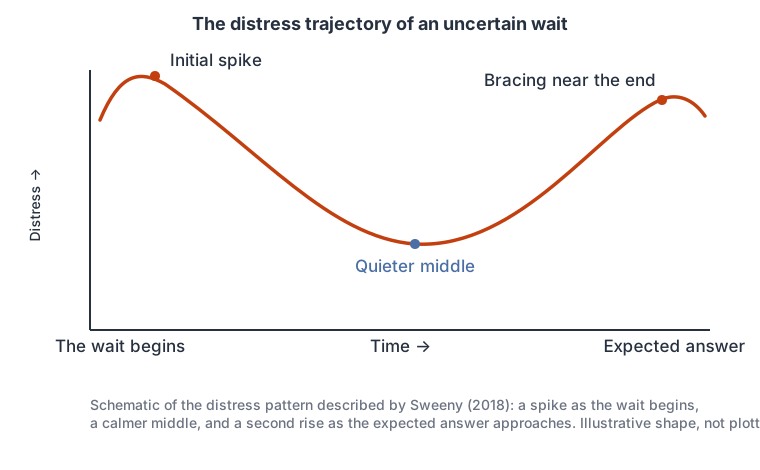
The shape most waits take: a spike as the silence begins, a calmer middle, and a second rise as the expected answer nears. It’s a schematic of the pattern, not measured data.
Why some waits feel longer than others (Maister)
If Sweeny explains the emotional weather, David Maister explains the clock. His 1985 essay “The Psychology of Waiting Lines” was written about queues — banks, restaurants, elevators — but its propositions map onto “we’ll call you” with almost unfair precision [3].
His most useful principle is an equation: Satisfaction = Perception − Expectation. How you feel about a wait isn’t the wait itself; it’s the wait measured against what you were led to expect. Set the expectation well and a long wait is fine. Set it badly and a short one is infuriating.
Around that sit a handful of propositions. Here they are, translated out of the queue and into the silence:
| Maister’s principle | The “we’ll call you” translation |
|---|---|
| Uncertain waits feel longer than known, finite waits | “We’ll get back to you” (open-ended) hurts far more than “you’ll hear by Friday” |
| Unexplained waits feel longer than explained waits | “Two weeks — three stakeholders have to align” beats a wall of silence |
| Anxiety makes waits feel longer | High stakes (the job, the deal) stretch every day |
| Unfair waits feel longer than equitable waits | Suspecting a rival gets updates while you don’t is corrosive |
| Pre-process waits feel longer than in-process waits | “You’re in evaluation now” feels better than not knowing if it’s even started |
| Occupied time feels shorter than unoccupied time | An empty week of waiting is worse than a full one |
Worth noticing, and we’ll come back to it: most of these levers sit with the deciding side, and none of them require revealing the decision itself.
The trait that turns a wait into a crisis (intolerance of uncertainty)
The same “we’ll call you” can barely register for one person and flatten another. A big part of that difference has a name: intolerance of uncertainty (IU), a trait-level tendency to experience uncertainty itself — not the bad outcome, the uncertainty — as threatening [4].
IU is what psychologists call transdiagnostic: it shows up across worry, anxiety, and related conditions rather than belonging to any single one [4]. And it tends to express itself in the same two behaviors we already met as the waiter’s failure modes: certainty-seeking (checking, re-reading, seeking reassurance) and paralysis (freezing, avoiding, unable to move on other options) [5]. The checking is an attempt to manufacture certainty; the paralysis is a refusal to act until certainty arrives. Both are the trait trying to resolve the intolerable, and both tend to feed it instead.
This is the point where I want to be careful, because it’s exactly where a blog post can drift into territory it has no business in. IU is studied clinically, and for some people waiting distress is genuinely chronic and worth talking to a professional about. That’s a different conversation than this one. Everything here is about the ordinary version — the normal, non-clinical churn of waiting on a normal, high-stakes decision. If the churn never switches off regardless of the situation, that’s a signal worth taking seriously, and not from a blog.
Why “don’t call us” makes you want to call (reactance)
Here’s a small cruelty built into the standard script. The instruction is almost always some version of “please don’t follow up.” And that instruction, by itself, makes following up more attractive.
The mechanism is psychological reactance, first described by Jack Brehm in 1966 and still holding up in a fifty-year review [6]. When a specific freedom is threatened or removed, we experience a motivational push to reassert it — the forbidden option becomes more appealing precisely because it’s forbidden. “Don’t call us” removes your freedom to make contact, and reactance quietly turns that freedom into something you now want to exercise more than you did before you were told not to.
So the itch to send “just a quick nudge” isn’t weakness or bad discipline. It’s a predictable response to being told you can’t — and knowing that is already half the antidote.
The open loop that won’t close (Zeigarnik)
There’s an old observation, associated with the psychologist Bluma Zeigarnik, that unfinished tasks occupy a privileged place in memory — we remember and mentally return to incomplete things more than completed ones [7]. Whatever the exact strength of the original effect, the everyday version is familiar: an open, undecided matter keeps intruding on your attention in a way a settled one doesn’t.
A pending offer, a submitted bid, an unresolved “we need time” is a textbook open loop. It sits there, tugging. And there’s evidence the tug isn’t harmless: a 2016 study found that unfinished work tasks were associated with more weekend rumination and poorer sleep, with the rumination doing much of the mediating work [8]. An open decision can literally cost you rest.
The important detail is how the loop closes. It closes with completion — the answer arrives — but the research on task interruption suggests it also closes, at least partly, with a concrete plan. That single mechanism quietly powers half of the playbook below.
How to actually cope while waiting (Sweeny’s navigation model)
Sweeny doesn’t just describe the distress; she and colleagues sketch how people get through it, grouping the coping strategies into a few families [1]. Three are worth naming because they translate straight into advice.
Consequence mitigation — softening the blow of a possible bad outcome in advance. It has a healthy version (keeping real alternatives alive) and an unhealthy one — the over-bracing we already met, where you pre-live the rejection so thoroughly you pay for it whether or not it comes.
Reappraisal — changing the meaning of the wait. The silence is about their process, not your worth. Most delays are logistics, not verdicts. Statistically, “haven’t heard back” correlates far more with “their calendar” than with “your ranking,” and reminding yourself of that isn’t wishful thinking, it’s better base rates.
Emotion regulation — and here the standout is flow. Sweeny’s work highlights absorbing, flow-inducing activity as one of the more reliable ways to make a waiting period tolerable [1]. Not distraction-by-doomscrolling, which keeps the loop half-open, but genuine absorption in something demanding enough to occupy the part of your mind that would otherwise be writing dark stories. Occupied time feels shorter — Maister said the same thing from the other direction.
What silence does to the person keeping you waiting
Now flip the table. If you’re the one who said “we’ll call you,” what does your silence actually do to the relationship? Two research threads answer that, and together they’re the most useful part of this whole essay for anyone who makes others wait for a living — which, if you hire, buy, lead, or decide, is you.
Procedural justice (Gilliland)
Robert Gilliland’s 1993 model of how job applicants judge a selection process identified a set of fairness rules: consistency, job-relatedness, honesty, the quality of interpersonal treatment, and, notably, timeliness of feedback [9]. The headline finding across this literature is that people judge a process at least as much by how fair it felt as by whether they got what they wanted, and that rejected applicants weight timely feedback especially heavily [10]. A fair process buffers a bad outcome: people accept a “no” far better when the road to it felt respectful. This generalizes well beyond hiring; the same dynamic runs through RFP decisions and partnership talks. Process fairness is the cheapest goodwill you will ever buy.
The trust model (Mayer, Davis & Schoorman)
The 1995 integrative model of trust breaks trustworthiness into three perceptions: ability (are they competent?), benevolence (do they care about my interests?), and integrity (do they do what they say?) [11]. It’s a clean lens because silence erodes each pillar differently, and knowing which one you’re bleeding tells you what to fix:
- Miss a deadline you set yourself, and you hit integrity — “they don’t do what they say.”
- Leave someone hanging with no acknowledgment, and you hit benevolence — “they don’t care what this is costing me.”
- Run a visibly chaotic, disorganized process, and you hit ability — “if this is how they decide, do I even want in?”
Trust-preserving waiting isn’t one skill. It’s protecting all three pillars while you take the time you legitimately need. And almost every practical move below maps back to one of them.
The playbook
Enough mechanism. Here’s what to actually do, on each side. Notice how symmetrical it is — and how cleanly it carries from the conference room to the kitchen table.
If you’re the one waiting
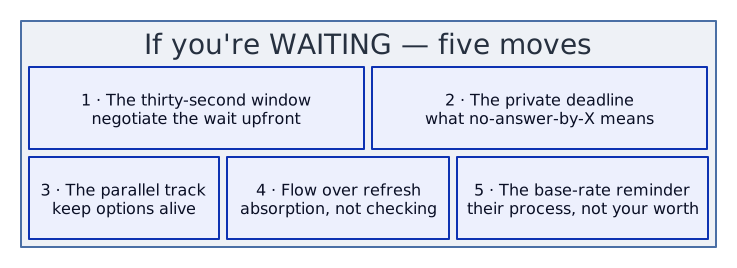
The waiting side’s five moves. Each one has a name so you can reach for it when the silence starts.
1 · The thirty-second window
Negotiate the wait before it starts. This is the highest-payoff move, and the window for it is open for about thirty seconds, before you leave the room or hang up. Ask: “When should I expect to hear? What happens if I don’t hear by then? Who’s the right person to check with?” You’ve just converted an uncertain, unexplained, open-ended wait into a finite, explained one (Maister’s two biggest levers), and you did it without breaking any “don’t call us” rule, because the rule hasn’t started yet. It is far easier to ask for the shape of the wait upfront than to break the silence later.
2 · The private deadline
Decide, in advance and just for yourself, what “no answer by the 20th” means: “I treat it as a no and act accordingly.” You’re not issuing an ultimatum to anyone. You’re closing your own open loop with a plan, so the Zeigarnik tug has somewhere to rest even if they never call.
3 · The parallel track
Keep your options alive. Single-threading on one pending decision maximizes both your risk and your rumination. Keep interviewing, keep the pipeline warm, keep talking to other people. This is consequence mitigation in its healthy form, and it does double duty: it protects you materially and it drains the emotional stakes out of any single answer.
4 · Flow over refresh
Spend the wait in flow, not in checking. Batch your email checks to once or twice a day. Don’t reread the thread. Find something absorbing enough to occupy the storytelling part of your brain. Certainty-seeking behaviors feel like they’re resolving the uncertainty; they’re feeding it.
5 · The base-rate reminder
Reappraise the silence. It reflects their process, not your worth. Say it to yourself as often as you need to, because it’s true and the base rates back you up.
If you’re the one deciding
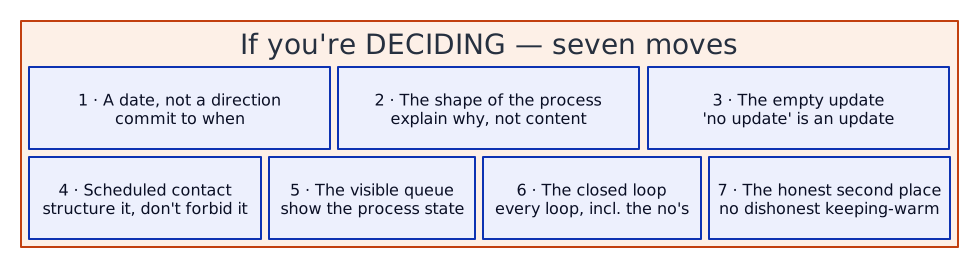
The deciding side carries more moves — because it holds more of the power, and with it more of the trust.
1 · A date, not a direction
“We’ll call you” becomes “you’ll hear from us by the 15th.” If you genuinely can’t commit to a decision date, commit to an update date, a moment you’ll tell them where things stand even if things haven’t moved. Finite beats open-ended, every time.
2 · The shape of the process
Explain the why. “We’re seeing candidates through end of month, then the panel meets.” “We need to align three departments on budget.” You don’t have to reveal the content of the decision to reveal the shape of the process, and the explanation itself signals that you see a person on the other end. Explained waits feel shorter; explaining them signals benevolence.
3 · The empty update
Treat “no update” as an update. This is the one almost everyone gets wrong. When your promised date arrives and there’s no decision yet, the instinct is to stay quiet until you have something real to say. Don’t. One sentence (“still deciding, new timeline is next Friday”) costs you nothing and preserves your integrity. Silence past a deadline you set yourself is the single most efficient way to destroy trust, because it hits the integrity pillar directly.
4 · Scheduled contact
Structure the contact instead of forbidding it. Instead of “don’t reach out,” try “here’s your contact, and feel free to check in after the 10th if you haven’t heard.” You’ve removed the reactance sting entirely. There’s no freedom to reassert because you didn’t take it away; you scheduled it.
5 · The visible queue
Make the process state visible. “Your proposal is with the evaluation committee now” moves someone from a dreaded pre-process wait to a tolerable in-process one, for the price of one sentence.
6 · The closed loop
Close every loop, including the no’s. A timely, respectful rejection is the strongest fairness signal you can send, and today’s rejected candidate or losing bidder is tomorrow’s colleague, customer, or referrer. The “no” you deliver well is an investment.
7 · The honest second place
Don’t keep someone warm dishonestly. Stringing along a fallback option with vague positivity is an integrity violation with a long fuse; it tends to surface eventually and costs more then. “You’re not our first choice, but we’re genuinely still deciding” is uncomfortable and trust-preserving. The comfortable lie is the expensive one.
The same machinery, off the clock
Everything above was framed for work, because that’s where most of us meet “we’ll call you” most often. But reread the two lists and swap the nouns, and they describe the kitchen table just as well — with the stakes turned up, because the emotional register is higher and there’s no HR process to hide behind.
When someone close to you says “I need some space,” the asymmetry is identical: they hold the timeline and the information, you hold neither. Reactance is why “please don’t bring this up for a while” makes bringing it up feel almost magnetic. Intolerance of uncertainty is why the same request can barely dent one person and unravel another. And the moves transfer almost one-for-one.
For the person asking for time: give a timeframe (“let’s talk again in two weeks”), not an open-ended fog. Explain what the time is for (“it’s my project stress, I need to get my head above water”). And — this is the piece with no clean workplace equivalent — reaffirm what is not in question. “This is about my workload, not about us.” That single sentence separates relationship security from process uncertainty, and it’s the difference between a wait the other person can settle into and one that quietly convinces them the ground is gone. In the office you’re protecting trust in a process. At home you’re protecting trust in the relationship, and the reassurance has to be explicit because the other person can’t see inside your head any better than a candidate can see inside a hiring committee.
For the person waiting on someone they love: agree on the check-in date instead of accepting open-ended silence. Fill the time with flow, not surveillance. Resist the certainty-seeking behaviors — the “just checking in” texts, the reading of tea leaves — because they don’t just feed your own anxiety, they pressure the other person and can paradoxically stretch the very time they asked for. And decide, privately, what you’ll do if the date passes and nothing has changed. Same loop, same close.
The uncomfortable symmetry is that most of us are much better at one side than the other. Plenty of people who would never dream of leaving a candidate hanging will go silent on someone they love, or vice versa. The mechanisms don’t care which room you’re in.
The one line to keep
If you remember nothing else from all of this, remember the pattern underneath it, because it holds across every version of the table:
Finite beats open-ended. Explained beats silent. A small kept promise (an update) beats a broken big one (a decision date you missed). And the person waiting copes best by negotiating the wait upfront, keeping options alive, and closing the loop internally with a plan.

The whole post in one picture: each side’s moves, and the trust bridge — ability, benevolence, integrity — that the silence puts at risk.
That’s the whole thing. Everything else is mechanism and evidence for why it works.
This is the first entry in what I think of as the asymmetry series — situations where two people stand at the same moment and live in completely different worlds. Timeline and information is the one we’ve just walked through. There are others I keep bumping into: the asymmetry of stakes (your routine transaction is my life event), of feedback (five minutes of discomfort to give, weeks of echo to receive), of knowledge (the expert who genuinely can’t remember not-knowing). I’m not committing to a syllabus. But this lens keeps earning its keep, so I suspect I’ll be back.
For now, I’d rather hear from you. What do you actually do while you wait — the mechanism that works, not the one you wish worked? And if you’re on the deciding side: what’s the smallest thing that’s ever made a wait bearable for someone you kept waiting? Put it in the comments. Someone reading this is stuck in a silence right now and would take the help.
Sources
[2] Sweeny et al. — The costs of preemptive benefit finding while waiting (2021)
[3] David H. Maister — The Psychology of Waiting Lines (1985)
[4] Intolerance of Uncertainty: A Common Factor in the Treatment of Emotional Disorders (2013)
[5] Intolerance of Uncertainty Scale factor review — certainty-seeking vs paralysis (2011)
[6] Rosenberg & Siegel — A 50-Year Review of Psychological Reactance Theory (2018)
[8] Syrek et al. — Unfinished tasks foster rumination and impair sleep (2016)
[10] Fairness from the applicant’s perspective — reactions to employee selection (University of Arizona)
Cross-posted to LinkedIn
🎬 Also available as a blog walkthrough video on YouTube
❤️ Created with the support of AI (Kiro)
📝 Last updated: September 2, 2026 — Diagram sizing fix (playbook + mechanism map render smaller)