

Ads for Agents · 13 min read
Same Ads, Different Room
 Stefan Christoph
Ads for Agents — Part 4 of 4
On this page
The earlier posts in this series, written over the past two months, were about ads the model reads: a publisher serving sponsored text to crawlers [9], an experiment showing that text can tilt an agent’s answer [10], the ad-free tier that follows from that [11], and the question of who pays for the agentic web [12]. This post is about ads people see in AI products, which just became a big business.
On 31 August 2026 OpenAI reported that ChatGPT Ads had reached a $1 billion annualized revenue run rate less than 200 days after launch, with tens of thousands of advertisers [1]. That is OpenAI’s own figure, and I use it once, as the data point that this is now a real market. US testing had started on 9 February 2026 [4]. The more useful question for publishers, agencies and brands is what kind of advertising this is, and where the money comes from.
Ads for people and ads for models
One kind of ad in AI products is aimed at the person using the tool, who sees the ad and decides whether to click. ChatGPT shows labeled ads next to answers on its Free and Go plans [4]. Google shows ads above, below and within AI Overviews and is testing new formats in AI Mode [5] [6].
The other kind is aimed at the model that writes the answer, and the two can run side by side. Part 1 covered a publisher that served AI crawlers a Markdown copy of its pages with sponsored FAQ units no human visitor sees, so the person only gets whatever the model made of them [9]. The rest of this post is about the first kind.
What stays the same as search
Read OpenAI’s two posts from August and October and the buying side looks very familiar. CPC and outcome-optimized bidding account for the majority of campaigns, and the Pixel and Conversions API are the foundation for measurement [1]. There’s a self-serve Ads Manager, which opened to small businesses in May and to advertisers in India, Europe, the Middle East and North Africa on 31 August [1]. Conversion data flows in through the integrations advertisers already use, and a long list of attribution partners (AppsFlyer, Adjust, Branch and others) is supported [2]. The ads are labeled and kept separate from the answer [1] [3]. That is the search playbook: an auction, intent targeting, click and conversion pricing, and the existing performance-marketing measurement stack.
Third-party open-auction programmatic display is the weaker comparison: there, the ad is sold through intermediaries on someone else’s page. An answer engine is a closed, logged-in, first-party platform that owns the page where the ad appears, structurally the same as a search engine or a social network. Google describes its own surface the same way. Ads above and below AI Overviews “serve following the existing auction ranking system and signals” [5].
Three things that changed
Search advertising starts from query context, and a query is a compressed guess at intent. Google’s broad match can also use the user’s recent searches and the content of the advertiser’s landing pages [15]. In OpenAI’s description, people “explain what they want to accomplish, what matters to them, and the constraints they face,” and the ads system “uses the context of the current conversation” to pick an ad [1]. A conversation carries the goal, the criteria, the constraints and the options the person has already rejected. A whole conversation is a much richer contextual signal than a query. Back in 2022 I wrote that contextual targeting would matter more once third-party cookies faded [13]. Google’s matching moves the same way, since ads within AI Overviews consider both the query and the content of the overview [5]. Depending on the country and the user’s settings, ChatGPT may also use context from the user’s broader history [1]. Personalized ads are not initially available in the EEA or Switzerland [4].
In the format I model below, an answer engine writes one recommendation and puts one ad next to it, where a results page has several ads beside ten links and the comparison happens later, on other sites. OpenAI describes an experience where “discovery, consideration, and decision-making come together in a single experience” [1], so the person decides without leaving the session.
The publisher also drops out of the chain. On a results page the platform earns from the ads and the publishers earn from the visitors the links send them. In an answer engine the platform owns the answer and the ad slot. Publishers show up as citations, and I assume a citation sends far fewer visitors than a ranked link.
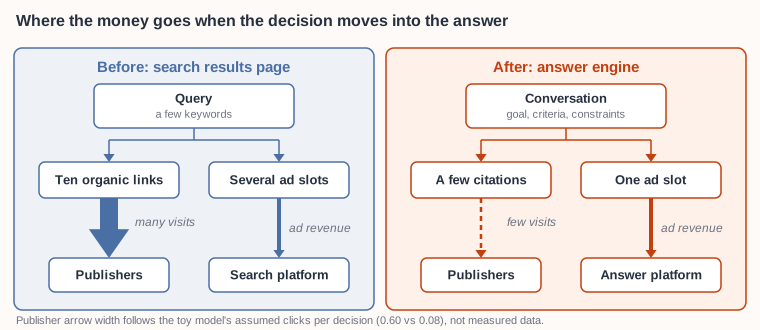
Same parts, different proportions. The ad money still goes to the platform; the visits that paid publishers shrink to a few citations. Arrow widths follow the toy model’s assumptions further down.
Private context also changes brand safety, because there’s no public page for a third party to scan. OpenAI’s brand-suitability pilots with DoubleVerify and IAS run “in a controlled testing environment, without accessing private user conversations” [2]. And a guardrail now decides first whether an ad may appear at all. OpenAI says its placement guardrails keep ads out of “emotionally vulnerable, sensitive, or otherwise unsuitable contexts” [2], and Google currently shows no ads within AI Overviews for sensitive verticals such as finance, healthcare and politics [5].
| Search ads | Modeled AI-answer format | |
|---|---|---|
| Targeting signal | A short query | The conversation: goal, criteria, constraints, rejected options |
| Ad sits next to | Ten links, with the comparison happening on other sites | One synthesized answer |
| Where the decision happens | After clicking out | Inside the session |
| Brand safety | Third parties scan the page | Context is private; tested in controlled environments |
| Sensitive topics | Keyword and category exclusions | A guardrail decides whether any ad appears |
| Can the user check the separation? | Partly, since rankings can be compared | Not directly, because answers vary between runs |
Who feels it
With one ad slot, users see fewer ads, and ads that match what they asked about. They also lose the step of comparing several sites, and they cannot directly verify whether ad budget shaped the answer, although repeated controlled tests can estimate influence.
When the answer replaces the click, publishers lose referral traffic and the display and affiliate income those visits earned. Meanwhile the decision-stage ad budget moves to a platform that owns both the answer and the ad.
Search engines now have a competitor with a richer signal, and they answer with the same model inside their own product, ads in AI Overviews and AI Mode [5] [6]. Advertisers get fewer clicks with more intent behind them, measured with the tools they already run [2], but they have to judge suitability in a context they can’t inspect.
Attribution and incrementality work stays with the measurement vendors (OpenAI calls its own incrementality work “still in its early stages” [2]). Brand-safety tools that scan pages can’t scan the private conversation, so suitability has to be evaluated on test conversations.
None of this is guaranteed to work. Perplexity, one of the first AI search companies to run ads, is winding its program down by the end of 2026; an executive said ads risk making users “suspicious of everything” [8].
A toy model: does the money grow or only move?
To see how these changes add up, I wrote a small simulation in plain Python. It’s a toy. Every parameter is an assumption I picked to show the mechanism, and the dollar figures aren’t a forecast of any market.
The model has one billion commercial decisions a month (“which savings account should I open?”). Each one happens either in search or in an answer engine. Search gives 0.04 ad clicks and 0.60 clicks to publishers per decision. The answer engine shows one ad on the 80% of decisions its guardrail allows and gets 0.03 ad clicks there. I assume it converts twice as well, 6% against 3%, for the richer signal. Publishers get 0.08 citation clicks per decision from it. It also adds 15% extra decisions that would never have been a search at all. Publishers earn from display ads and affiliate links on the visits they get. Advertisers either keep a fixed total budget, or they bid up to the value a click delivers at a target return of 1.5, so spending can grow when clicks get more valuable.
How the model computes it, per month:
- conversion value = ad clicks × conversion rate × $60 value per conversion
- ad spend, value mode = conversion value ÷ target return 1.5
- ad spend, fixed mode = the value-mode spend of both channels, scaled by one common factor so the total stays at the $48M of the 0% case
- advertiser net value = conversion value − ad spend
- search ad clicks = search decisions × 0.04
- answer-engine ad clicks = answer-engine decisions × 0.80 eligible × 0.03
- publisher revenue = visits × $0.09 (1.5 pages at $20 per 1,000 views, plus 2% affiliate conversion at $3)
- break-even conversion ratio = 0.04 ÷ (0.80 × 0.03 × (1 + new decisions)) = 1.67, or 1.45 with 15% new decisions
I moved 0% to 60% of decisions from search to the answer engine. This is what came out.
| Share moved | Budget mode | Search ad revenue | Answer-engine ad revenue | Total ad spend | Publisher revenue |
|---|---|---|---|---|---|
| 0% | either | $48.0M | $0 | $48.0M | $54.0M |
| 40% | fixed | $25.0M | $23.0M | $48.0M | $35.7M |
| 40% | value | $28.8M | $26.5M | $55.3M | $35.7M |
| 60% | value | $19.2M | $39.7M | $58.9M | $26.6M |
| 60% | value, no uplift | $19.2M | $17.3M | $36.5M | $25.9M |
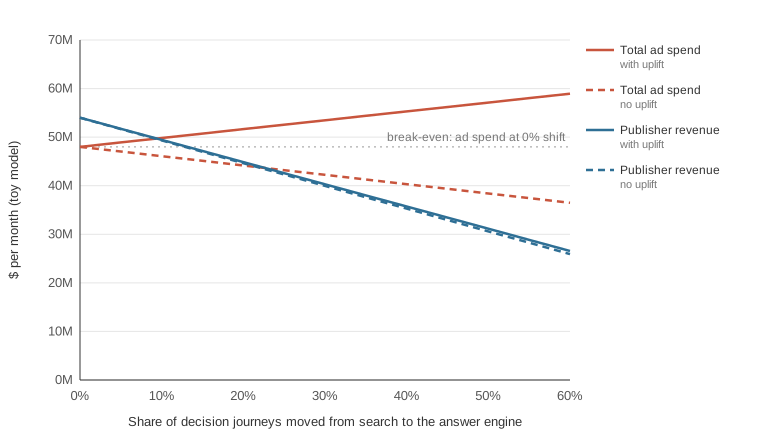
Toy model, value-bidding mode. Publisher revenue falls whether or not the answer engine adds value; total ad spend only grows if it does.
Publishers lose in every scenario. At a 60% shift their revenue halves, from $54M to about $27M, because clicks to the open web drop from 0.60 to about 0.30 per original decision. The loss is the same in both budget modes, because publisher revenue in the model depends only on visits, not on how advertisers set budgets.
New ad money only appears if the answer engine adds value, through better conversion or through decisions that never happened in search. With both, total ad spend grows by about 23% at a 60% shift. Without them it falls to $36.5M, because one ad slot produces fewer clicks than a results page does.
To keep total ad spend flat in value mode, the answer engine has to convert about 1.67 times as well as search, or about 1.45 times with the 15% extra decisions, which is a high break-even point. That ratio doesn’t depend on how much traffic moves, since it only has to make up for what the single ad slot gives up against a results page.
Who keeps the gain depends on competition for the slot. With fixed budgets it’s pure redistribution from search to the answer engine, and advertisers keep the efficiency gain. Their net value goes from $24M to $40.4M at a 60% shift. With value bidding, the target-return bidding rule moves most of the gain to the platform, and advertiser net value only reaches $29.5M.
My click assumption for publishers is harsh, so I checked how much hangs on it. Ahrefs compared 300,000 keywords between December 2023 and December 2025 and found that an AI Overview correlates with a 58% lower click-through rate for the top-ranking page [7]. An answer engine replaces the results page rather than sitting on top of it, so I assumed a steeper drop, from 0.60 to 0.08 clicks. If I set the answer engine’s citation clicks to 0.25, a cut close to the Ahrefs ratio, publishers still lose. At a 60% shift they make $37.1M against $54M. In this model they only break even when a citation-based answer sends about 0.52 clicks per decision, which is almost as many as a full results page.
The model leaves out a lot: subscriptions, organic visibility inside answers, competition between answer engines, and anything non-linear. If one assumption looks wrong to you, change it and run it again. The code and a README with every parameter are in the blog-samples repository [14].
The promise users can’t check directly
OpenAI’s principles say ads “do not influence the answers ChatGPT gives you” and that conversations are kept private from advertisers [3], and the whole arrangement rests on that being true. The third-party pilots announced so far test brand safety for advertisers [2]. I haven’t seen a public method for testing answer integrity for users, and a user can’t check it directly, because answers vary between runs. Repeated controlled tests can estimate influence, but they can’t prove isolation.
Part 2 showed why that matters: when sponsored text entered the model’s context, the sponsor went from being named in about half the answers to being named in all of them [10]. A platform can design its system so ad content never reaches the answer path, but from outside that property is invisible. That is also why the ad-free tier from Part 3 is a product [11], and one that already ships. ChatGPT shows ads on Free and Go, while Plus and Pro stay ad-free [4].
If you work on the publisher side, the number to remember from the model is the citation click rate. If you work on the platform side, it is the conversion multiple.
What would it take for you to trust that an ad next to an answer didn’t change the answer?
Sources
- [1] OpenAI — A milestone in expanding access to AI — 31 Aug 2026. Run rate, advertisers, markets, bidding and measurement (self-reported)
- [2] OpenAI — Building advertising for the way people use AI — 5 Oct 2026. Measurement partners, placement guardrails, DoubleVerify and IAS pilots
- [3] OpenAI — Our approach to advertising and expanding access to ChatGPT — January 2026. Ads principles
- [4] OpenAI Help Center — Ads in ChatGPT — test start date, eligible plans, personalization by region
- [5] Google Ads Help — About ads and AI Overviews — placement, auction, matching, sensitive verticals
- [6] Google — Ads in AI Mode — new ad formats being tested in AI Mode
- [7] Ahrefs — Update: AI Overviews Reduce Clicks by 58% — 4 Feb 2026. Method and position-1 CTR data
- [8] Campaign US — Perplexity pulls the plug on ads, citing trust concerns for AI — 20 Feb 2026, reporting the Financial Times
- [9] Your Website’s Second Audience Just Got Its Own Ads — Ads for Agents, Part 1
- [10] When Ads Bias Your Agent — Ads for Agents, Part 2 (the experiment)
- [11] Who Pays to Un-Bias Your Agent? — Ads for Agents, Part 3 (the ad-free tier)
- [12] Who Pays for the Agentic Web — the Agent or the Advertiser? — the series capstone
- [13] Contextual targeting is gaining relevance in a post-3rd party cookie area — 2022
- [14] schristoph-blog-samples on GitHub — the simulation code (folder
same-ads-different-room;python3 sim.pyprints the results table,python3 sweep.pywritessweep.csv, the chart and the break-even multiples) - [15] Google Ads Help: About keyword matching options. Broad match signals: recent search activity, landing-page content
❤️ Created with the support of AI (Kiro)