The Service Catalog Pattern for AI Agents
 written by Stefan Christoph
The Problem We Already Solved Once
In 2012, Netflix open-sourced Eureka [1]. The problem it solved was simple to state and hard to live without: in a microservices architecture, you can’t hardcode where services live. Instances spin up and down. IP addresses change. New capabilities appear. Old ones get deprecated. Without a registry, every service needs to know the exact location of every other service it depends on. That doesn’t scale.
Eureka’s answer was a service registry. Services register themselves on startup. Clients query the registry to discover available instances. Instances renew their lease with periodic heartbeats; when renewals stop, the server expires the lease and removes the instance (unless its self-preservation mode suppresses eviction during widespread outages). The registry becomes the single source of truth for “what exists and where to find it.”
Eureka’s primary motivation was runtime reliability: routing requests to healthy instances. But the foundation it established was more general. Before you can route, load-balance, or govern anything, you need to know what exists. That visibility layer is the pattern that transfers.
A decade later, we have the same problem with AI agents. Except it’s worse.
Why Agents Have It Harder
A typical microservice has a fixed API and does one thing. Its contract is versioned and documented. When you query a service registry, you know exactly what you’ll get back.
AI agents are different along every dimension that matters:
| Dimension | Microservices | AI Agents |
|---|---|---|
| Capabilities | Typically fixed at deploy time | Dynamic, skills added/removed without redeployment |
| Discovery | By service name or endpoint | By capability description (semantic) |
| Versioning | API version in URL | Skill version, model version, prompt version, all independent |
| Trust | mTLS, service mesh | Who approved this agent? What can it access? |
| Composition | REST/gRPC calls | Tool use, delegation, multi-agent orchestration |
In a microservices world, you ask: “Where is the payment service?” In an agent world, you ask: “Which agent can process refunds in German for enterprise customers?” The query is semantic, not structural. The answer might change tomorrow when someone publishes a new skill.
I wrote about this gap in The Agent Security Stack Nobody Is Building [2]: shadow AI is the core accelerant. Teams spin up agents with no tickets, no approvals, no paper trail. You can’t secure what you don’t know exists. You can’t govern what you can’t discover. And you can’t reuse what you can’t find.
The Service Catalog Pattern
The solution is the same architectural pattern, adapted for the new medium. A service catalog for AI agents needs four capabilities that go beyond what Eureka provided:
1. Registration with Metadata
Agents, tools, skills, and MCP servers register themselves with rich metadata: what they do, what inputs they expect, what permissions they need, who built them, and what stage they’re in (development, staging, production).
In the microservices world, registration was mostly about network location. In the agent world, registration is about capability description. The metadata IS the discovery surface.
2. Semantic Discovery
Keyword search isn’t enough. When a developer needs “something that can summarize legal documents in compliance with GDPR,” they need search that matches on meaning, embedding-based or hybrid retrieval, not just string matching against resource names.
This is the fundamental difference from Eureka or Consul. Those registries answered “where is service X?” The agent catalog answers “what can do Y?” The query language shifts from structural to natural.
3. Governance and Approval
In microservices, any team could deploy a service and register it. The blast radius was comparatively contained: a bad service mostly hurt its own consumers, though failures could still cascade through synchronous call chains and shared resources. In the agent world, a poorly governed agent can access data, make decisions, and take actions across organizational boundaries.
The catalog needs an approval workflow. Someone publishes a new skill. A curator reviews it, checking permissions, data access patterns, and compliance requirements. Only approved resources become discoverable. For everything that flows through the catalog, this is the organizational immune system that keeps shadow AI from metastasizing, agents that never register still need detection outside it.
4. Live Discovery
Static catalogs go stale. The most valuable pattern is URL-based discovery: point the registry at a live MCP server endpoint, and it automatically retrieves the current tool schemas, capability descriptions, and metadata. The catalog can stay fresh because it reads from the source of truth, the running system itself, as often as the sync mechanism runs.
This is analogous to how Consul combined service discovery with health checking. A registered service that fails health checks gets removed from the discovery pool. In the pattern’s ideal form, a registered MCP server whose endpoint drifts from what’s cataloged gets re-synced, whether by polling, push, or an explicit refresh is an implementation decision (Agent Registry’s tutorials cover both pull- and push-based synchronization [7]).
From Pattern to Implementation
AWS Agent Registry [3], available through Amazon Bedrock AgentCore, implements this pattern. It’s in preview as of April 2026, and it maps directly to the four capabilities above:
| Pattern Capability | Agent Registry Implementation |
|---|---|
| Registration with metadata | Manual registration via console/API, or URL-based auto-discovery from live MCP servers |
| Semantic discovery | Combined semantic + keyword search; natural language queries against capability descriptions |
| Governance and approval | Built-in approval workflow; records must be approved before becoming discoverable |
| Live discovery | URL-based discovery auto-retrieves metadata from running endpoints |
The registry supports four resource types: MCP servers, agents, agent skills, and custom resources. It’s accessible three ways: the AgentCore Console UI, APIs (CLI/SDK), or, and this is the interesting one, as an MCP server itself. That means your coding agent can query the registry directly from your IDE to discover available tools without leaving the development flow.
Access control uses IAM or OAuth (Custom JWT), one authorization type, chosen per registry at creation time, and registry API activity is logged through CloudTrail for auditing [3]; as with any CloudTrail integration, check which management and data events are captured by default and which need enabling.
The Killer Feature: Skill Updates Without Redeployment
Here’s where the pattern diverges most from traditional service registries. In microservices, updating a service means deploying a new version. In the agent world, updating a skill can mean changing a prompt, adjusting a tool schema, or adding a new capability, all without touching the agent’s deployment.
Danny Teller’s team demonstrated this concretely [4]: they registered 16 skills in under an hour, and the critical insight was that skill updates propagate to consuming agents without redeployment. Change a skill’s behavior, update the registry record, and every agent that fetches the catalog at its next session start picks up the new version.
This is hot-swapping at session granularity for agent capabilities, with a caveat worth being precise about: the registry distributes the updated descriptor, while the skill’s behavior lives wherever it’s hosted. Change a skill where it runs, update the registry record, and agents that re-fetch the catalog pick up the new version at their next session start. Agents pinned to a cached catalog keep the old one until they refresh. The closest microservices analogy is feature flags, but instead of toggling behavior within a single service, you’re toggling capabilities across an entire fleet of agents.
The trade-off is latency. Teller’s team measured approximately 1.2 seconds at session start for the catalog fetch [4]. That’s the cost of dynamic discovery versus hardcoded tool lists. For most use cases, it’s invisible. For latency-critical paths, you’d cache the catalog and accept eventual consistency, exactly the same trade-off Eureka made with its client-side caching. A client-side cache can also provide resilience: design your agents to fall back to their last-known catalog if the registry is temporarily unreachable, with a TTL and a fail-closed rule for revoked capabilities, since a stale cache also delays revocations and approval changes.
The Governance Layer We Were Missing
In From Cloud-Native to AI-Native [5], I described the governance gap: everything practitioners were building worked because it was personal and sandboxed. One user, their own data, mistakes that affect only them. The enterprise version needs identity, access control, audit trails, and cost management.
The service catalog pattern fills a specific part of that gap: the visibility layer. Before you can secure agents, authorize them, or audit them, you need to know they exist. Before you can prevent duplicate work, you need to know what’s already been built. Before you can enforce standards, you need a place where standards are discoverable.

Without a registry, teams rebuild capabilities independently. With one, they discover and reuse.
This connects directly to the shadow AI problem I described in the security stack article [2], drawing on IBM’s shadow-AI research: you can’t secure what you don’t know exists. The registry is the answer to “what exists?”, the foundation the other governance controls build on, for everything that actually registers.
A word of caution: centralization creates coupling. Not every skill should be shared; some duplication preserves team velocity and autonomy. The registry should catalog what’s worth sharing, not mandate sharing everything. The microservices world learned this lesson with shared libraries: too much sharing creates coordination bottlenecks. The same applies here.
The MCP Connection
The registry’s most architecturally interesting property is that it’s itself an MCP server. This creates a recursive pattern: agents use MCP to discover other MCP servers through the registry.
In From Chaos to Control [6], I described the progression from ad-hoc agent code to governed tools. The registry is the infrastructure that makes that progression manageable at scale. Instead of each team maintaining their own list of available tools, there’s a single, governed, searchable catalog that every agent can query.
The MCP-native access pattern also means the registry integrates naturally with the emerging agent development workflow. You don’t need a separate console or CLI to discover available capabilities. Your agent’s existing MCP client can query the registry the same way it queries any other tool server.
What This Means for Architects
If you’re designing multi-agent systems, the service catalog pattern changes your architecture in three ways:
Decouple capability from deployment. Skills and tools become independently versionable resources, not hardcoded dependencies. Your agent’s capabilities are defined by what it discovers at runtime, not what was compiled in at build time.
Centralize governance, distribute execution. The registry is the governance chokepoint: approval workflows, audit trails, access control. But execution remains distributed. Agents run wherever they need to, discovering capabilities dynamically.
Enable composition without coordination. When Team A publishes a new skill, Team B’s agents can discover it without the teams ever exchanging an endpoint, the registry mediates the “who has what” problem. Schema compatibility, authorization, and trust review still take coordination; what disappears is the directory-keeping. This is the same loose coupling that service registries gave microservices, the mesh layer handled traffic, identity, and policy; the registry handled knowing what exists.
For multi-account AWS organizations, the current pattern is a registry in a shared-services account with cross-account IAM policies. Cross-registry federation (connecting multiple registries and searching as one) is not yet available, absent a public AWS commitment, treat it as anticipated rather than promised.
The Maturity Curve
Not every organization needs a full registry on day one. The maturity progression looks like this:
| Stage | What You Have | What You Need |
|---|---|---|
| Exploring | A few agents, hardcoded tool lists | Nothing, just build |
| Scaling | 10+ agents, duplicate capabilities, no visibility | A catalog, even a spreadsheet helps |
| Governing | Production agents handling real data | Approval workflows, audit trails, access control |
| Optimizing | Large fleet, dynamic capabilities | Semantic discovery, live sync, automated governance |
Most organizations I work with are between “Scaling” and “Governing.” They’ve moved past the experimentation phase but haven’t yet built the infrastructure to manage agents at scale. The service catalog pattern is the bridge.
If you have fewer than 10 agents today, you don’t need a managed registry yet. But the organizations that built service catalogs early in their microservices journey avoided years of technical debt from service sprawl. The same will be true here. The question isn’t whether you’ll need this, it’s whether you’ll build it proactively or reactively.
Rolling Your Own: Agent Registry on AWS
Enough theory. Here’s how to implement the service catalog pattern using AWS Agent Registry. I tested this end-to-end in eu-west-1, the code below is what actually worked, including the gotchas I hit along the way.
Prerequisites
- An AWS account with AgentCore access (available in us-east-1, us-west-2, ap-northeast-1, ap-southeast-2, eu-west-1, note: eu-central-1/Frankfurt is not yet available)
boto3 >= 1.42.87(earlier versions don’t have the Registry APIs)- IAM permissions for
bedrock-agentcore-control:*andbedrock-agentcore:*
pip install --upgrade 'boto3>=1.42.87'
Step 1: Create a Registry
The registry is your catalog. You can organize by team, environment, or resource type, whatever maps to your governance model.
import boto3
import time

REGION = 'eu-west-1'
control_client = boto3.client('bedrock-agentcore-control', region_name=REGION)

# Create the registry
response = control_client.create_registry(
    name='my-agent-registry',
    description='Central catalog for agent skills and MCP servers'
)

registry_id = response['registryId']
print(f"Registry ID: {registry_id}")
print(f"Status: {response['status']}")  # CREATING

# Wait for ACTIVE status (~90 seconds)
while True:
    status = control_client.get_registry(registryId=registry_id)['status']
    if status == 'ACTIVE':
        break
    print(f"  Waiting... status={status}")
    time.sleep(10)

print("Registry is ACTIVE")
Gotcha #1: Registry creation takes about 90 seconds. Don’t poll too aggressively, a 10-second interval works well. Note that the fixed
time.sleep(5)and unboundedwhile Truepolling in this walkthrough are demo shortcuts: production code should poll for the target status with bounded backoff, a timeout, and explicit handling of failure states.
Step 2: Register a Resource
Each record represents something discoverable, an MCP server, an agent, a skill, or a custom resource. The CUSTOM type is the easiest to start with because it doesn’t require strict schema validation.
# Register a skill (using CUSTOM type for flexibility)
record_response = control_client.create_registry_record(
    registryId=registry_id,
    name='pricing-lookup-skill',
    description='Looks up AWS service pricing by region, instance type, and usage pattern. Returns hourly and monthly cost estimates.',
    recordType='CUSTOM',
    descriptorType='CUSTOM',
    descriptor={
        'customDescriptor': {
            'description': 'AWS pricing lookup tool for Solutions Architects',
            'metadata': {
                'owner': 'platform-team',
                'stage': 'production',
                'capabilities': 'pricing, cost-estimation, region-comparison',
                'invocation': 'MCP tool via bedrock-agentcore gateway'
            }
        }
    }
)

record_id = record_response['recordId']
print(f"Record ID: {record_id}")
print(f"Status: {record_response['status']}")  # CREATING → DRAFT
Gotcha #2: The
descriptorTypemust be one of:A2A,CUSTOM,MCP,AGENT_SKILLS. If you useMCP, the descriptor must comply exactly with the MCP registry schema version2025-12-11, which is strict and not well-documented yet. Start withCUSTOMfor quick iteration.
Step 3: Submit for Approval
Records aren’t discoverable until approved. This is the governance gate.
# Wait for record to reach DRAFT status
time.sleep(5)

# Submit for approval
control_client.submit_registry_record_for_approval(
    registryId=registry_id,
    recordId=record_id
)
print("Submitted for approval")
If your registry has auto-approval enabled, the record transitions directly to APPROVED. Otherwise, a curator must explicitly approve it:
# Curator approves the record
control_client.approve_registry_record(
    registryId=registry_id,
    recordId=record_id
)
print("Record approved — now discoverable")
Step 4: Discover via Semantic Search
This is where it gets interesting. The search isn’t just keyword matching, it understands intent.
# Search uses the data plane client (not control plane!)
data_client = boto3.client('bedrock-agentcore', region_name=REGION)

# Semantic search — no exact keyword match needed
results = data_client.search_registry_records(
    registryIds=[registry_id],
    searchQuery='I need help estimating cloud costs for a customer'
)

for record in results.get('records', []):
    print(f"  Found: {record['name']}")
    print(f"  Description: {record['description']}")
    print(f"  Score: {record.get('score', 'N/A')}")
Gotcha #3: Search is on the data plane client (
bedrock-agentcore), not the control plane (bedrock-agentcore-control). The parameter issearchQuery(notsearchTerm) andregistryIdstakes a list.
In my testing, querying “I need help finding AWS pricing information” matched a record described as “Research and documentation tools for SA workflows. Includes AWS doc search and pricing lookup.” The shared terms (“AWS”, “pricing”) mean this was a hybrid match rather than proof of pure semantic understanding, a cleaner test would use a query with no overlapping words. Still, ranking on intent rather than exact names is, in my view, the killer feature for enterprise adoption, though I should note this was tested with a small number of records. How well semantic ranking holds up with thousands of records across an enterprise is an open question in preview.
Step 5: Access as an MCP Server
The registry is exposed over MCP. In the configuration below, the AWS CLI spawns a local stdio process that bridges MCP calls to the registry’s API, so your agents can discover other agents’ capabilities without leaving the MCP protocol:
{
  "mcpServers": {
    "agent-registry": {
      "command": "aws",
      "args": [
        "bedrock-agentcore", "start-mcp-server",
        "--registry-id", "YOUR_REGISTRY_ID",
        "--region", "eu-west-1"
      ]
    }
  }
}
Add this to your agent’s MCP configuration, Kiro, Claude Code, or any MCP client that can launch a local stdio server process (this config shape assumes the client spawns the AWS CLI), and the agent gains a search_registry_records tool it can call at runtime to discover available capabilities dynamically.
Registering an MCP Server (Advanced)
For teams ready to register actual MCP servers with full schema validation:
# URL-based discovery — registry pulls metadata from a live endpoint
record_response = control_client.create_registry_record(
    registryId=registry_id,
    name='weather-mcp-server',
    description='Real-time weather data for any location worldwide',
    recordType='MCP',
    descriptorType='MCP',
    discoveryUrl='https://your-mcp-server.example.com/.well-known/mcp.json'
)
URL-based discovery automatically retrieves tool schemas and capability descriptions from the live endpoint. The registry stays fresh because it reads from the source of truth, the running server itself.
The Full Lifecycle
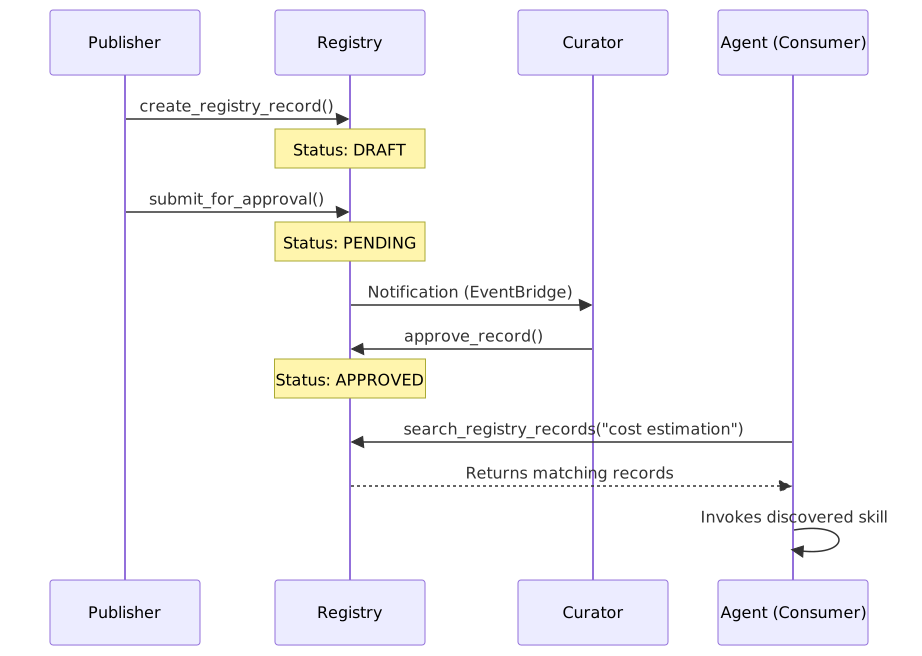
The full lifecycle: publish → approve → discover. EventBridge notifications keep curators in the loop.
Authorization Models
Choose based on your organization’s identity setup:
| Model | Best For | Setup Complexity |
|---|---|---|
| IAM | AWS-native teams, CLI/SDK access | Low, standard IAM policies |
| JWT (Cognito quick-create) | Quick start, AWS-managed IdP | Low, auto-configured |
| JWT (Bring your own IdP) | Enterprise with Okta/Entra/Auth0 | Medium, requires Discovery URL + audience config |
Gotcha #4: Auth type cannot be changed after registry creation. A registry supports only ONE auth type. Choose carefully upfront.
Official Resources
The AgentCore Starter Toolkit on GitHub [7] has 15+ tutorials covering:
- Admin approval flows
- Semantic and filter-based search
- OAuth-based flows
- Pull and push-based synchronization
- Calling registry search at runtime from Strands agents
- Integration with Kiro using Dynamic Client Registration
- Publishing agents/MCP tools using Kiro
The Zero to Registry in 10 Minutes notebook [7] is the fastest path to a working setup.
For the full API reference, see the Agent Registry documentation [8].
Scope and Freshness
This post reflects the state of AWS Agent Registry as of its preview launch on April 9, 2026 [3]. The service is in preview, features, APIs, and regional availability will evolve. Versioning and cross-registry federation are not yet available, anticipated directions, not published commitments. Check the official documentation [8] for the latest.
The architectural pattern itself, centralized catalog, semantic discovery, governance workflows, is stable and vendor-neutral. Whether you implement it with Agent Registry, build your own, or use a different platform, the pattern applies.
What’s your current approach to agent discovery? Are your teams still maintaining hardcoded tool lists, or have you started building toward a catalog? I’d love to hear what’s working at scale.
Sources
[1] Netflix, “Netflix Eureka” (open-sourced 2012): https://github.com/Netflix/eureka
[2] Christoph, S., “The Agent Security Stack Nobody Is Building” (May 2026): https://schristoph.online/blog/agent-security-stack/
[3] AWS, “AWS Agent Registry for centralized agent discovery and governance is now available in Preview” (April 9, 2026): https://aws.amazon.com/about-aws/whats-new/2026/04/aws-agent-registry-in-agentcore-preview/
[4] Teller, D., “AgentCore Registry: 16 Skills, 1 Hour, Zero Downtime” (customer blog, 2026): https://dev.to/aws-builders/agentcore-registry-16-skills-1-hour-zero-downtime-4ne7
[5] Christoph, S., “From Cloud-Native to AI-Native: What Actually Changes” (April 2026): https://schristoph.online/blog/from-cloud-native-to-ai-native/
[6] Christoph, S., “From Chaos to Control: Building Predictable AI Agents That Get Smarter Over Time” (January 2026): https://schristoph.online/blog/from-chaos-to-control-building-predictable-ai-agents-that-ge/
[7] AWS, “AgentCore Samples: Agent Registry Tutorials” (GitHub): https://github.com/awslabs/agentcore-samples/tree/main/01-tutorials/10-Agent-Registry
[8] AWS, “Agent Registry Documentation”: https://docs.aws.amazon.com/bedrock-agentcore/latest/devguide/registry.html
About the Author
Stefan Christoph is a Principal Solutions Architect at AWS, focused on agentic AI, media & entertainment, and helping builders move from demo to production. He writes about AI architecture, developer productivity, and the future of software.
This is a personal blog. Opinions expressed here are my own and do not represent the views or positions of my employer.