Announcements Fade. Experiences Stick. — My AWS Summit Hamburg 2026 Recap
 written by Stefan Christoph
I’m writing this on the train back to Düsseldorf. Hamburg is behind me, but the buzz isn’t. So hot, apparently, that the train just made an emergency stop, four crew members rushed in with three fire extinguishers. Luckily, false alarm. Or maybe just the intensity of the Summit still radiating.
Two days in Hamburg, conversations with customers, partners, and colleagues, quite a few of them friends at this point. The kind of event where you leave with more energy than you arrived with.
This is my personal recap. Not a session summary. Not a product announcement roundup. Just what stuck with me, and what stuck with 300 people in my LinkedIn network.
The Week Around the Summit
The Summit itself was Wednesday. But the week started earlier.
Tuesday was AWS HouseWarming day, a free, hands-on event the day before the Summit that has become a tradition in its own right. Instead of one conference hall, HouseWarming spreads across the city: this year, 15 different company offices in Hamburg opened their doors for 27 workshops. Small groups of 16-40 people, two shifts, topics from GenAI to Security to DevOps. Companies like New Work, Jimdo, Jungheinrich, MaibornWolff, and Skaylink hosted sessions in their actual offices, you visit real tech companies, build real things, and network with both AWS engineers and the local community. Add an AWS Jam with certification voucher prizes, and you have a format that consistently gets people more excited than the Summit keynote.
Tuesday evening: the TMEGS customer reception. A room full of customers and partners, good food, relaxed conversations. The kind of setting where you hear what people actually think, not what they’d say on stage. Perfect to cool down after a busy day of preparation.
Wednesday was the Summit itself, and after a full day on the expo floor and stage, the team dinner was exactly what you need to decompress. Delicious food, familiar faces, and the kind of energy that comes from people who genuinely enjoy working together.
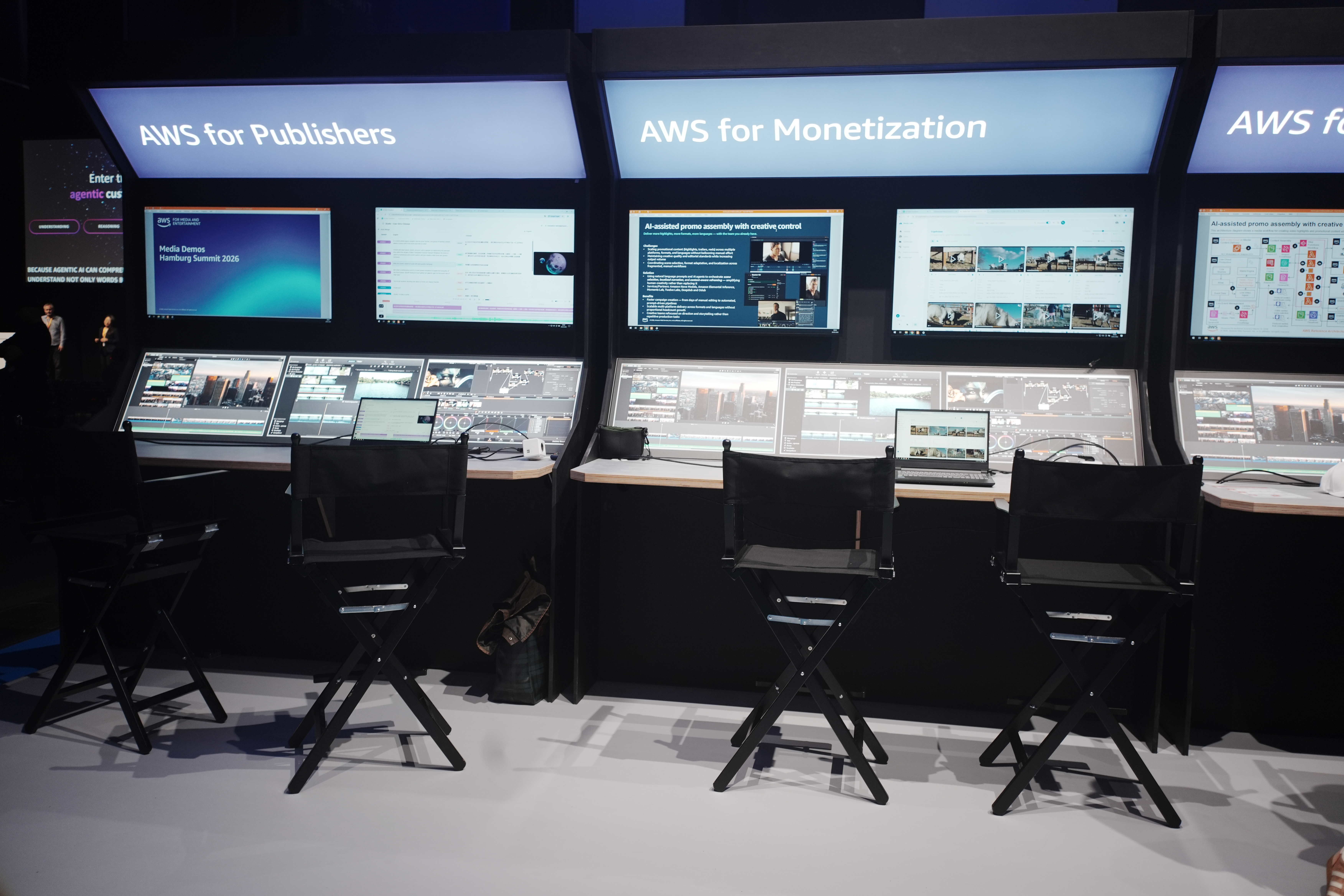
Our Media & Entertainment booth, AWS for Publishers, Monetization, and more. Photo: Miguel Almeida (CC)
My team was running the M&E booth, and we had a steady stream of broadcasters and publishers visiting throughout the day. The conversations that kept coming back: agentic AI and monetization. How do you let agents transact on behalf of users? How do you monetize content when the consumer is a machine, not a human? If you’ve read my recent piece on HTTP 402 and agentic payments [8], you know this is a door that’s just opening, and the publishers at our booth could feel it.
And the staff party? Cherry on the cake. Hamburg knows how to close a day.
The Talk: From Demo to Deployment
My session, AIM201, “From demo to deployment: solving agentic AI’s toughest challenges”, went well. The room was full, the energy was good, and the questions afterwards kept coming. I hope that’s because the content was interesting and not because it was confusing. ;)
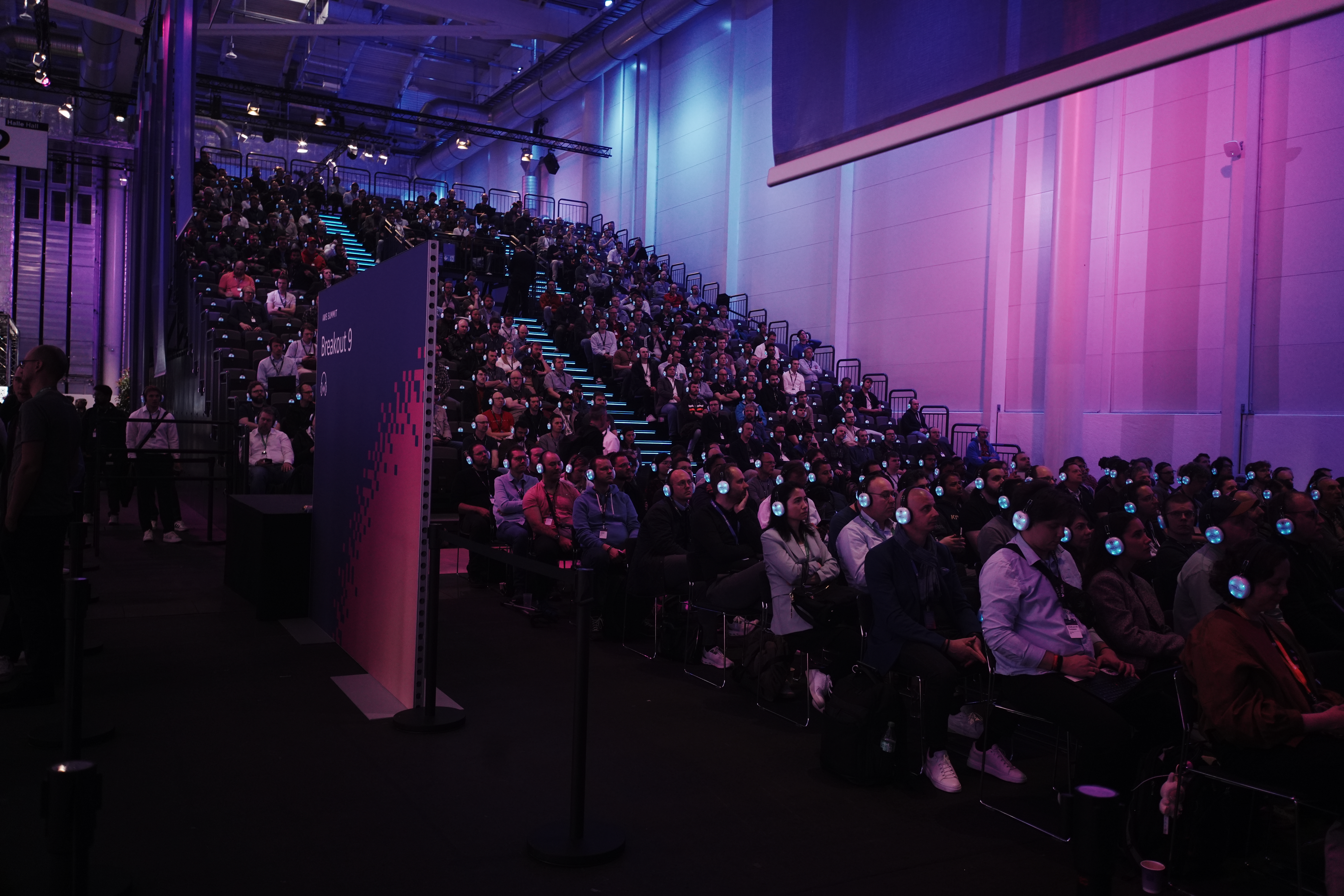
A full house at Breakout 9. Photo: Miguel Almeida (CC)
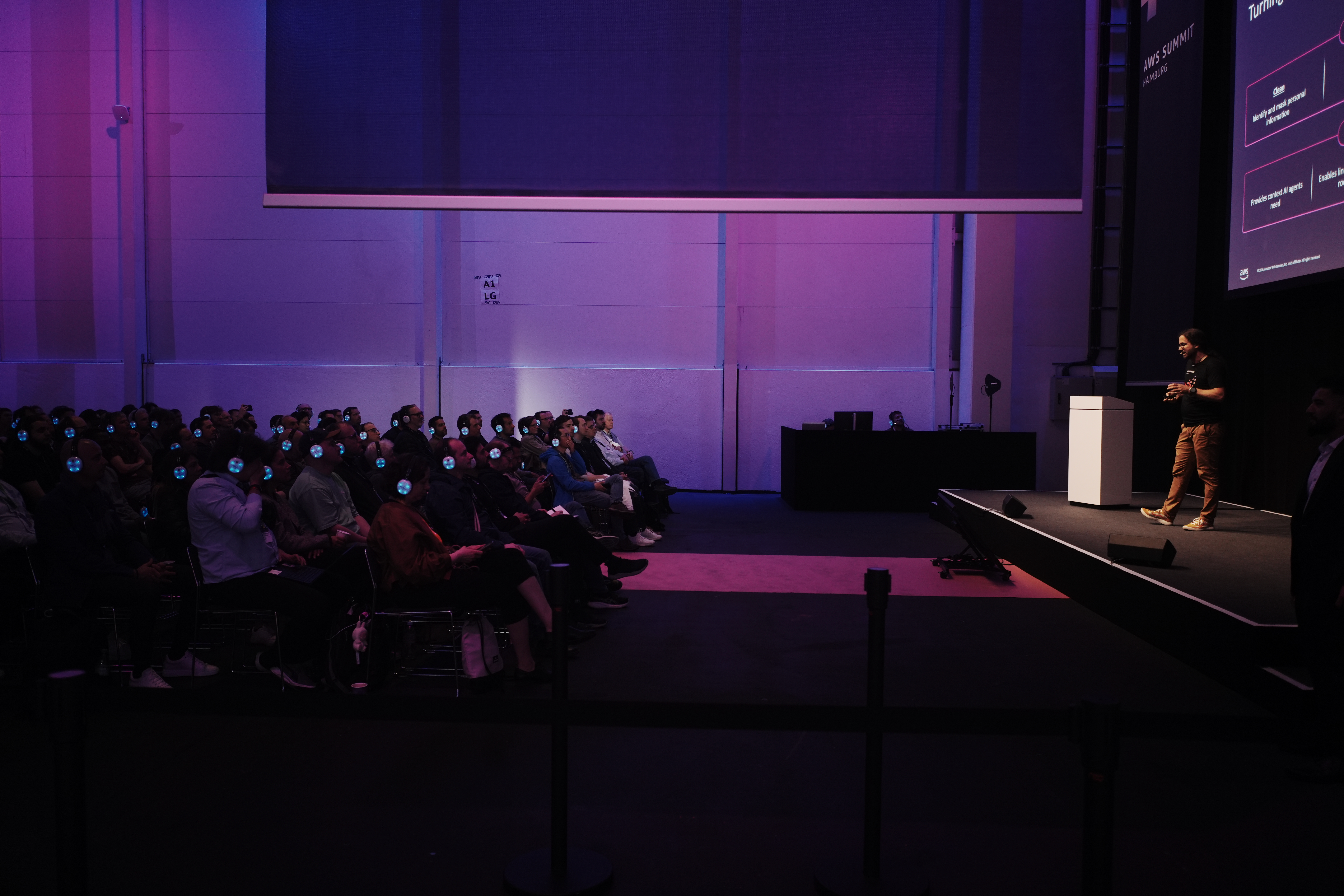
On stage. Photo: Miguel Almeida (CC)
I walked through the top challenges builders face when moving AI agents from prototype to production: build vs. buy decisions, reliability, observability, cost management, security, and evaluation. The goal was to give people a framework for thinking about these problems, not just a list of services.
A first for me: a marching band with dancers passed right by the breakout room while I was mid-sentence. You haven’t truly presented until you’ve competed with a tuba for your audience’s attention.

The marching band that ‘contributed’ to my talk. Photo: Miguel Almeida (CC)
The Question That Stuck
One question from the audience stayed with me. It came in the context of evaluation, I’d made the point that your agent will need to answer business requests, so you need to make sure to bring business folks along when defining what “good” looks like.
The question was: “How do you actually get business people involved?”
My answer: Domain-Driven Design. Specifically, Event Storming, a facilitation technique that, in my experience, brings business and tech people into one room and leaves them with a shared view and a shared language. Evaluation requires defining what “good” looks like for agent outputs, and that definition must come from business stakeholders, not just engineers. Event Storming surfaces the processes, decision points, and vocabulary you need to write meaningful evaluation criteria.
This isn’t new. DDD has been around for over two decades. But it’s more relevant than ever in the agentic era. Why? Because unless you give them persistent memory, AI agents re-onboard every session. Out of the box, they have no memory of last week’s disambiguation and don’t carry context between conversations. If your domain language is ambiguous, your agent will guess, often confidently wrong, and not necessarily the same way twice.
My colleague Dennis Traub published an article this week that crystallizes this perfectly: “Your agent keeps using that word…” [1]. His thesis: Ubiquitous Language, scoped to bounded contexts, is more relevant in the age of AI agents than it ever was for human developers. Because humans eventually learn the tribal knowledge. Agents never do, unless you encode it explicitly.
Event Storming, Context Mapping, Ubiquitous Language, these aren’t legacy practices. They’re the bridge between business intent and agent behavior. If you’re building agents that need to understand your business, start there.
Kiro on the Floor
One thing you couldn’t miss on the expo floor: Kiro was everywhere. The highlight? A full-on escape room, haunted house themed, cobwebs and all, where teams had to solve coding challenges using Kiro to break out. As far as I know, all participants made it out alive and in one piece. No agents were harmed in the process.
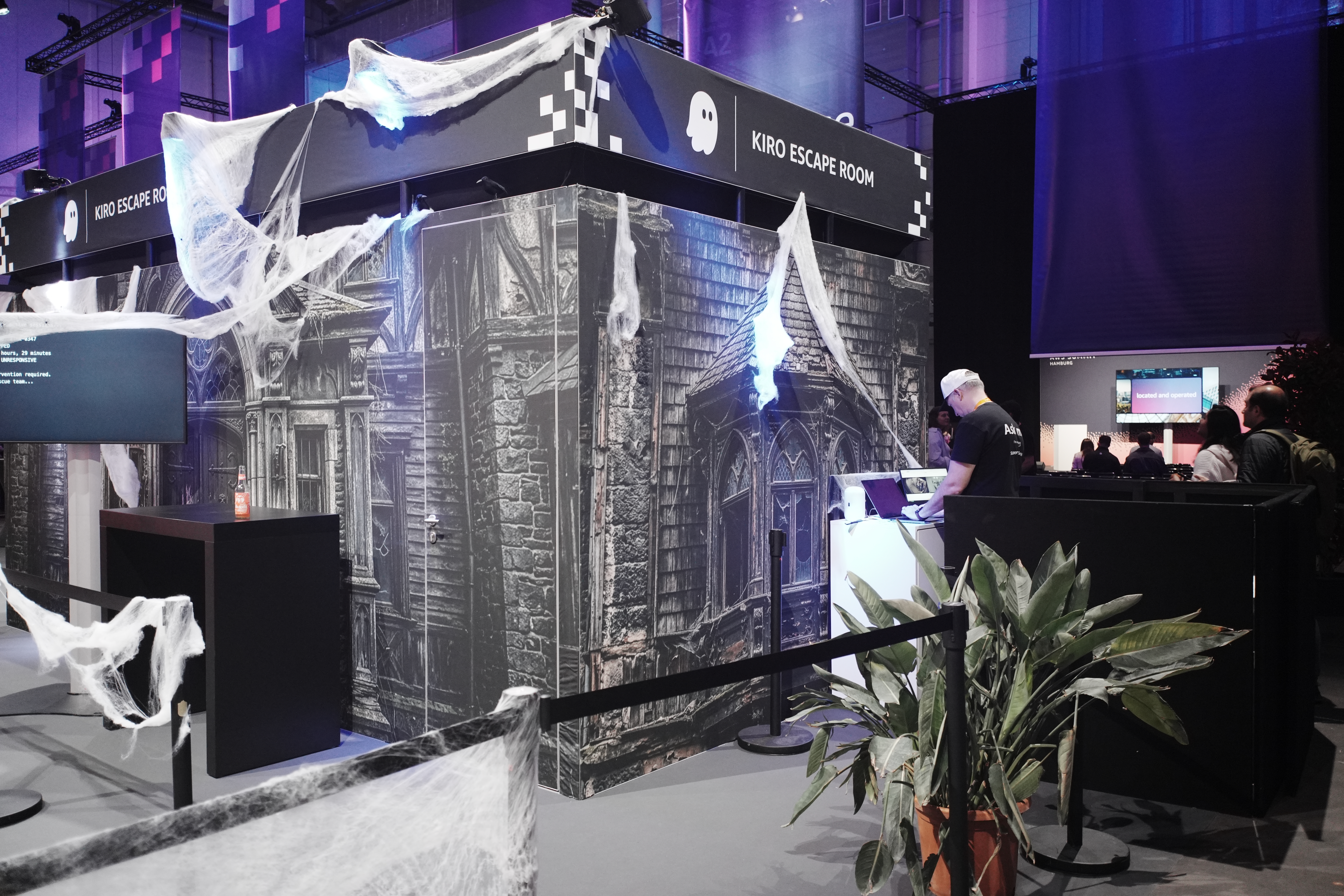
The Kiro Escape Room. Photo: Miguel Almeida (CC)
As someone who works with Kiro daily, it’s my primary development environment at this point, it was great to see the broader community get hands-on with it in such a creative format. The buzz around spec-driven development and agentic coding workflows was real, and the escape room was the perfect way to make it tangible.
What 300 LinkedIn Posts Tell You
Instead of just writing what I saw, I did something different this year. I collected 300 posts from my LinkedIn network, customers, partners, community builders, and colleagues, and ran a trend analysis on what everyone was talking about.
Here’s what the data says.
The Dominant Narrative: Agentic AI (43%)
Not as a buzzword. As an architectural shift.
Robin Rump captured it best: “We are moving from AI as a tool you prompt, to AI as a system that can reason, act, and execute workflows with increasing autonomy.” [2]
Christos Christodoulos went further: “The actual AI model is no longer the interesting part. The model is a component inside a structured system built around it.” [3]
And Benjamin Wilms delivered the sobering reality check: “97% of companies have deployed agents. Only 12% scale them into production.” His thesis: “Trust is the precondition. And trust is binary.” [4]
The announcements matched the narrative, AWS Security Agent, AWS DevOps Agent, Amazon Bedrock AgentCore. But the real signal was in the hallway conversations: everyone I talked to is building agents, almost nobody has figured out governance yet.
European Sovereign Cloud: Strategic, Not Just Regulatory (31%)
Nearly a third of posts mentioned digital sovereignty. The AWS European Sovereign Cloud landed as a concrete answer to a question regulated industries have been asking for years, though whether it fits a given workload still depends on that workload’s specific legal and technical requirements.
But here’s the interesting part: sovereign cloud mentions dropped 13 percentage points in Day 2 posts. The keynote-driven attention faded as people shifted to writing about what they personally experienced. Sovereignty is a boardroom decision, not a hallway conversation, important, but not what generates post-event excitement.
Community: The Only Constant (61%)
The most mentioned theme across all 300 posts, and the only one that stayed perfectly stable between Day 1 and Day 2.
Darya Petrashka said what many felt: "#AWS Summit Hamburg feels like one big community family." [5]
Nicolas Andritsch put it differently: “What I valued most were the conversations behind the technology.” [6]
When 61% of posts independently mention community, networking, or reconnecting with people, that’s the actual product of a Summit. The sessions are the excuse. The people are the reason.
The Day 1 → Day 2 Shift
The most interesting finding wasn’t any single theme. It was the shift between posts written on Day 1 versus Day 2:
| Day 1 (200 posts) | Day 2+ (100 posts) | |
|---|---|---|
| Character | Announcement-driven | Experience-driven |
| Rising | , | Sessions +5%, Booths +6%, Atmosphere +6% |
| Falling | , | Partner -17%, Sovereign Cloud -13%, Keynote -6% |
Day 1: “Here’s what was announced.” Day 2: “Here’s what I learned and felt.”
For anyone writing a Summit recap: your Day 1 posts give you the news. Your Day 2 posts give you the story.
The Products People Actually Talked About
| Product | Mentions | Trend |
|---|---|---|
| Bedrock | 41 | 📈 Growing (more in Day 2) |
| Sovereign Cloud | 42 | 📉 Fading after keynote |
| Kiro | 32 | ➡️ Steady |
| AgentCore | 20 | 📈 Growing, deeper technical posts appearing |
Bedrock and AgentCore growing in later posts tells you something: people went home, processed what they heard, and then wrote about the technical substance. The keynote creates awareness. The second-day posts reveal what actually resonated.
The Quote That Sticks
Thomas Reulen delivered the metaphor of the event: “Wenn die Digitale Transformation ein Triebwagen war, und die Cloud Transformation ein ICE, dann ist die KI Transformation ein Eurofighter.” [7]
Translation: If digital transformation was a railcar, and cloud transformation was a high-speed train, then AI transformation is a fighter jet.
The speed is the point. And based on 300 posts from people who were there: nobody disagrees.
Looking Back from the Train
Hamburg has a way of pulling you in. The city, the people, the Fischbrötchen. This was my second Summit here, and it already feels like a tradition.
What I’m taking home:
- The community is real. Not a marketing term. 61% of 300 people wrote about it unprompted.
- Agentic AI is the conversation. Not “will it happen” but “how do we govern it.”
- Business involvement is the missing piece. In the projects I see, the tech is rarely the blocker, the organizational alignment is. DDD and Event Storming are the bridge.
- The energy shift from Day 1 to Day 2 is the story. Announcements fade. Experiences stick.
See you next year, Hamburg. ⚓
Sources
Note: [2]–[7] link to each author’s LinkedIn activity feed rather than the individual post, look for their May 2026 Summit Hamburg post there.
- [1] Dennis Traub, “Your agent keeps using that word…” (May 2026), https://dev.to/aws/your-agent-keeps-using-that-word--4g36
- [2] Robin Rump, LinkedIn post on AWS Summit Hamburg (May 2026), https://www.linkedin.com/in/robin-rump/recent-activity/all/
- [3] Christos Christodoulos, LinkedIn post on AWS Summit Hamburg (May 2026), https://www.linkedin.com/in/christos-christodoulos/recent-activity/all/
- [4] Benjamin Wilms, LinkedIn post on AWS Summit Hamburg (May 2026), https://www.linkedin.com/in/benjamin-wilms/recent-activity/all/
- [5] Darya Petrashka, LinkedIn post on AWS Summit Hamburg (May 2026), https://www.linkedin.com/in/daryapetrashka/recent-activity/all/
- [6] Nicolas Andritsch, LinkedIn post on AWS Summit Hamburg (May 2026), https://www.linkedin.com/in/nicolas-andritsch-5640a548/en/recent-activity/all/
- [7] Thomas Reulen, LinkedIn post on AWS Summit Hamburg (May 2026), https://www.linkedin.com/in/thomasreulen/recent-activity/all/
- [8] Stefan Christoph, “HTTP 402: The Status Code That Waited 30 Years for AI Agents” (May 2026), https://schristoph.online/blog/http-402-agents-pay/
Interested in how I collected and analyzed 300 LinkedIn posts? Ping me and I’ll tell you, or write a follow-up on the methodology.
About the Author
Stefan Christoph is a Principal Solutions Architect at AWS, focused on agentic AI, media & entertainment, and helping builders move from demo to production. He writes about AI architecture, developer productivity, and the future of software.
This is a personal blog. Opinions expressed here are my own and do not represent the views or positions of my employer.